Updated 9/24/202612 min readBy Simon Liu · Licheng Knitwear
A buyer's glossary of 40+ custom knitwear sourcing terms — MOQ, gauge (GG), FOB/Incoterms, tech pack, lab dip, fully-fashioned, jacquard, OEM/ODM and more — each with a plain definition and a link to a deeper guide.
TL;DR — Plain-English definitions of 40+ custom-knitwear sourcing terms buyers meet when quoting and producing — MOQ, gauge (GG), FOB/Incoterms, tech pack, lab dip, fully-fashioned vs cut-and-sew, jacquard vs intarsia, OEM vs ODM and more — each linked to a deeper guide.
New to sourcing custom knitwear? The trade runs on shorthand — GG, FOB, lab dip, fully-fashioned, MOQ — and misreading a term can cost you a sample round or a margin point. This glossary defines the 40+ terms brand owners and buyers actually meet when quoting and producing sweaters, cardigans and knit programs, with links to deeper guides for each.
Yarn count — A measure of yarn thickness (e.g. 2/26, 2/48). Lower count = thicker yarn = heavier, often lower-gauge knit. Drives hand-feel, warmth and price. See the yarn material guide.
Ply — The number of single strands twisted together (2-ply, 4-ply). More ply usually means a fuller, more durable yarn. Most relevant when comparing cashmere grades.
Merino wool — Fine, soft, breathable wool graded by micron (lower micron = finer/softer). A mid-to-premium fibre; see merino sourcing tiers.
Cashmere — Luxury fibre graded by fibre length, fineness and ply; quality (and price) varies widely — decode it with the cashmere grades guide.
Cotton (combed / ring-spun / mercerized / Pima/Supima) — Cotton terms that signal smoothness, strength and sheen. The cotton knitwear decoder explains what each is worth.
Acrylic / blends — Synthetic or blended yarns that lower cost and add easy-care properties; right for some programs, wrong for others — see when acrylic/nylon blends fit.
Wool vs cotton — The two base choices for most sweaters; warmth, drape, care and cost differ — compare in cotton vs wool for fashion brands.
Gauge, machines & construction
Gauge (GG) — Needles per inch on the knitting machine; sets fabric weight. 3GG = chunky, 5–7GG = mid-weight, 9–12GG = lightweight, 14–18GG = fine. Finer gauge = more machine time = higher cost. See the knit gauge guide and a 7GG vs 12GG vs 14GG comparison.
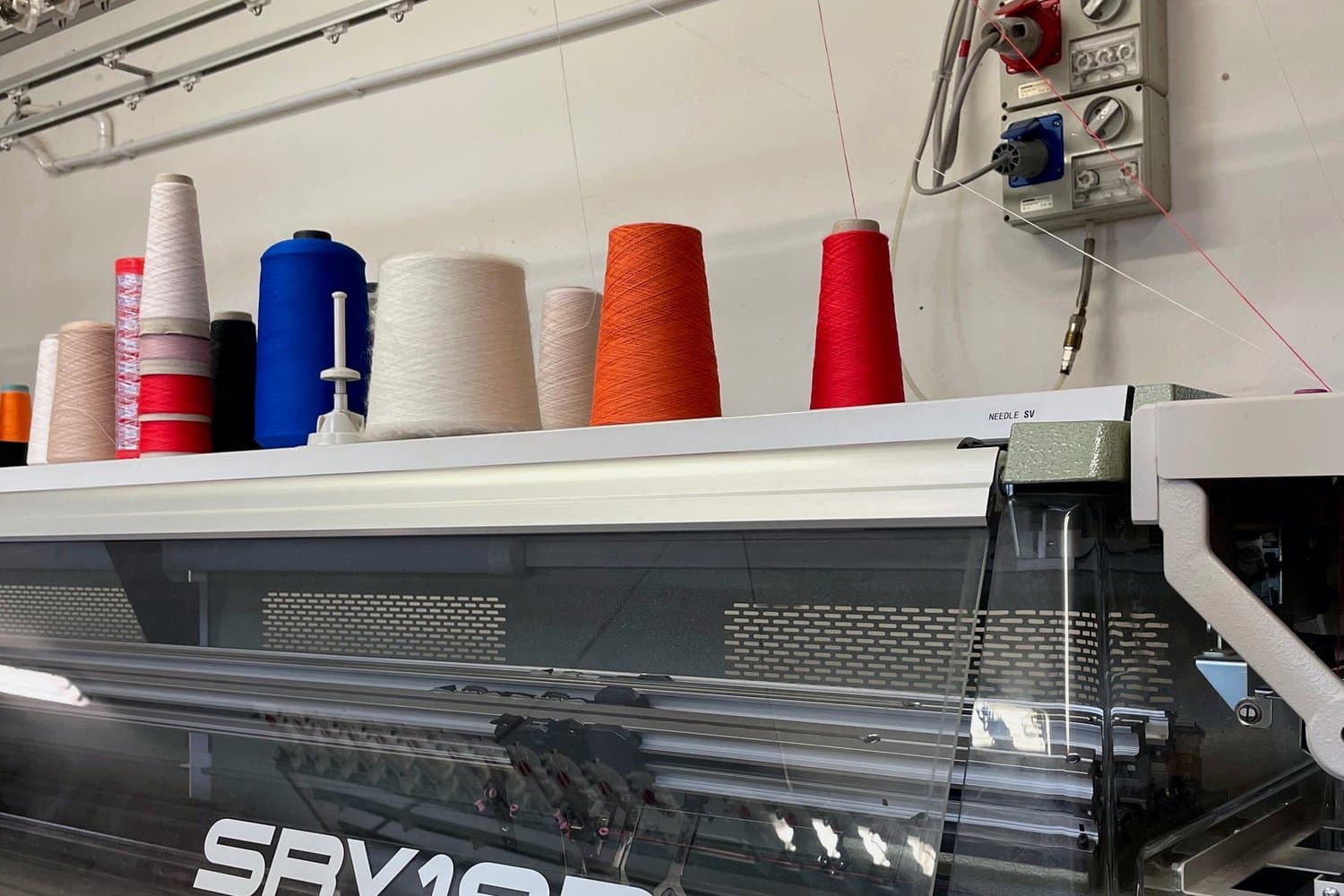
Flat knitting — Knit-to-shape production on computerized flat machines (how most sweaters/cardigans are made), as opposed to cut-and-sew from fabric.
Fully-fashioned — Panels knitted to the exact garment shape (with shaped edges) and linked together — cleaner, more premium, less waste — vs cut-and-sew from knit fabric. See fully-fashioned vs cut-and-sew.
Linking — Joining knitted panels stitch-by-stitch (hand or machine). Linking quality affects seam neatness and durability — see linking methods trade-offs.
Process, sampling & quality
Tech pack — The spec sheet that defines your garment: measurements, yarn, gauge, colours, trims, labels, construction. A complete tech pack = faster, more accurate quotes. See how to prepare a sweater tech pack.
Proto / sample / lead time — Stages of a development sample; samples run ~15–25 days from confirmed tech pack and yarn. See the sampling lead-time guide.
Lab dip — A small swatch dyed to match your target colour, approved before bulk dyeing. Lab-dip rounds are a common source of timeline slippage — see colour approval & lab dips.
Pantone / colour matching — Specifying colour by Pantone (TCX/TPG) so the factory can match consistently. See the Pantone matching guide.
Commercial & sourcing terms
MOQ (Minimum Order Quantity) — The smallest quantity a factory will run, set per style and per colour. Ours is 30 pcs per colour per style, with sizes mixed inside the 30 — jacquard and intarsia included. See the MOQ guide and low-MOQ options for small brands.
OEM vs ODM — OEM = factory makes to your design/tech pack; ODM = factory offers its own designs you rebrand. See OEM vs ODM.
Private label — Producing goods sold under your brand's label. Common for boutiques building an own-brand knit line.
RFQ (Request for Quotation) — Your formal request for pricing; a clear RFQ (quantity, gauge, yarn, tech pack) gets faster, comparable quotes. See how to write a knitwear RFQ.
Use this glossary
Bookmark it for your next RFQ. When you're ready to quote a style, send quantity, gauge, yarn and a tech pack up front for a same-day or next-day quote — or start with our cost benchmarks to budget first.
Which knitwear terms cause the most confusion between buyer and factory?
MOQ (per style or per colour?), gauge (machine gauge, not hand-knitting gauge), the OEM / ODM / private label family, and the incoterm set. Each of those has a precise meaning to a factory and a looser one in general use, which is where most quotation misunderstandings start.
Does MOQ mean per style or per colour?
Per colour, in almost all knitwear quoting - including ours, where it is 30 pieces per colour. A brand planning three colourways at 'MOQ 30' is committing to 90 pieces, and this single ambiguity accounts for a large share of surprised buyers.
Does gauge mean the same thing in knitwear manufacturing as in hand knitting?
No, and the overlap causes real confusion. In manufacturing, gauge is needles per inch on the machine bed - 3GG is chunky, 18GG is fine. In hand knitting it means stitches achieved over a measured swatch. They are unrelated numbers.
What is the difference between an RFQ, a tech pack and a quotation?
An RFQ states what you want made and on what commercial terms; a tech pack specifies how the garment is constructed; a quotation is the supplier's price against both. Sending a tech pack with no commercial terms, or an RFQ with no specification, produces a number that will change.
Where should a buyer start if the vocabulary is unfamiliar?
With the four commercial terms - MOQ, gauge, incoterm and lead time. Those four determine whether a conversation with a factory is productive; the material and construction vocabulary can be learned as the product takes shape.
A measure of yarn thickness, written for example as 2/26 or 2/48. A lower count means a thicker yarn, which usually means a heavier, lower-gauge knit; it drives hand-feel, warmth and price.
A small swatch dyed to match your target colour and approved before bulk dyeing. Lab-dip rounds are a common source of timeline slippage, so they belong in the calendar from the start.
Yarn-dye colours the yarn before knitting; piece-dye and garment-dye colour after knitting. Each affects colour consistency, hand-feel and cost differently.
Fully-fashioned panels are knitted to the exact garment shape and linked together - cleaner, more premium and with less waste. Cut-and-sew garments are cut from knitted fabric and sewn.
Your true per-unit cost: the FOB price plus freight, duty and clearance. It is the number to budget on, not FOB.
We focus on men's sweaters, cardigans, knit jackets, jacquard knitwear and private label knitwear. We support B2B buyers with OEM/ODM development, sampling and bulk production planning.
Ready to Start Your Project?
Get a free catalog or submit an RFQ today. Our team will respond within 24 hours.
Stitch structures — Plain (jersey), rib, cable, pointelle, etc. — the knit pattern that defines look and stretch. Overview in the stitch structures buyer guide.
Jacquard — A multi-colour pattern knitted into the fabric (the colourwork itself). Intarsia is a block-colour technique with no floats on the back. Compare in jacquard vs intarsia.
Dyeing methods — Yarn-dye (dye the yarn before knitting), piece-dye or garment-dye (dye after) — each affects colour consistency, hand and cost. See dyeing methods compared.
Pilling — Small fibre balls that form with wear; controlled via yarn choice and finishing — see pilling resistance.
Shrinkage — Dimensional change after washing; controlled in yarn prep and finishing — see shrinkage control.
QC / inspection (AQL) — Quality control checks (often to an AQL sampling standard) on measurements, defects and finishing before shipment. Use the QC checklist.
Quotation line items — What a quote should break down: yarn, knitting, linking, trims, finishing, packing, sample/mould. Decode it with how to read a knitwear quotation.
FOB / CIF / DDP / DAP (Incoterms) — Trade terms that define who pays/risks at each shipping stage. FOB = price to the loading port; DDP = delivered duty paid to you. See the Incoterms decoder and the FOB line-item decoder.
Landed cost — Your true per-unit cost including FOB price + freight + duty + clearance. Model it with knitwear landed cost.
Lead time (bulk) — Production time after sample approval; 30–45 days depending on quantity and complexity. Numbers in the benchmarks report.
Compliance / certifications — Standards buyers may require: OEKO-TEX (chemical safety), GRS/RWS (recycled/responsible wool), BSCI/Sedex (social audit). See OEKO-TEX explained and certifications explained.
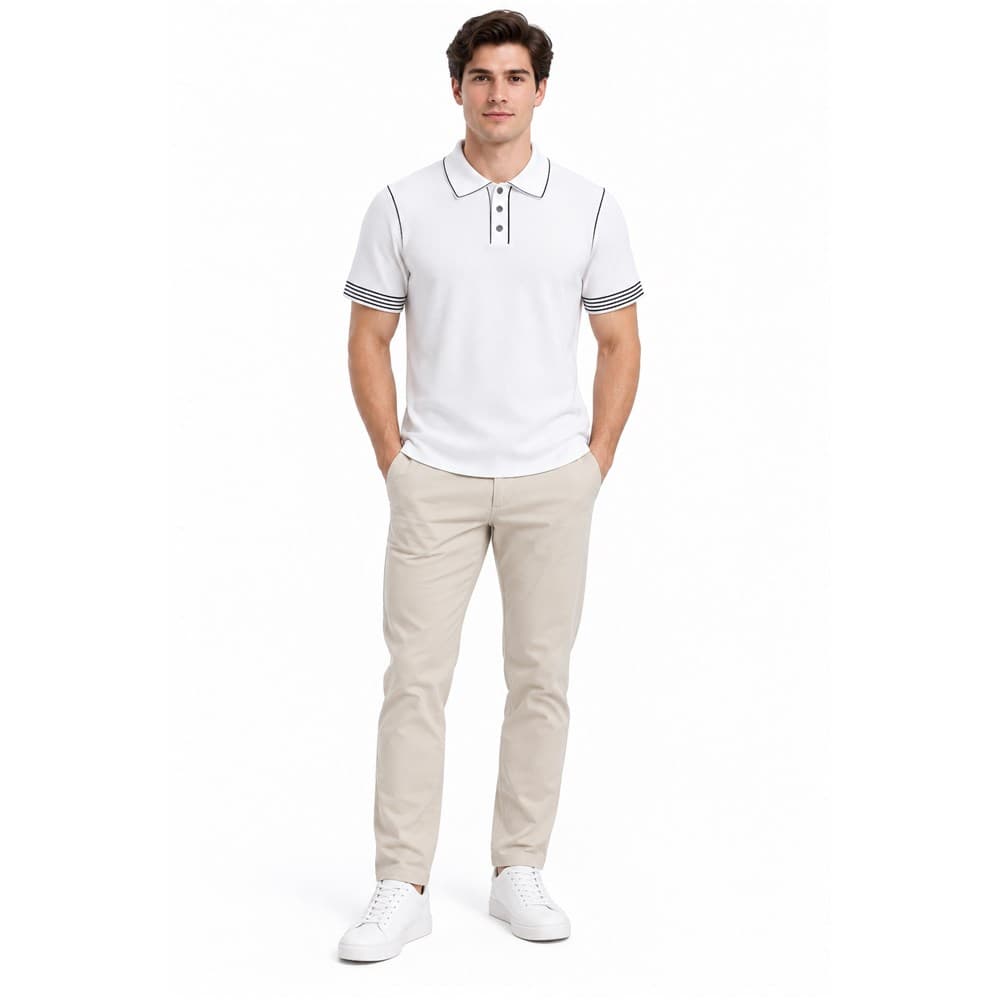
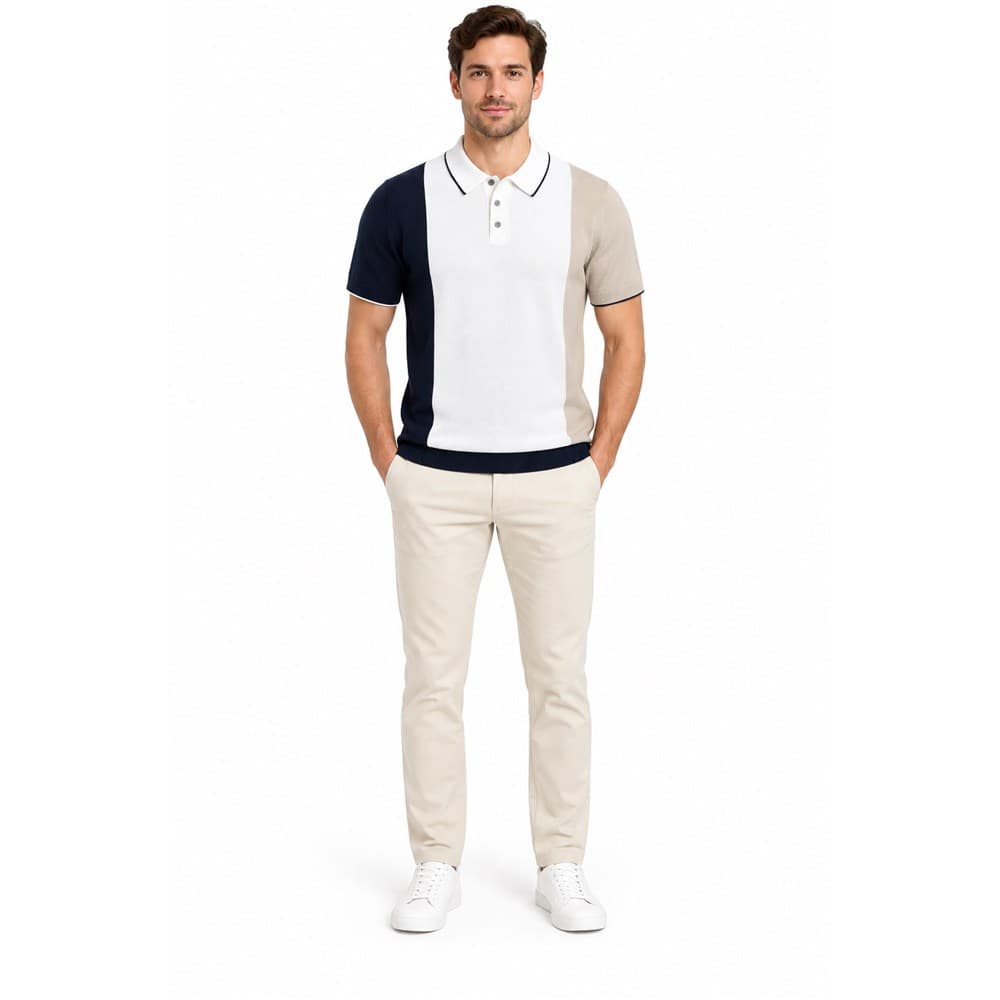
Men's Multicolour Colour-Block Short-Sleeve Knit Polo
MOQ, lead time, cost ranges, gauge selection and QC checkpoints across typical OEM/ODM knitwear programs in NA + EU. Enter your email — we'll send you the report link in 30 seconds.
No spam. Unsubscribe with one reply. We use your email only to send you the report and follow up if you want a sourcing conversation.
Brand names shown are previously serviced OEM/ODM partners. Logos are decorative and do not imply current endorsement.