Shrinkage Control in Wool & Cotton Knitwear Production
Updated 8/24/202612 min readBy Simon Liu · Licheng Knitwear
Shrinkage is the single most common reason a measurement-spec sweater fails inspection at final QC — and the failure almost always traces back to the sample stage, not the bulk run. Wool felts when scales lock together under moisture, heat, and agitation. Cotton swells in water and contracts as it dries, especially in heavier gauges where yarn tension is high. Both behaviors are predictable, both are controllable in production, and both need to be written into the purchase order before bulk knitting starts. This guide walks a QC lead through the physics of shrinkage in wool and cotton knit structures, the production controls Licheng applies at yarn, panel, and finished-garment stages, the tolerance ranges buyers typically write into POs (commonly 1-3%), and the language to use on the PP sample approval form so bulk shrinkage liability is unambiguous.
Shrinkage is the single most common reason a measurement-spec sweater fails inspection at final QC. In our experience running OEM/ODM programs out of Dongguan since 2018, when bulk fails the tape, the root cause is almost always traceable to a sample that was approved without a wash-and-measure step — not to a problem that emerged later in the bulk run. The physics of why wool and cotton knits change dimension under moisture and heat are well understood. The production controls that hold dimension within ±1-3% are routine. What is not routine — and what this guide is written to help you fix — is the way the tolerance language gets specified on the PP sample approval form and the purchase order.
This article is written for a QC lead about to issue measurement tolerances on a first pre-production (PP) sample. The goal is to give you the physics, the production controls, the tolerance numbers commonly used in mid-market knitwear contracts, and the exact PO language that makes bulk shrinkage liability unambiguous.
Why Wool And Cotton Shrink Differently
Ready to Start Your Project?
Get a free catalog or submit an RFQ today. Our team will respond within 24 hours.
Why do wool and cotton shrink differently?
They shrink by different mechanisms. Cotton relaxes and takes up; wool can also felt, where the fibre scales interlock irreversibly under heat and agitation. That difference is why one care instruction cannot be copied across both fibres, and why wool tolerance conversations are stricter.
What shrinkage tolerance should a buyer write into the order?
A number, agreed against the actual construction. A tolerance carried over from a different gauge or fibre is not a tolerance. Whatever is agreed should be tested to ISO 6330 domestic washing on the pre-production sample.
When is the last chance to catch a shrinkage problem cheaply?
At the pre-production sample, before bulk yarn is committed. After that the options are expensive - re-finishing, re-grading, or accepting goods outside tolerance - which is why the PP sample should be treated as a gate rather than a formality.
Does the care label need to match the test result?
Yes, and mismatches are a common and avoidable failure. If a garment is tested and approved under one wash regime, the label must instruct that regime. A label promising a gentler wash than the garment was tested for transfers the risk to the customer and back to you.
Can shrinkage be corrected after production?
Sometimes partially, through re-finishing, and never reliably. Prevention runs through three stages - yarn selection, knitting tension and finishing - and control at those stages is far cheaper than remediation after.
Wool and cotton shrink for completely different reasons, and confusing the two leads to the wrong corrective action.
Wool shrinks primarily through felting. Each wool fiber is covered in directional scales (the cuticle). When fibers are exposed to moisture, heat, and mechanical agitation simultaneously — the conditions inside a domestic washing machine — the scales open, slide past one another in the direction of the scale tip, and then lock when conditions cool. The fiber cannot return to its original position. The fabric densifies, becomes thicker and shorter, and the change is irreversible. A wool sweater that has felted cannot be stretched back to its original measurements.
Cotton shrinks through a different, mostly reversible mechanism: fiber swelling and yarn relaxation. Cotton fibers absorb water, swell across their diameter (typically 20-25% in cross-section), and the swollen fibers force the yarn structure to take up. When the fabric dries — especially under tumble-dry heat — the yarn contracts back, but it contracts with the yarn relaxed rather than under the tension it had when knitted. The net result is a fabric that has shortened in the wales (length) direction. Unlike felting, cotton relaxation shrinkage is partially recoverable by stretching during drying, but buyers cannot rely on consumers doing this.
Both mechanisms are amplified in heavier gauges (5GG, 7GG) where yarn tension at knitting is higher, and in tighter stitch structures (full cardigan, double jersey) where relaxation has more stored energy to release.
The Three Stages Where Production Controls Shrinkage
Shrinkage is controlled at three production stages. Skipping any one of them transfers risk to the consumer's first wash.
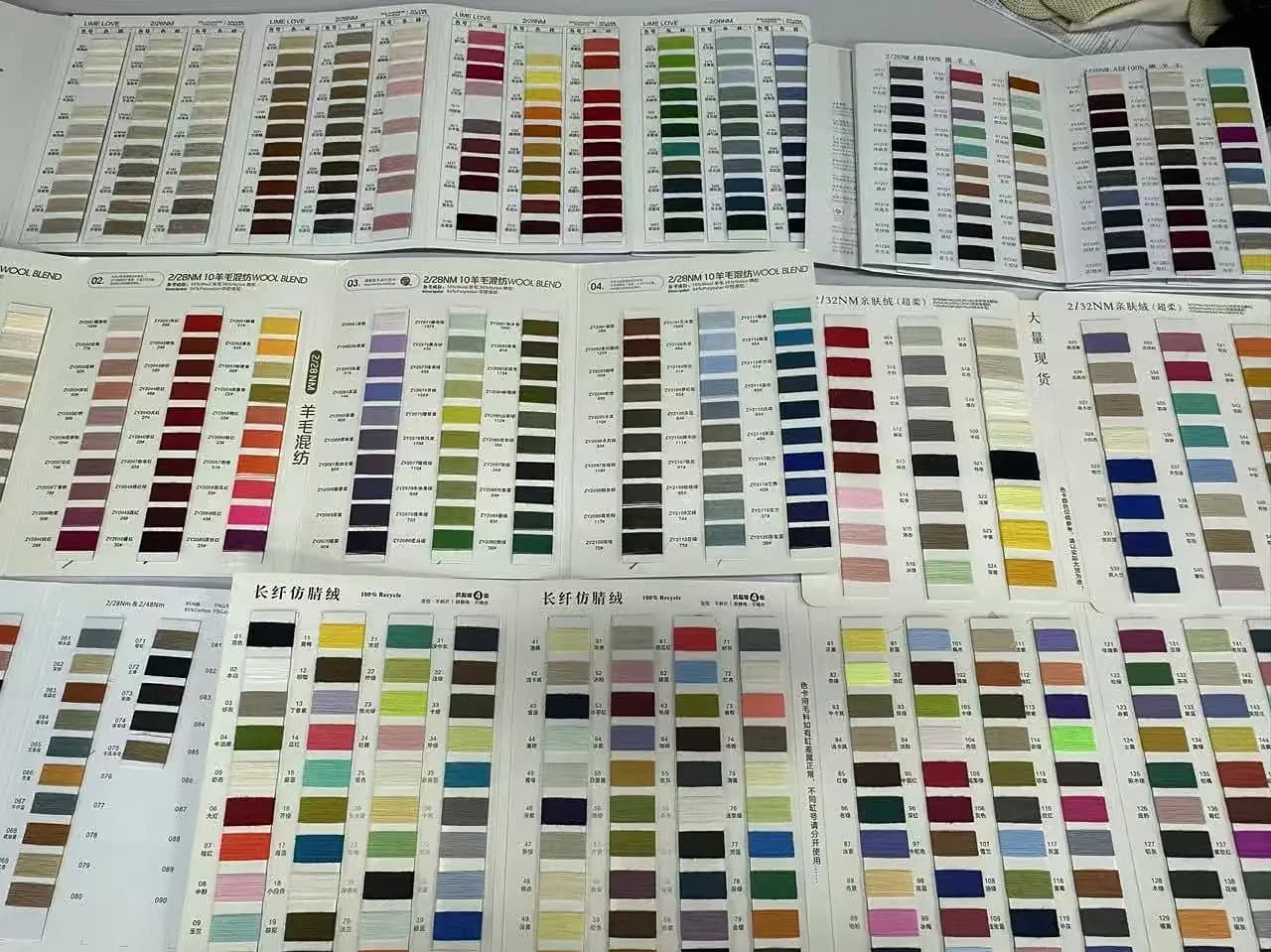
Stage 1: Yarn pre-treatment. Premium wool yarns for export programs are typically supplied with a Hercosett-type chlorination/resin treatment (commonly marketed as machine-washable or superwash wool). The treatment chemically modifies the cuticle scales so they cannot lock under agitation, eliminating felting shrinkage at the source. For cotton, mercerised yarn has been pre-tensioned in caustic soda, which reduces relaxation shrinkage and also improves dye uptake and luster. Specifying the yarn type on the BOM is the highest-leverage shrinkage control the buyer has.
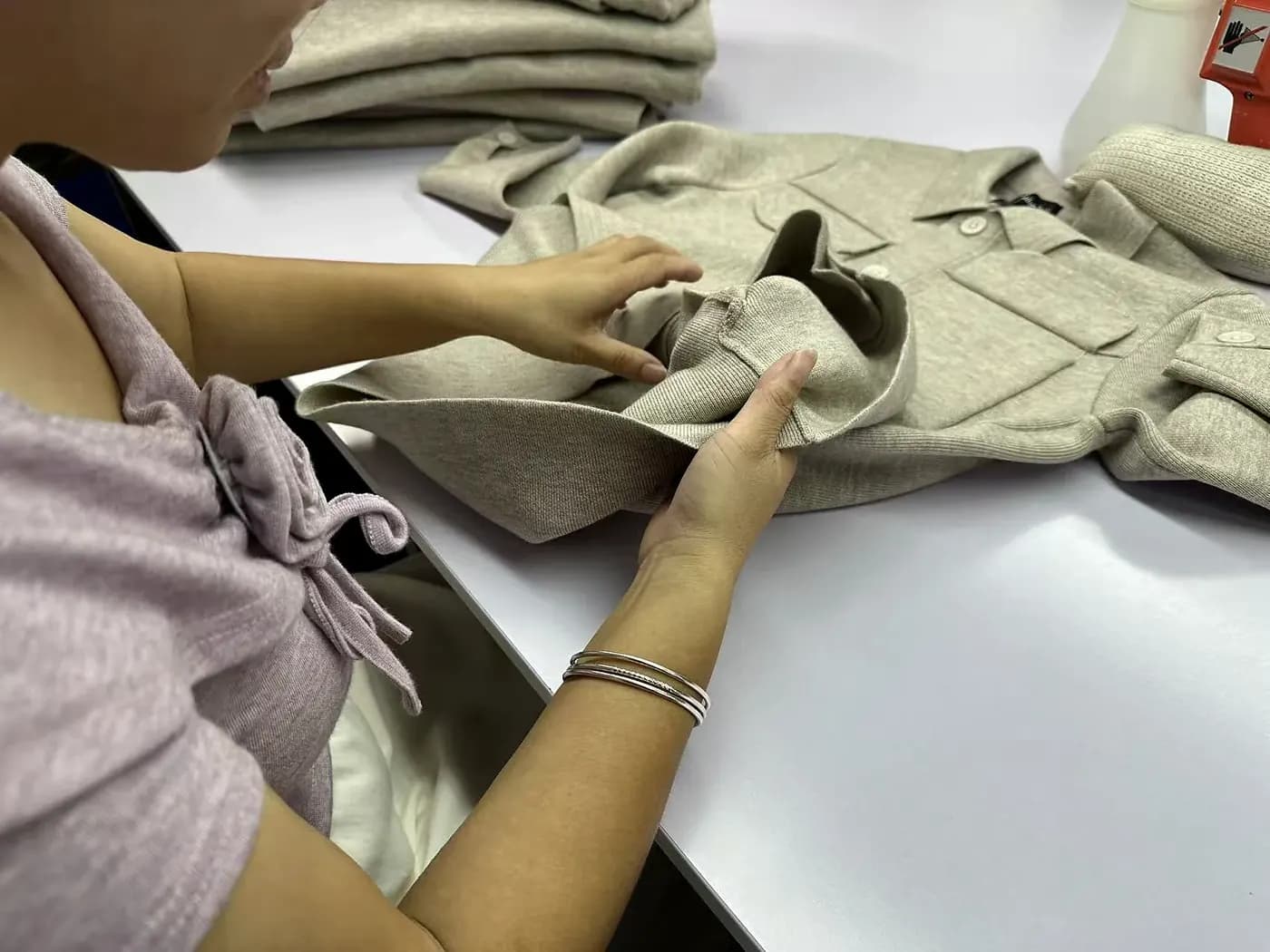
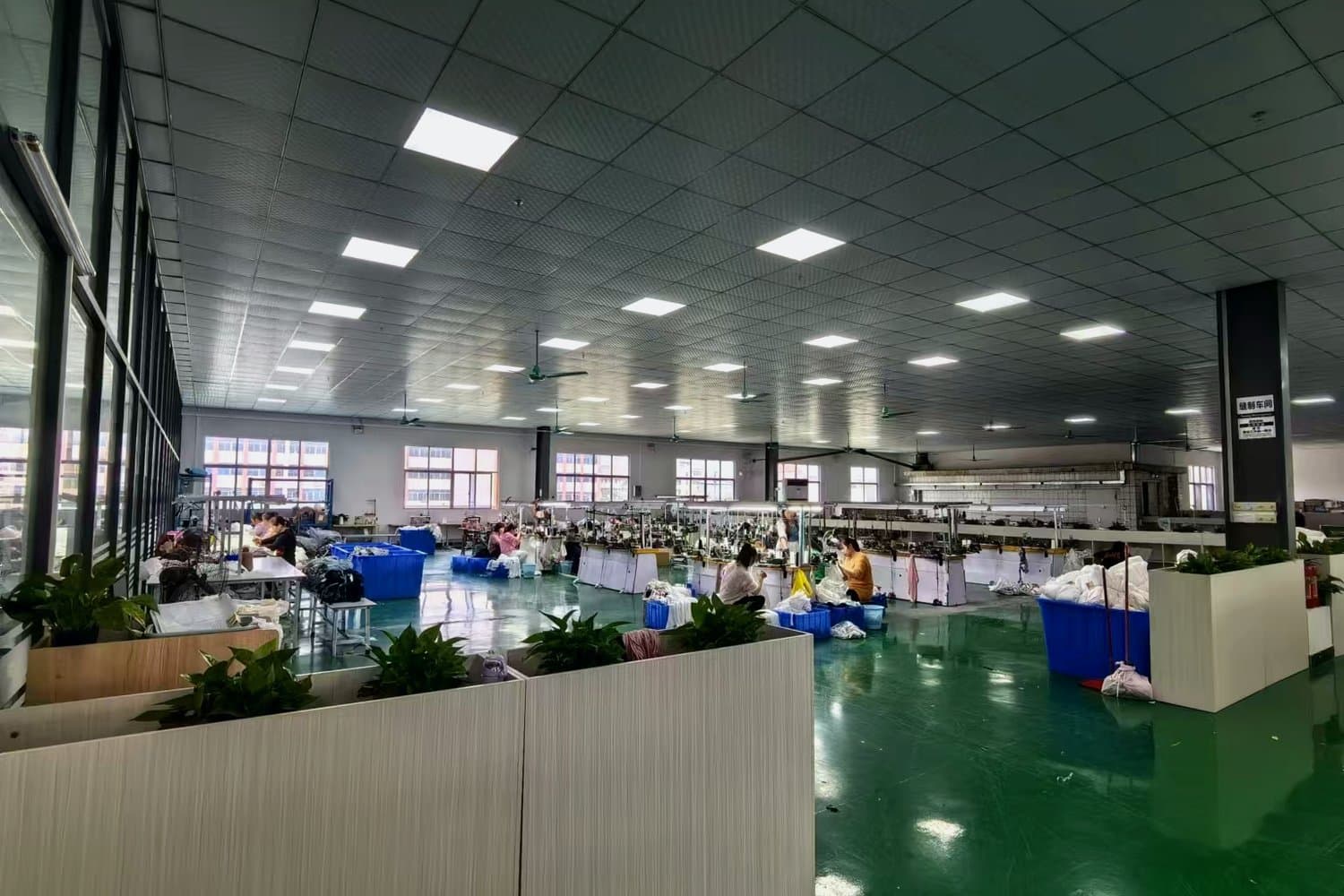
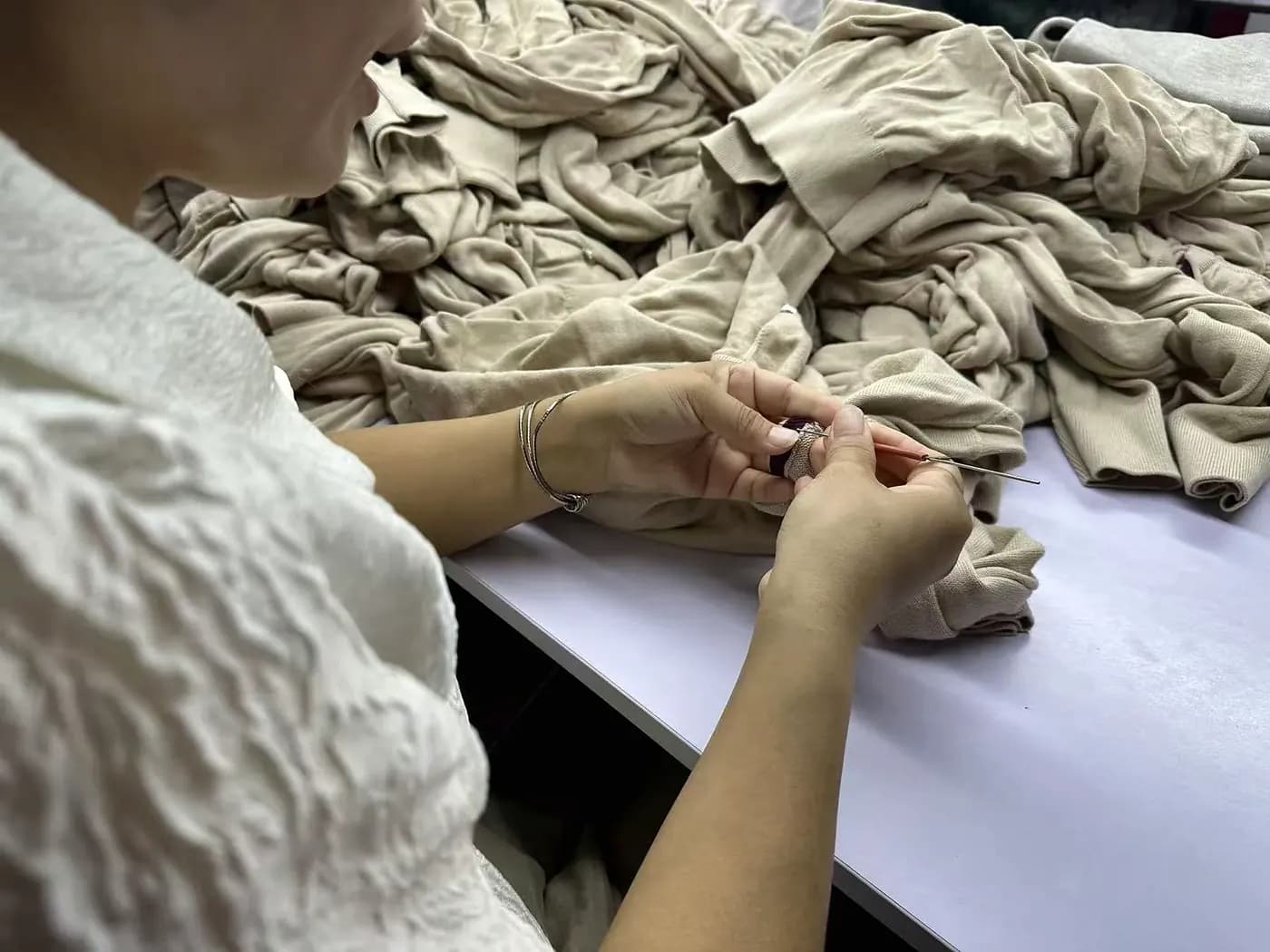
Stage 2: Calibrated steam during panel finishing. After knitting, panels are steamed and relaxed before linking. Calibrated steam — controlled temperature, dwell time, and humidity — releases the residual knitting tension so the panel reaches near-equilibrium dimensions before it is sewn. If steaming is skipped or rushed, the garment will release that stored tension at the consumer's first wash. We track steam dwell time per panel as part of the WIP routing.
Stage 3: Finished-garment wet pre-treatment. For programs where the consumer-facing care label calls for machine-wash, the bulk garments themselves are run through a controlled wash-and-tumble cycle in our finishing line before final inspection. This is the most expensive control (it adds 1-2 days to lead time and consumes water and energy) but it is the only way to deliver a garment whose first-consumer-wash dimensional change is effectively zero.
The combination of these three stages is what allows a sweater to be specified at a ±1-3% tolerance on the consumer side.
Tolerance Ranges Buyers Should Write Into The PO
The table below summarises tolerance bands we see most often in PO contracts for mid-market mens and womens knitwear. These are not regulatory limits — they are commercial norms negotiated between buyer QC teams and manufacturers, and they are what we generally accept as binding.
Fibre / Construction
Length (Wales) After Wash
Width (Courses) After Wash
Notes
Superwash merino, 12GG fine gauge
±1.5%
±2.0%
Tightest band achievable in volume; PP wash test mandatory
Untreated wool, 7GG
±3.0%
±3.0%
Dry-clean-only care label assumed
Wool/acrylic blend (50/50), 5-7GG
±2.0%
±2.5%
Acrylic stabilises; common workhorse spec
Mercerised cotton, 12GG
±2.0%
±2.5%
Mercerisation is the key lever
Cotton/linen blend, 5-7GG
±3.0%
±3.5%
Linen relaxes aggressively first wash
Cashmere or cashmere-blend, 12GG
±2.0%
±2.5%
Hand-wash care; PP test required
The key practical point: a 1% length tolerance on a 70cm body length is 7mm. That is below the resolution of a hand-held tape measure used by a roving QC inspector. Tolerances tighter than ±1.5% are inspector-unfriendly and tend to generate disputes rather than better garments. We typically push back on buyers asking for ±1.0% unless they are willing to fund automated measurement at final QC.
The tolerance should be specified separately for length and width — the two directions shrink at different rates because the knit structure is anisotropic, and a single combined number creates ambiguity.
Using The PP Sample As The Gating Test
The pre-production sample is the contract-grade reference for shrinkage. We recommend buyers structure the PP approval gate as follows:
1. Manufacturer ships two identical PP samples cut from the same panel and using bulk yarn.
2. Buyer measures sample A against the tech-pack measurement chart and confirms it is within construction tolerance.
3. Buyer washes sample B per the proposed care label (or sends it to a third-party lab — SGS, Intertek, TUV — for an ISO 5077 / AATCC 135 test).
4. Buyer re-measures sample B and computes percentage change in length and width at each point of measurement.
5. If both samples are within tolerance, the PP is approved and bulk knitting is released.
6. If sample B fails, the buyer specifies the corrective action: change yarn (e.g. require superwash), add wet pre-treatment to the bulk routing, or modify the care label to remove machine-wash.
Skipping step 3 is the single most common cause of bulk failure. A PP sample that has only been dry-measured tells you nothing about the consumer experience. Our standard sample lead time is 7-25 days; budgeting an extra 3-5 days for a proper wash test is cheaper than running 30 pieces of bulk through rework.
When bulk shrinks more than the PP did, the typical root causes are: (a) bulk yarn from a different mill lot with slightly different cuticle treatment levels, (b) steam dwell time shortened in bulk to hit a tight ship date, or (c) finishing wash temperature set incorrectly. All three are detectable in a bulk inline check and avoidable if the PP test is treated as binding.
Care Label Language That Matches Production Reality
The care label is the final mechanism by which the buyer transfers residual shrinkage risk to the consumer. The label must match what production has actually controlled for. The common mismatches:
Label says *machine wash cold* but bulk was not wet pre-treated. First wash will release 4-6% of stored relaxation; consumer returns the garment.
Label says *do not tumble dry* but the consumer tumble-dries anyway. Wool felting accelerates. This is a residual risk and the label is doing its legal job, but buyers should still spec superwash yarn for any program where consumer compliance with the care label is doubtful (mass market, kids, gift-giving categories).
Label says *dry clean only* on a 100% cotton sweater. The consumer assumes a labelling error and machine-washes. The garment shrinks. Cotton should not carry dry-clean-only labels unless the trim or construction strictly requires it.
We issue a draft care label with every PP sample so buyers can validate it against their own market regulations (US FTC care labelling rule, EU textile labelling regulation 1007/2011, individual market additions) and confirm it matches the wash test result.
What To Specify In The Purchase Order
A shrinkage-aware PO should contain, at minimum, the following six clauses:
1. Fibre and yarn treatment, e.g. *100% superwash merino, 19.5 micron, Hercosett-treated, supplier Z-Yarn lot to be disclosed*.
2. Construction parameters: gauge, stitch, weight per square metre. We work 3GG to 18GG; specify the gauge the PP was knitted at.
3. Measurement tolerance, separated into length and width, at each point of measurement, e.g. *body length ±2.0%, chest width ±2.5%*.
4. Shrinkage test method and limit, e.g. *ISO 5077 after one cycle ISO 6330 type 4N at 30°C, max 3% length / 3% width*.
5. PP sample gating language: *bulk release contingent on PP wash test pass; PO not binding until PP signed*.
6. Care label text, exact wording to be applied to bulk; any change requires buyer countersignature.
This structure makes shrinkage liability unambiguous: yarn-treatment failures are mill liability, wash-test failures are manufacturer liability, label compliance is buyer liability. Disputes resolve quickly because each party knows what they signed up for.
How Licheng Handles It Day-To-Day
For each new program we run, the shrinkage control checklist is: (1) confirm yarn treatment on the BOM, (2) run a 3-piece pilot through finishing before committing bulk, (3) wash-test one of the three against the proposed care label, (4) re-measure and report against tech-pack tolerance, (5) only then release bulk knitting. Bulk lead time of 30-45 days assumes this pilot step is included; trying to compress it routinely produces the bulk-shrank-more-than-sample failure mode.
For buyers running their first program with us, we recommend writing the ±1-3% tolerance into the PO from the start and treating the PP wash test as the contractual gate. It is the single piece of structure that protects both sides through bulk inspection at AQL 2.5 and onward to consumer delivery.
---
Talk to our team about this
If you're planning a real project around any of the points above, we'd be glad to take a quick look. Send a short brief and we'll come back within one business day with a practical direction, MOQ + lead time estimate, and a sample plan if it makes sense.
For untreated wool at 5-7GG with a dry-clean care label, ±3% length and ±3% width is the workhorse spec. For superwash merino at 12GG with a machine-wash label, you can tighten to ±1.5% length and ±2.0% width — but only if the manufacturer commits to wet pre-treatment in the finishing line and you gate bulk on a PP wash test against ISO 5077 or AATCC 135. Anything tighter than ±1.5% becomes inspector-unfriendly and tends to generate disputes.
Three typical causes. First, bulk yarn came from a different mill lot than the PP, with slightly different cuticle treatment or twist. Second, steam dwell time on panels was shortened in bulk to hit ship date. Third, the PP sample was dry-measured but never wash-tested, so the consumer-wash behaviour was never actually checked. The fix is to gate the PO on a PP wash test (not just a dry measurement) and to require bulk yarn lot disclosure.
Partially. Cotton shrinks because the fibres swell in water and the yarn relaxes as it dries. The relaxation can be partly reversed by stretching the garment back to shape during line-drying, but buyers cannot assume the consumer will do this. The reliable controls are mercerised yarn (pre-tensioned in caustic soda at the mill) and finished-garment wet pre-treatment before final QC. Wool felting, by contrast, is irreversible.
No. Knit fabric is anisotropic — it shrinks at different rates along wales (length) than along courses (width), and the two directions need separate tolerances. A single combined number creates ambiguity at inspection. Standard practice is to specify each direction at each point of measurement on the tech-pack, e.g. body length ±2.0%, chest width ±2.5%, sleeve length ±2.5%.
Technically yes, but it should require a buyer countersignature because changing the label changes the shrinkage liability allocation. If you approved a PP under a dry-clean label and then ask for the bulk to ship with a machine-wash label, the manufacturer must re-run the PP wash test under the new condition. Otherwise you have approved one product and shipped another. We block label changes at our end until the test result is in writing.
We focus on men's sweaters, cardigans, knit jackets, jacquard knitwear and private label knitwear. We support B2B buyers with OEM/ODM development, sampling and bulk production planning.
MOQ, lead time, cost ranges, gauge selection and QC checkpoints across typical OEM/ODM knitwear programs in NA + EU. Enter your email — we'll send you the report link in 30 seconds.
No spam. Unsubscribe with one reply. We use your email only to send you the report and follow up if you want a sourcing conversation.
Brand names shown are previously serviced OEM/ODM partners. Logos are decorative and do not imply current endorsement.