How to Read a Knitwear Quotation: FOB Price Breakdown for Buyers
Updated 9/19/202612 min readBy Simon Liu · Licheng Knitwear
Learn to read a sweater quote line by line — yarn, knitting, linking, trims, overhead and margin — plus Incoterms, what's not included, and the red flags that separate a real quote from a number designed to win the order.
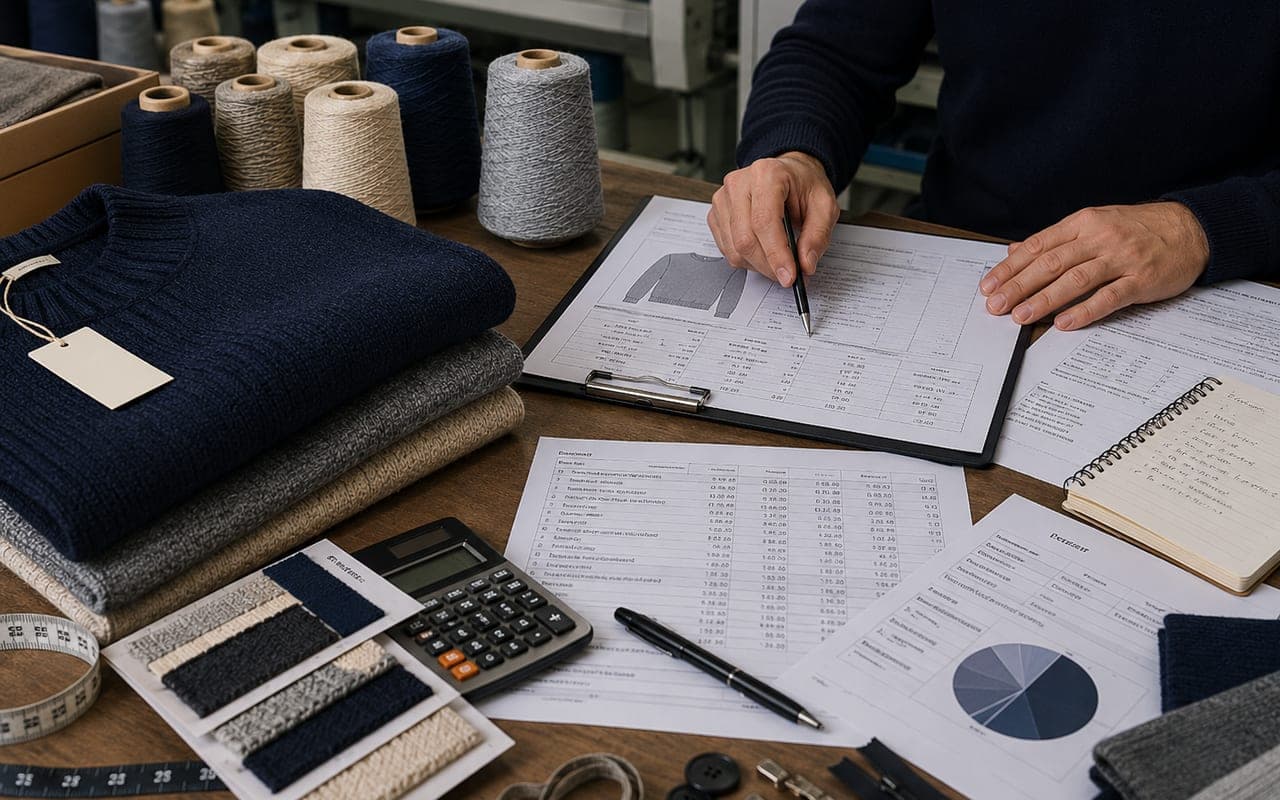
When a factory sends back a quote, most buyers look at one number: the FOB price. But a knitwear quotation is a story about how your product is built — and learning to read it line by line is the difference between negotiating from knowledge and guessing. This guide breaks down what's inside a sweater quote, what each line means, and the red flags that separate a real quote from a number designed to win your order and renegotiate later.
A quote that's missing its assumptions — gauge, yarn count, weight per piece, Incoterm, MOQ — isn't a quote, it's a teaser. Always ask for the breakdown. A transparent factory will give it to you.
Read a quote line by line, not just the bottom-line FOB number.
What a complete quotation should contain
Common Questions
What should a complete knitwear quotation contain?
Unit price with the incoterm named, the MOQ the price is quoted against, sampling cost and lead time, bulk lead time, payment terms, the yarn and gauge assumed, and what is excluded. A quotation missing the incoterm or the assumed specification is not comparable with another.
What are the red flags in a quotation?
A price without an incoterm; an MOQ that is not stated per colour; no sampling terms; no statement of the yarn or gauge assumed; and a number that arrives before the supplier has seen what you want made. Each of those means the figure will move later.
How do I compare two quotations fairly?
Normalise them first. Put both under the same incoterm, confirm both assume the same yarn count and gauge, and check whether the MOQ is per style or per colour. Most apparent price differences shrink or reverse once those three are aligned.
Does the lowest quotation usually win?
Not once the total is counted. The lowest FOB frequently carries a higher sample cost, a longer reorder cycle, or an assumption about yarn that will not hold. Compare landed cost and the terms around it, not the headline.
What should I send to get a quotation worth reading?
Quantity, gauge, yarn, size run, branding position, delivery date and incoterm - a tech pack covers most of it. With those, a quotation is a real number rather than a starting position.
Incoterms: what the price does and doesn't include
EXW (Ex Works) — price at the factory door; you arrange and pay for everything after.
FOB (Free On Board) — most common in knitwear; price includes getting goods onto the vessel at the export port. You handle freight and import duty.
CIF — adds sea freight and insurance to the destination port.
Two quotes are only comparable if they use the same Incoterm. An "EXW" price will always look cheaper than an "FOB" price for the same garment — that's not a discount, it's a different scope.
Compare quotes on the same Incoterm, gauge and weight — or you're comparing nothing.
Red flags in a quotation
No weight per piece stated. Yarn is 40–60% of cost; if weight is vague, the price is too.
A price far below the others. Often it's a thinner yarn, lower count, looser construction, or a number that climbs once you're committed. Cross-check against the 2026 sourcing benchmark report.
MOQ that seems too good but ignores per-colour minimums.
No sample cost or lead time — a sign the development conversation hasn't really happened.
1. Normalise the Incoterm and MOQ across all quotes.
2. Compare yarn composition, count and weight — not just price.
3. Factor in sampling speed and reject risk, which affect landed cost and your season.
4. Ask each factory to quote the same tech pack — see how to prepare a sweater tech pack.
Get a transparent quote
Licheng Knitwear quotes with the breakdown shown — gauge, yarn, weight, Incoterm, MOQ, sample and bulk lead time — so you can compare apples to apples. Send your product idea, reference photo or tech pack and target quantity, and request a quote. We'll come back with a clear, itemised proposal, or browse product directions to start from a style you like.
---
Talk to our team about this
If you're planning a real project around any of the points above, we'd be glad to take a quick look. Send a short brief and we'll come back within one business day with a practical direction, MOQ + lead time estimate, and a sample plan if it makes sense.
FOB unit price, yarn and gauge, MOQ, sample and bulk lead times, customisation and trims, packaging, and payment terms.
Yarn choice, gauge and complexity, order quantity (MOQ spreads setup cost), trims and finishing, and whether the colour is stock or custom-dyed.
Yarn dye-lot minimums, custom trim and hardware minimums, lab dip and sample fees, special finishing, and packaging. Ask for each as a line item.
We focus on men's sweaters, cardigans, knit jackets, jacquard knitwear and private label knitwear. We support B2B buyers with OEM/ODM development, sampling and bulk production planning.
Ready sample styles and selected custom programs can support lower-risk trials before larger seasonal orders.
Yes. Brands, including new labels preparing a first collection, can pay for a sample and see it before placing a production order. Two routes: a ready sample of a published style at USD 60 per piece in about 7 days, or a development sample from your tech pack at USD 150 per style, covering yarn sourcing, knit programming, one prototype and one revision round, in 15-25 days. Cashmere and mohair styles are quoted individually and shipping is charged at cost. Production starts only after you approve the physical sample, at our minimum of 30 pieces per colour with sizes mixed inside the 30. A sample does not commit you to a production run; we do not make garments for personal use.
Ready to Start Your Project?
Get a free catalog or submit an RFQ today. Our team will respond within 24 hours.
MOQ, lead time, cost ranges, gauge selection and QC checkpoints across typical OEM/ODM knitwear programs in NA + EU. Enter your email — we'll send you the report link in 30 seconds.
No spam. Unsubscribe with one reply. We use your email only to send you the report and follow up if you want a sourcing conversation.
Brands We've Worked With
Brand names shown are previously serviced OEM/ODM partners. Logos are decorative and do not imply current endorsement.