Color is the part of a knit program most buyers are most emotional about — and the part where the factory has the least margin for error. A sweater that arrives one shade off from your reference can make the entire bulk unsellable. This guide explains how Pantone color matching actually works in custom knitwear, what tolerances are realistic, and how to set up an approval process that lands the color you imagined.
Color is not subjective in production. It is measured, signed-off and tracked — and the buyers who treat it that way get repeatable results.
Why is colour matching harder in knitwear than in woven fabric?
Because a knitted surface is three-dimensional. Loops create shadow, so the same dye reads differently at different gauges and in different structures. A colour approved on a flat swatch can look different on a ribbed cuff of the same yarn.
Should I specify TPX or TCX?
TCX, where you have the choice. The cotton-based standard is closer to a textile surface than the paper-based one, so it gives the dyehouse a more achievable target. Whichever you use, name it - a Pantone number without the suffix is ambiguous.
What is a lab dip and how many rounds are normal?
A lab dip is a small dyed sample submitted for approval before bulk dyeing. More than one round is normal; each round costs a fee and calendar time, which is why an unambiguous colour reference at the start is the cheapest thing a buyer can provide.
What is Delta-E and why should it be in the spec?
Delta-E is a numeric measure of colour difference. Specifying an acceptable Delta-E turns colour approval from an argument into a measurement, which matters most when a colour has to match across styles or across a reorder.
Why do buyers need to agree the light source?
Because a match under one light can fail under another - the effect known as metamerism. Agreeing the light booth conditions, typically D65 with a secondary source, means both sides are approving the same thing.
💬 Sourcing this for an upcoming project? Request a free quote → · MOQ 30 pcs/colour · Sample in 15–25 days · WhatsApp us
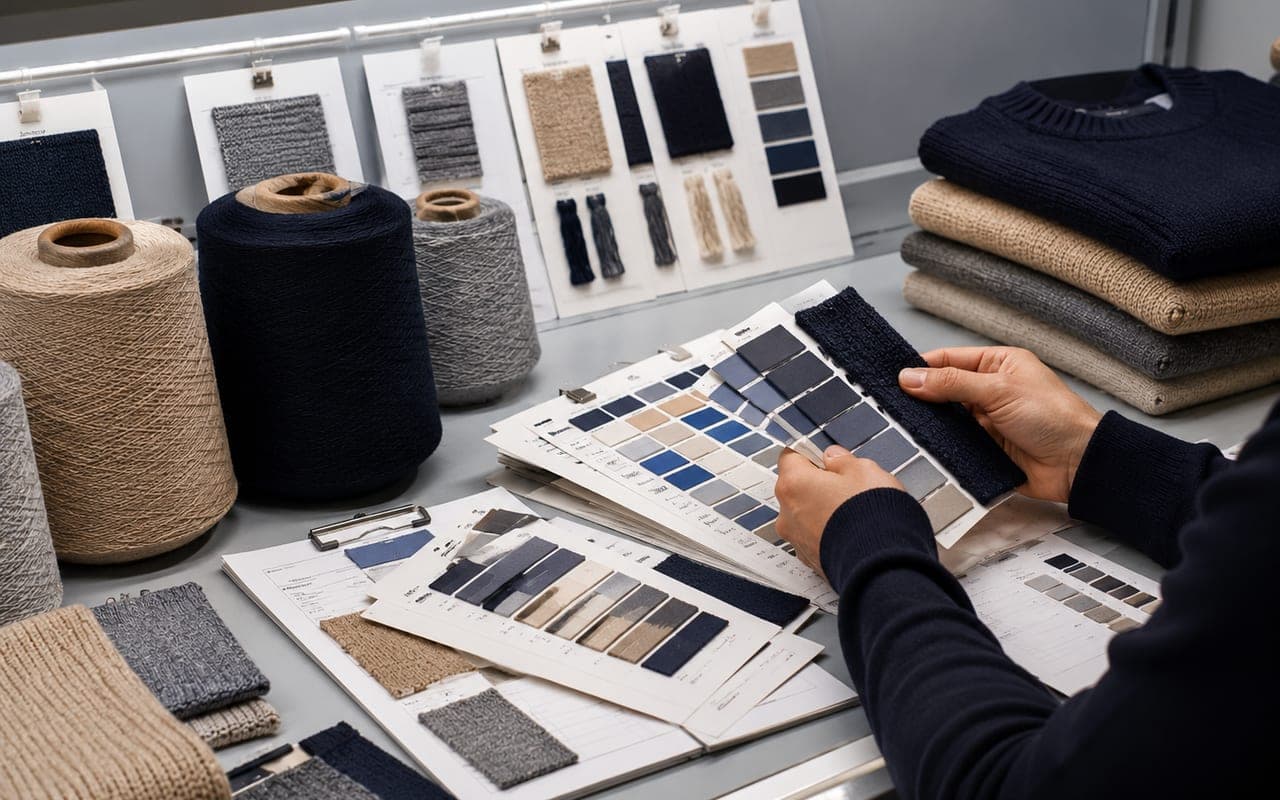
A flat woven swatch and a knitted swatch dyed in the same dye bath will read differently to the eye. The reason is structure: knit loops scatter and absorb light differently than the flat warp-and-weft of a woven, so the perceived color shifts. Surface texture changes this further — a brushed mohair reads softer and lighter than a smooth fine-gauge merino dyed in the identical lot.
That is why Pantone matching for knitwear is always fiber-on-fiber: the lab dip must be done on the exact yarn that will be used in bulk, knitted to the same gauge and stitch, with the same finishing.
|
| Fiber | Cotton, wool, acrylic absorb dye differently | Final yarn composition |
| Gauge | Loop size changes light reflection | Final GG (e.g. 7GG vs 12GG) |
| Stitch structure | Cables and ribs cast shadow | Reference stitch |
| Finishing | Brushing, washing, anti-pill alter shade | Finishing route |
| Light source | Color shifts under D65, TL84, A | Approve under all 3 |
Not every Pantone book is appropriate for knitwear. The three you will encounter:
- Pantone Solid Coated (PMS-C) — the graphic design standard. Useful as a starting reference but printed on paper, so it does not represent a textile.
- Pantone TPX (Textile Paper eXtended) — pigments printed on paper, designed for textile briefing. Common in tech packs.
- Pantone TCX (Textile Cotton eXtended) — the same colors dyed on cotton fabric. The most accurate reference for textile work.
Where possible, brief in TCX. A code like `19-1664 TCX True Red` gives the dye house a real textile target rather than a printed approximation. If you only have a Solid Coated reference, send it but flag that the match will be interpreted onto yarn.
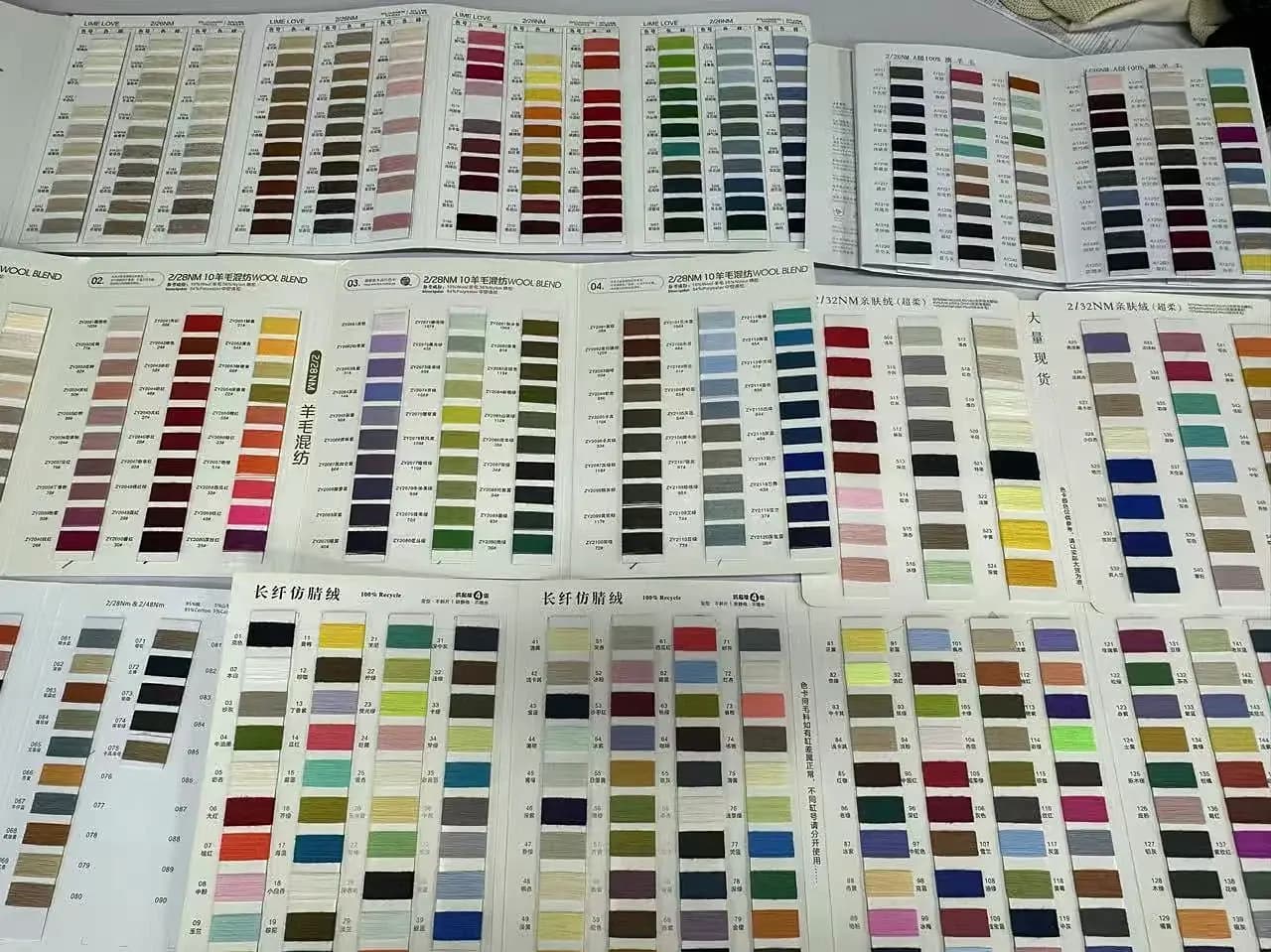
A lab dip is a small test-dyed yarn skein produced before bulk dyeing. The dye house mixes a recipe, dyes a skein, and sends two or three options — usually a tone slightly above, on, and slightly below the target. The buyer picks the closest, comments on direction ("warmer," "less yellow," "darker by 5%"), and a second round is dyed against that feedback.
A typical lab dip cycle:
|
| Round 1 | 7–10 days | 2–3 options against your Pantone | Comment on direction |
| Round 2 | 5–7 days | Refined 1–2 options | Approve or fine-tune |
| Round 3 (if needed) | 5–7 days | Final corrected lab dip | Sign-off for bulk |
Most colors land in 2 rounds. Difficult shades — saturated reds, deep navies, vibrant teals, fluorescent tones — can take 3 or more. Build that into your calendar; do not assume one round is enough. For broader timeline context, see our sweater sampling lead time guide.
Professional color approval uses a measured tolerance, not just an eyeball check. Delta-E (ΔE) is the calculated distance between two colors in a uniform color space (CIELAB). Lower ΔE means closer match.
- ΔE ≤ 1.0 — virtually no perceptible difference, premium standard
- ΔE ≤ 1.5 — Licheng's working tolerance for bulk vs approved lab dip
- ΔE ≤ 2.0 — acceptable for casual / promotional ranges
- ΔE > 2.5 — visible difference, typically rejected
Reputable factories use a spectrophotometer (such as Datacolor or X-Rite) to measure bulk yarn against the approved standard. Ask whether your factory measures color or only assesses visually — measurement is what makes color repeatable across reorders.
Two colors that match under one light source can mismatch under another. This is called metamerism, and it is the source of most color disputes between buyer and factory.
All serious color approval is done in a standardized light booth under three illuminants:
- D65 — average daylight; the primary standard for apparel
- TL84 — European retail fluorescent; how the sweater will look in store
- Illuminant A — incandescent / warm domestic light
Approve your color under all three. If it matches under D65 but shifts noticeably under TL84, the dye recipe needs adjustment before bulk. This is also why approving a lab dip from a phone photo is never sufficient — request the physical skein.
Lab dip approval is not the end. Before mass production, the factory dyes the actual bulk yarn lot and sends a bulk yarn submit (sometimes called BYS or bulk lab dip) against the approved lab dip standard. Only when the bulk lot reads within the agreed ΔE tolerance does knitting begin.
For multi-color programs, also confirm whether colors must match across styles within the collection — a navy on a polo should read the same as the navy on a crew neck. This requires shared dye lots or strict lot-to-lot tolerance, and should be flagged in the tech pack.
- Approving from a JPEG. Screens lie. Always sign off on the physical skein under booth lights.
- Skipping the bulk yarn submit. A great lab dip does not guarantee a great bulk lot.
- Briefing with a worn garment as reference. Wash, sun and time shift the original color; it is not a reliable target.
- Underestimating saturated and dark shades. Reds, royal blues and deep blacks routinely need an extra dip round.
- Mixing fiber composition mid-program. If you change from 100% cotton to a cotton/acrylic blend after lab dip approval, the color will move.
Before the first lab dip:
- [ ] Pantone code(s) specified, ideally TCX, with `Solid Coated` only as fallback
- [ ] Final fiber, gauge and stitch confirmed
- [ ] Finishing route (washed, brushed, anti-pill) confirmed
- [ ] Required ΔE tolerance written into the PO
- [ ] Lab dip cycles built into the calendar (assume 2 rounds, allow 3)
- [ ] Approval method agreed: physical skein under D65/TL84/A
Licheng Knitwear's color matching and Pantone lab dip capability covers fiber-correct lab dips, spectrophotometer measurement to ΔE ≤ 1.5, three-illuminant booth approval, and bulk yarn submits before knitting. For deeper background on the approval workflow, also see our knitwear color approval guide and knitwear dyeing methods explainer.
Request a quote with your Pantone references and we will run the lab dip program against your tolerance, on the exact yarn you will use in bulk.
---
If you're planning a real project around any of the points above, we'd be glad to take a quick look. Send a short brief and we'll come back within one business day with a practical direction, MOQ + lead time estimate, and a sample plan if it makes sense.
→ Request a free quote · Download the men's knitwear catalog · WhatsApp us · info@lcgarment.cn