Sourcing Knitwear from China to Canada: Logistics, Duties and Lead-Time Math
Updated 8/24/202612 min readBy Simon Liu · Licheng Knitwear
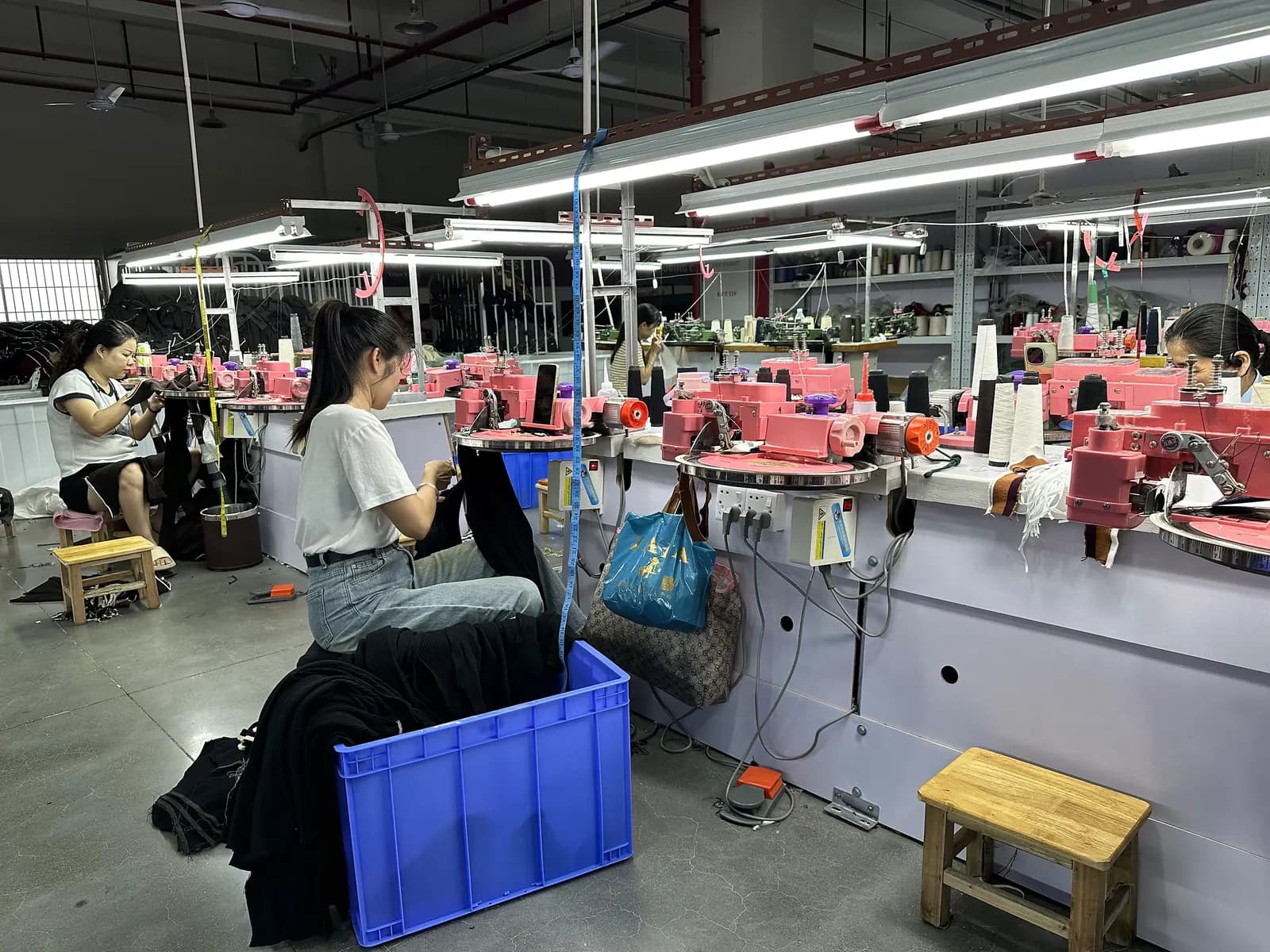
Canadian apparel buyers comparing a FOB China quote against landed cost in Toronto or Vancouver are usually working with two very different numbers. The FOB price covers yarn, knitting, linking, trims, packing and a small margin — it stops at the port of loading. The landed number adds ocean or air freight, MFN duty, customs brokerage, GST, and inland trucking to your warehouse. This guide, written from Licheng's perspective as a Dongguan-based knitwear manufacturer working with North American brands, walks through the lead-time math, MOQ realities, yarn and gauge directions Canadian buyers tend to favour, the compliance items Canadian retailers ask for, and the Incoterms and payment conventions we see most often on Canada-bound knitwear programs.
Canadian apparel brands have a sourcing geography problem most buyers in the US do not have to think about as sharply. The product still ships across the Pacific, but the receiving ports, the brokerage workflow, the duty rate and the inland trucking distances are different — and the bilingual labelling adds a step at the factory, not at the warehouse. At Licheng we run knitwear programs for Canadian buyers from our base in Dongguan, Guangdong, and the questions we get from a Toronto private-label brand or a Vancouver outdoor label tend to follow the same pattern: what does this actually cost landed, how long does it really take, and what do I need to specify so customs and my retailer accept the goods. This guide answers those questions with the numbers and process notes we use on real Canada-bound programs.
Why Canada Matters for Knitwear Sourcing
Common Questions
What labelling does knitwear sold in Canada require?
Canadian requirements include bilingual English and French information on the elements that must be presented in both languages, alongside fibre content and dealer identification. That affects label artwork and therefore has to be agreed before trims are developed, not after bulk is knitted.
Ready to Start Your Project?
Get a free catalog or submit an RFQ today. Our team will respond within 24 hours.
How do duties affect the landed cost of knitwear into Canada?
Enough to change a sourcing decision, and enough that they should be modelled before the PO rather than discovered at clearance. Ask your broker for the classification you will actually be entered under, and build the landed cost from that rather than from the FOB price.
What MOQ and lead time apply for a Canadian brand?
30 pieces per colour, sampling in 15-25 days from confirmed yarn and artwork. West coast entry generally offers shorter ocean transit than east coast entry, which is worth factoring into a seasonal calendar.
Which yarns and gauges suit the Canadian market?
Cold-weather layering drives it: wool and wool blends in mid to chunky gauges, with finer gauges for pieces worn under an outer layer. The specification conversation resembles the Nordic one more than the US one.
Which incoterm makes sense for a first Canadian order?
DDP is often the simpler start, because it converts duty and clearance uncertainty into one price. Moving to FOB is a sensible step once volume makes it worth carrying the freight and customs work yourself.
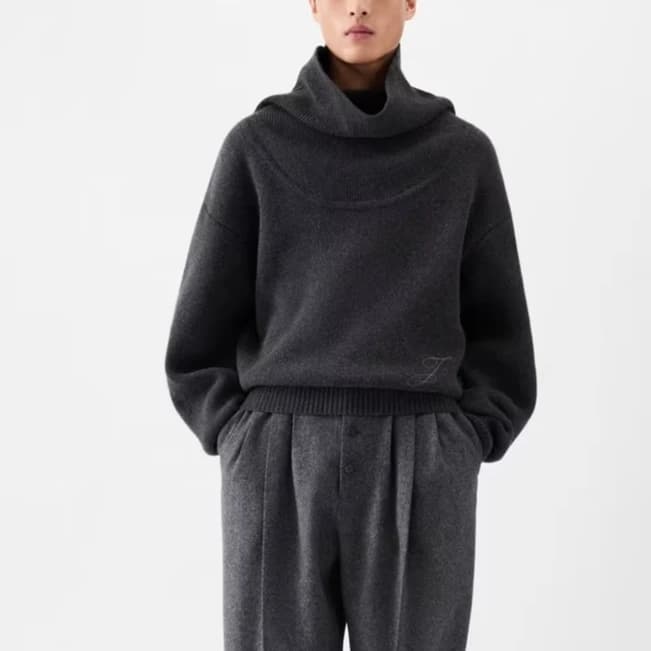
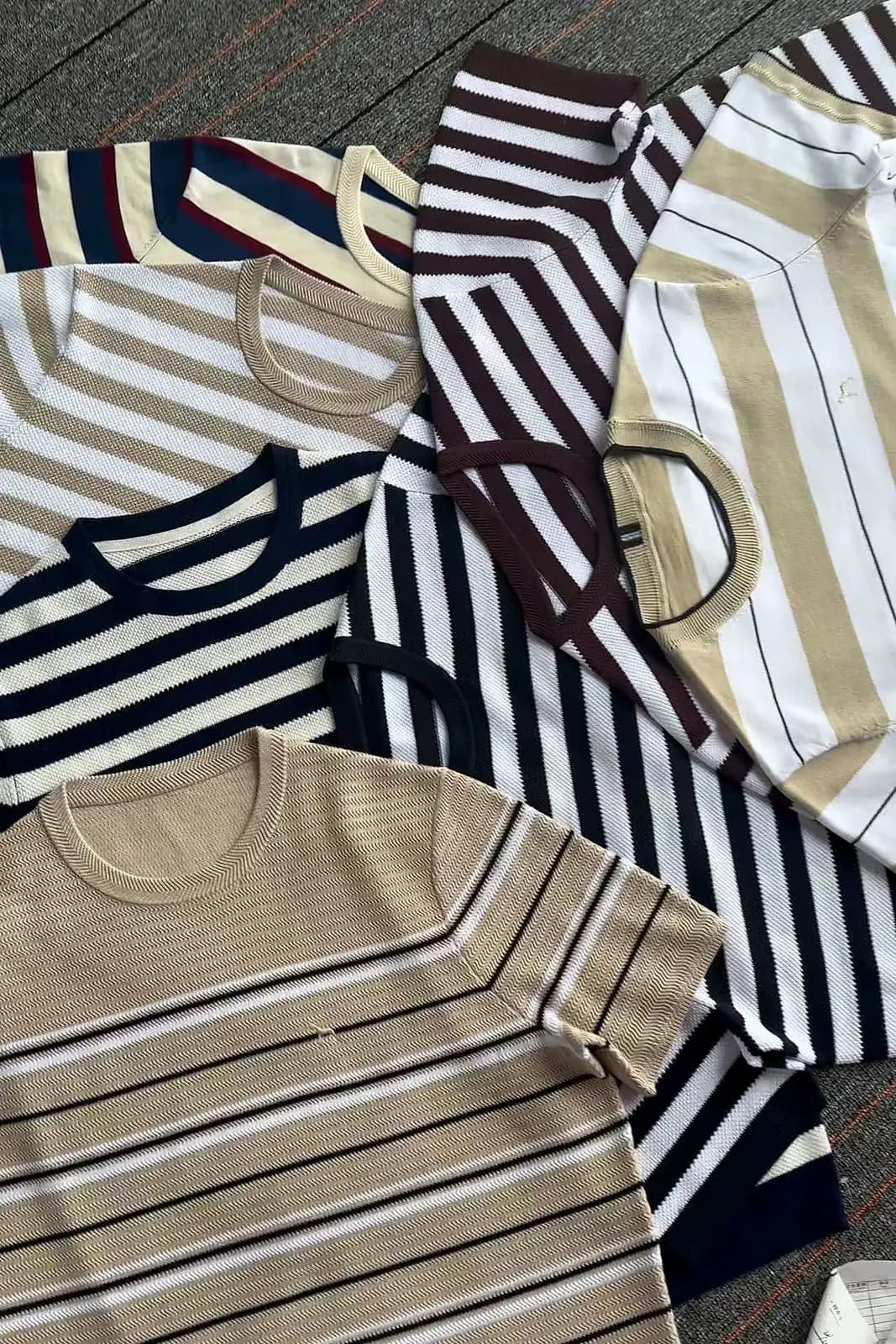
Canada is a cold-weather knitwear market with a long fall/winter selling window, which makes it a natural fit for the categories we make: mid-to-heavy gauge sweaters, cardigans, knit jackets and merino base layers. Canadian buyers we work with tend to plan deeper into chunky 3GG and 5GG constructions than US buyers do, because the retail season runs longer and consumers tolerate weight on a sweater that a Texas or California buyer would reject as too warm.
The other distinguishing feature is consolidation. The Canadian apparel buying base is smaller than the US one, so order quantities per style are often modest — a Toronto DTC brand may launch a sweater in 150 to 400 pieces across sizes, with two or three colour ways. That sits comfortably inside our catalogue MOQ of 30 pieces per colour, which means Canadian buyers rarely need to inflate quantities just to clear a factory floor. Trial orders and small reorders work without friction.
Finally, Canada is two distinct logistics regions for ocean freight. Containers landing at the Port of Vancouver feed western Canada and a meaningful share of the Prairie market; containers landing at Halifax or routed via Prince Rupert plus rail land in Toronto and Montreal. The choice of port changes transit time by roughly a week and inland trucking cost by a meaningful amount, so the FOB China number is only the start of the conversation.
Sample Lead Time and Bulk Production Realities
The lead-time math for a Canada-bound knitwear program is the same as for any other market in terms of factory days, but Canadian buyers need to add a longer logistics tail than a US buyer importing into Los Angeles or New York.
At Licheng our sample lead time is 7 to 25 days, depending on how unusual the yarn is and whether we are developing a fully fashioned style or a cut-and-sew construction. A straight crew-neck in a yarn we already stock can ship a proto in about a week; a Fair Isle or intarsia program with custom-dyed yarn and complex panel shaping lands at the upper end of the range. Bulk production runs 30 to 45 days after PP sample approval and final PO, again driven by yarn dyeing, gauge and order size. A 500-piece reorder in an existing colourway moves faster than a 3,000-piece launch with three new dye lots.
For a Canadian buyer planning a fall-winter launch on the floor by late August, the working calendar looks like this: PP sample approved by mid-April, bulk start late April, ex-factory mid-June, ocean transit to Vancouver around 18-22 days or to Toronto via Halifax around 28-35 days, customs clearance and inland trucking another 7-10 days. That gets cartons to a Toronto 3PL late July with two weeks of buffer. Compress that calendar and the buffer disappears, which is why we push Canadian buyers to lock yarn and PP approval earlier than they think they need to.
Our related guide on seasonal-knitwear-production-planning walks the backward calendar in more detail, and knitwear-shipping-logistics-guide covers the freight side of this math.
MOQ and Commercial Terms for Canadian Brand Sizes
Canadian apparel brands skew smaller than the US average. The brands we serve in Canada are typically DTC labels, independent boutiques scaling into wholesale, or specialist outdoor and lifestyle brands — not mass-market retailers placing 50,000-piece programs. Our catalogue MOQ of 30 pieces per colour is calibrated for exactly this customer.
In practice a Canadian launch we run might look like a 4-style capsule, two colourways per style, 60-120 pieces per colour, totaling 600-1,000 pieces of the program. That comfortably hits MOQ on every SKU and gives the buyer enough size depth to sell through. Custom yarn dyeing pushes the per-colour minimum up because yarn mills want at least one dyeing batch worth of fibre, which is why we encourage Canadian buyers to consider stock-dyed yarn for their first season and migrate to custom dye lots once the colour story stabilises.
Deposit and balance terms for Canadian buyers are conventional: a 30% deposit on PO confirmation against a proforma invoice, balance against a copy of the bill of lading before container release. Payment goes through bank wire in USD. We do not currently offer LC terms or open account for first orders. Our knitwear-payment-terms-trade-conditions guide covers the deposit/balance structure in more depth.
Yarn, Gauge and Construction Directions Canadian Buyers Favour
Canadian knitwear demand skews heavier and warmer than what we see going to southern US states. Across the Canada programs we run, a few directions show up repeatedly.
Gauge mix runs toward the heavier end. 5GG and 7GG dominate the order book, with meaningful 3GG chunky pieces for winter retail. Fine 12GG fine-gauge sweaters and polos exist for spring/summer and resort programs but represent a smaller share than they do for European or warm-state US buyers. Our knit-gauge-guide-3gg-5gg-7gg-12gg explains how gauge interacts with weight and price.
Yarn direction leans wool-blend and wool-cotton-blend for fall/winter, with merino requested for higher-price outdoor and base-layer programs. Cashmere and cashmere blends come up at the premium end of the Canadian market — typically Toronto and Vancouver labels positioning above CAD 250 retail. Recycled and certified-content yarns are increasingly requested but rarely required on the first order; many Canadian brands plan their sustainability claims for season two once they have proof of factory fit. See sustainable-recycled-yarn-knitwear and merino-wool-knitwear-guide for the supporting detail.
Construction-wise, fully fashioned panels remain the default for premium mid-gauge sweaters and cardigans where shoulder shaping matters; cut-and-sew shows up on chunky pieces, knit jackets and casual hoodies where the silhouette tolerates seamed shoulders. fully-fashioned-vs-cut-and-sew-knitwear covers the trade-offs.
Quality Control, Compliance and Canadian Labelling
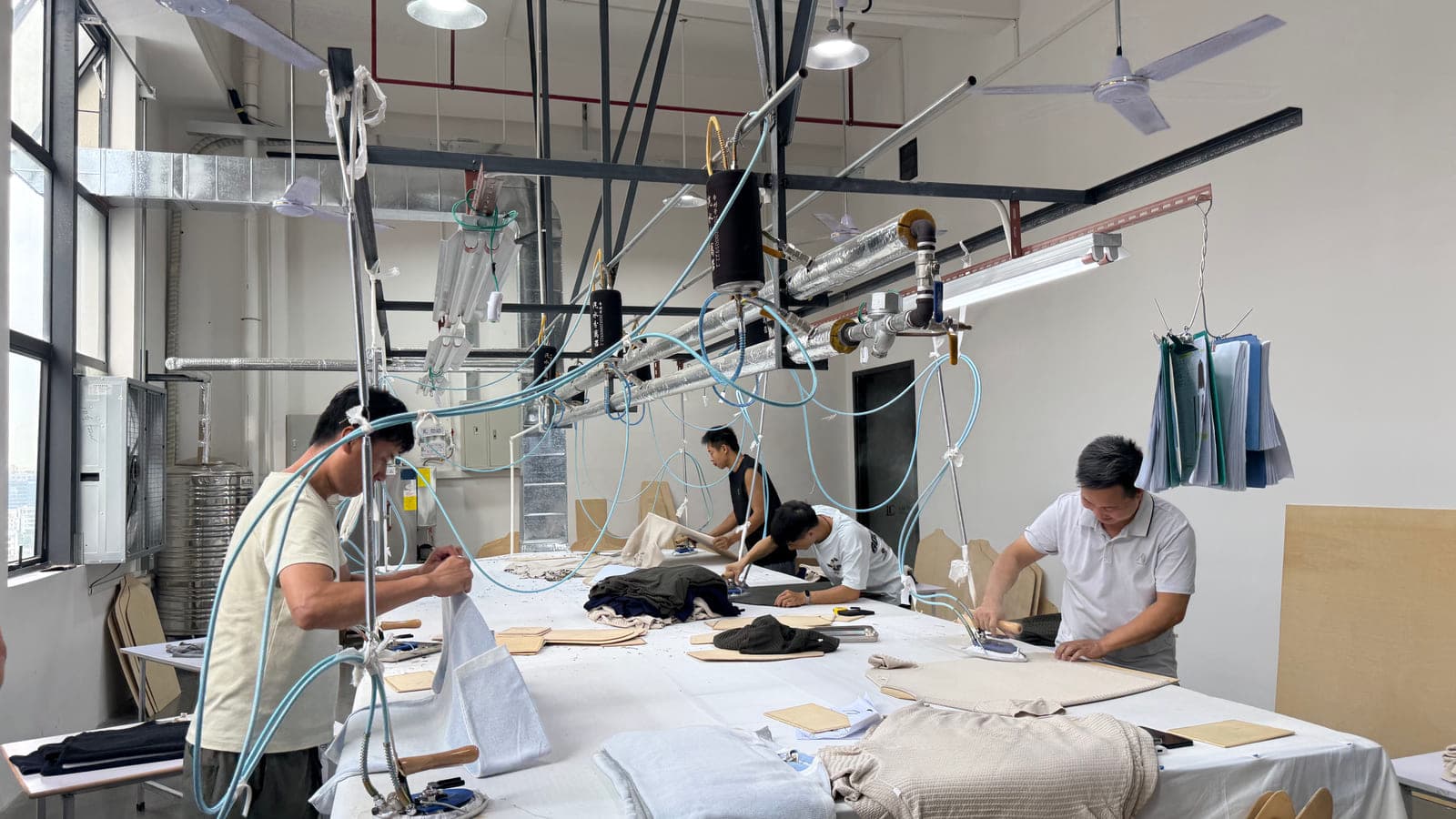
Quality control on a Canada-bound knitwear program covers the same factory checks we run for any market: AQL-based in-line and final inspection, needle and metal detection on every finished piece, and pre-shipment carton-level checks against the packing list. We follow the procedure in our sweater-quality-control-checklist and apply tighter sampling on first orders.
For Canadian destinations the compliance step that catches buyers off guard is bilingual labelling. Care labels on goods sold at retail in Canada must show care instructions in both English and French, and the fibre content declaration on the label and hangtag must be bilingual under Canadian textile labelling rules. We handle this at the factory rather than at the brand's 3PL — it is faster and cheaper to print bilingual care labels in Dongguan than to relabel cartons in Mississauga. Buyers send us the French translation with the tech pack; if a translation is missing we flag it before PP approval.
On material certifications we follow the rule we apply for every market: we do not display certificate logos we have not earned, and any third-party documentation for yarn certifications (recycled content, animal-welfare standards) is shared on request once the specific certified yarn is selected, not assumed by default. Our knitwear-certifications-explained-rws-oeko-tex-grs guide explains which certifications are mill-level versus factory-level and how chain-of-custody works.
Third-party inspection is welcome on any Canada-bound order. Canadian buyers who use SGS, Bureau Veritas or QIMA for final random inspection typically schedule the inspector for the day after our internal AQL pass, and we coordinate the visit. third-party-inspection-knitwear-guide explains how this slots into the production timeline.
Logistics, Duties and Incoterms: The Landed Cost Math
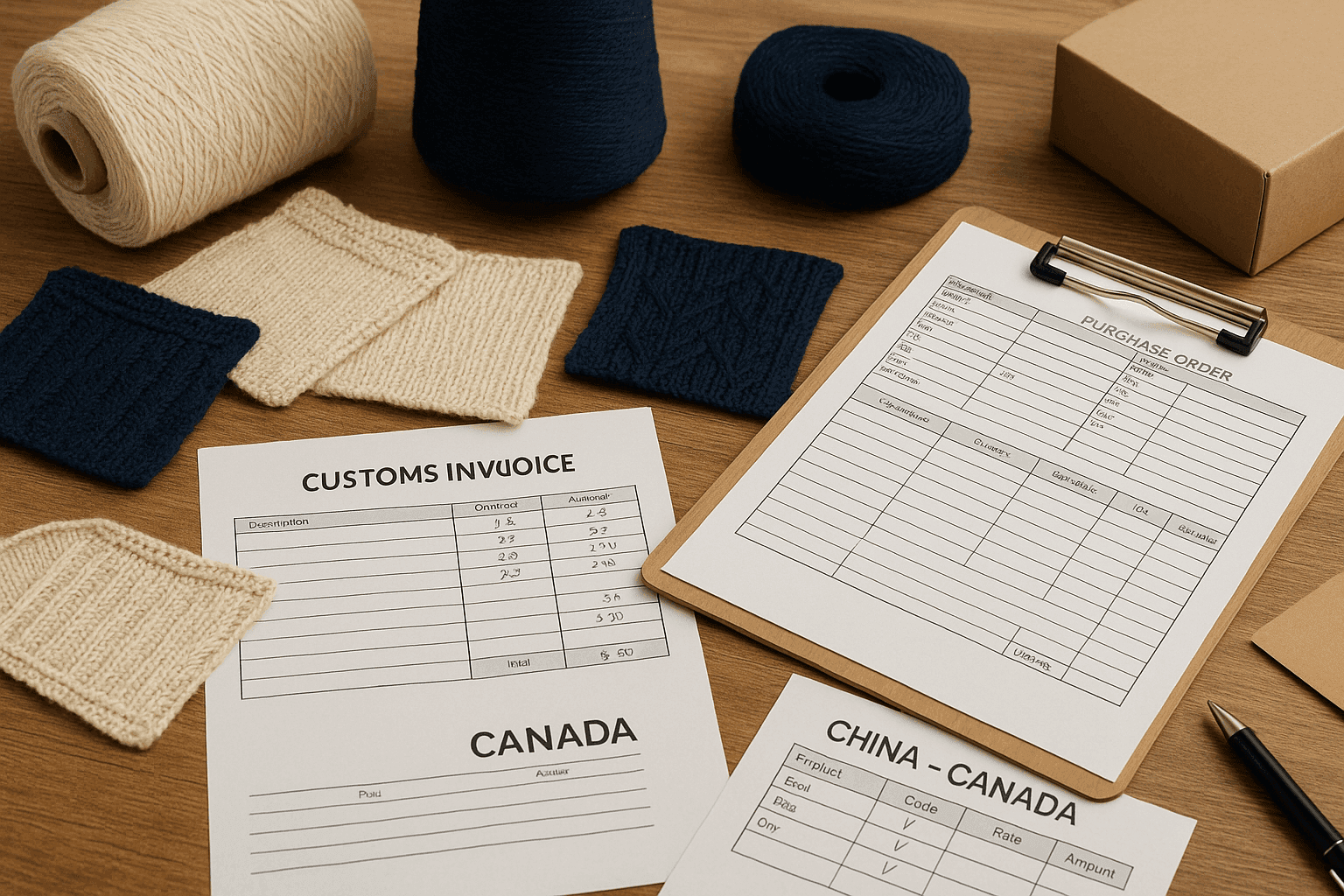
This is the section Canadian buyers ask for first when comparing quotes. The FOB number is one cost; the landed cost in Toronto or Vancouver is another. Here is how the components stack up on a representative Canada-bound knitwear shipment. The figures below are illustrative ranges we observe — buyers should confirm freight quotes and duty classification with their own broker.
The duty line is the largest single add. Most knitted sweaters fall under HS heading 6110, which carries an MFN rate of 18% on imports from China into Canada. China is not a free-trade-agreement partner with Canada, so the MFN rate applies — there is no CUSMA, CPTPP or CETA preference available on China-origin knitwear. Buyers comparing China against Vietnam should note that Vietnam is a CPTPP partner with Canada, which changes the duty math materially; we cover the production-side comparison in china-vs-vietnam-vs-bangladesh-knitwear-sourcing, and the landed-cost framework in knitwear-landed-cost-import-duty-freight.
Ocean transit to Vancouver from Yantian or Shenzhen runs about 14-18 days port-to-port, plus 3-5 days for customs clearance and inland. Toronto via Halifax or via Vancouver-and-rail adds roughly a week. Air freight at 3-5 days is available for samples and emergency replenishment but moves the per-piece freight line from cents to several dollars; we use it for protos and salesman samples, rarely for bulk.
Incoterms convention on most Canada programs is FOB Yantian or FOB Shenzhen, with the buyer's nominated freight forwarder. CIF and DDP are available — DDP requires us to nominate a Canadian customs broker on the buyer's behalf, and the duty and GST are pre-paid into the quoted price, which is convenient for first-time importers but reduces the buyer's control over brokerage cost. We recommend FOB for any Canadian buyer with their own broker relationship, and CIF or DAP for buyers who want simplicity on first orders. how-to-read-a-knitwear-quotation covers how Incoterms change the line items on a quote.
---
Talk to our team about this
If you're planning a real project around any of the points above, we'd be glad to take a quick look. Send a short brief and we'll come back within one business day with a practical direction, MOQ + lead time estimate, and a sample plan if it makes sense.
Most knitted sweaters fall under HS heading 6110 and attract Canada's MFN (Most-Favoured-Nation) duty rate of 18% on imports from China. China is not a free-trade partner under CUSMA, CPTPP or CETA, so no preferential rate is available on China-origin knitwear. GST of 5% then applies on the duty-paid value. Buyers should confirm the exact HS subheading for each style with their licensed Canadian customs broker — fibre content, gender, and construction can shift the classification within heading 6110.
Ocean transit from the Yantian or Shenzhen container ports to Vancouver runs about 14-18 days port-to-port, plus 3-5 days for customs clearance and inland trucking to a Vancouver-area 3PL. Toronto via the all-water Halifax route or via Vancouver plus rail typically lands 28-35 days port-to-port. Add our 30-45 day bulk production lead time before ex-factory, and a Canadian buyer should plan a 75-90 day window from PO confirmation to cartons-on-the-dock for an ocean shipment.
Our catalogue MOQ is typically 30 pieces per colour, which works well for the smaller Canadian brand sizes we see. A four-style capsule with two colourways per style at 60-100 pieces per colour comfortably hits MOQ and delivers enough size depth for a DTC or boutique launch. Custom yarn dyeing pushes the per-colour minimum higher because yarn mills run minimum dye batches, so first orders are often easier to plan around our stock-dyed yarn options.
Yes. Canadian textile labelling rules require care instructions and fibre content to appear in both English and French on goods sold at retail in Canada. We produce bilingual woven care labels and bilingual hangtags at the factory rather than asking the brand to relabel cartons in Canada — it is faster and cheaper to print correctly the first time. Buyers send the French translation with the tech pack; if it is missing we flag it before PP sample approval so bulk does not start with the wrong label.
Most Canadian buyers with an established broker relationship are best served by FOB Yantian or FOB Shenzhen — they keep control over freight costs, customs brokerage and duty drawback opportunities. DDP suits first-time importers who want a single landed price and are willing to pay a modest premium for simplicity. CIF or DAP sits in between: we handle ocean freight and insurance to the port or named destination, the buyer's broker handles clearance and duty. We can quote any of these on request.
We focus on men's sweaters, cardigans, knit jackets, jacquard knitwear and private label knitwear. We support B2B buyers with OEM/ODM development, sampling and bulk production planning.
MOQ, lead time, cost ranges, gauge selection and QC checkpoints across typical OEM/ODM knitwear programs in NA + EU. Enter your email — we'll send you the report link in 30 seconds.
No spam. Unsubscribe with one reply. We use your email only to send you the report and follow up if you want a sourcing conversation.
Brands We've Worked With
Brand names shown are previously serviced OEM/ODM partners. Logos are decorative and do not imply current endorsement.