Sourcing Men's Knitwear for US East Coast vs West Coast Buyers
Updated 8/24/202612 min readBy Simon Liu · Licheng Knitwear
US knitwear sourcing is rarely a single market. Buyers based on the East Coast and West Coast operate under different climates, freight gateways, retail rhythms and aesthetic expectations, and those differences shape the men's sweater, cardigan and knit jacket assortments we develop with them. At Licheng Knitwear, we work with US apparel brands shipping into both LA/Long Beach and New York/New Jersey, and we plan production calendars, gauges and packaging accordingly. This guide breaks down what changes — and what doesn't — when you move a US knitwear program from one coast to the other, covering sample lead time, bulk lead time, MOQ, yarn direction, gauge mix, QC, payment and Incoterms. It is written for sourcing managers, founders and merchandisers comparing a coastal anchor point for their next men's knit drop.
The United States is not one knitwear market. The men's sweater program a brand runs out of Brooklyn looks different — in gauge, in yarn, in delivery timing, sometimes in packaging — from the program a brand runs out of Los Angeles. At Licheng Knitwear, founded in 2018 and based in Dongguan, Guangdong, we ship to US buyers on both coasts, and the calendar, freight routing and aesthetic mix we plan with them rarely overlap perfectly.
This article walks through how we think about US knitwear sourcing when the buyer's center of gravity is East Coast versus West Coast. It is meant for sourcing managers, founders and merchandisers deciding which gateway to anchor on, how to time their drops, and how to brief a Chinese knitwear manufacturer so the assortment lands right for their actual customer.
Why the US Market Splits Along Coastal Lines for Knitwear
Common Questions
Ready to Start Your Project?
Get a free catalog or submit an RFQ today. Our team will respond within 24 hours.
Does the choice of US coast actually change lead time?
Yes. Ocean transit from China is materially shorter to west coast ports than to east coast ports, and that difference is real weeks in a seasonal calendar. Inland distribution then runs the other way, so the right answer depends on where your fulfilment sits, not only on the port.
What MOQ should a US brand plan for?
30 pieces per colour. For a first men's knitwear programme that generally means committing to fewer colourways rather than fewer styles, since the minimum counts per colour.
Do east and west coast buyers specify differently?
In practice yes. East coast programmes skew toward heavier AW knitwear and more classical constructions; west coast programmes skew lighter and more year-round, which pushes gauge finer and pulls wool content down in favour of cotton and blends.
How should a US buyer handle duty and landed cost?
Model it before the PO. Get the classification you will be entered under from your broker and build landed cost from there; the gap between FOB and landed is where first-time programmes most often lose their margin.
What lead time should a US buyer plan for an autumn drop?
Work backwards from the floor-set date: sampling 15-25 days from confirmed yarn and artwork, then bulk, then ocean transit that differs by coast. Colour approval is the step to start first, because a dyed-to-order shade carries the mill's minimum and lead time.
For most categories of apparel, "the US" is a useful enough abstraction. For knitwear, it isn't. Climate, retail calendar and aesthetic culture all pull the two coasts apart, and those differences show up in the tech packs that arrive in our inbox.
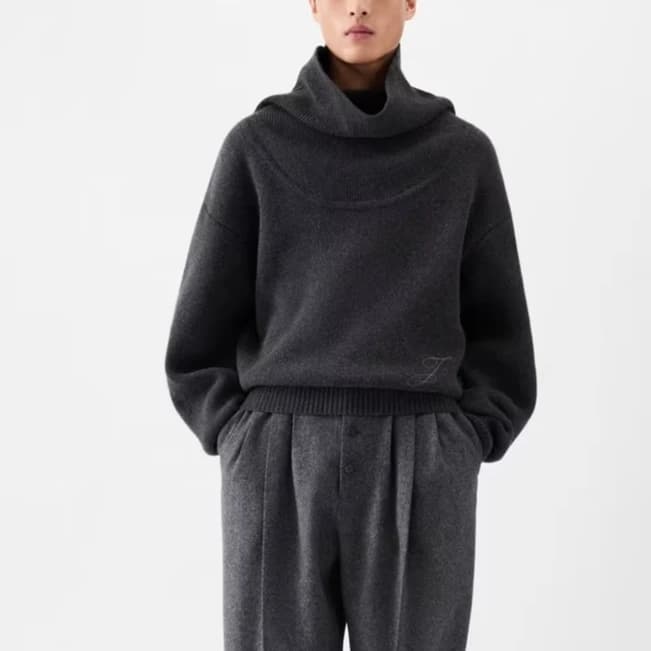
East Coast buyers — New York, Boston, Philadelphia and the wider Mid-Atlantic — sell into genuine winters. A real fall/winter sweater program there means heavier weights, more wool content, more 3GG-5GG chunky cable and Fair Isle styles, and a long selling window that can stretch from August drops into late February markdowns. The men's customer expects warmth, structure and traditional knitwear references — fisherman cable, shawl-collar cardigan, full-zip wool jacket.
West Coast buyers — Los Angeles, San Francisco, the Pacific Northwest excepted — sell into a much milder climate. Knitwear there is often layering knitwear: 7GG and 12GG fine-gauge cotton-blend crew necks, knit polos, half-zip mid-weights, cardigans that work as a light jacket. Drops come earlier in the season and the on-floor window is shorter. The aesthetic skews to relaxed silhouettes, washed and earth-tone palettes, surface texture rather than heavy hand.
These are observed patterns from our own US buyer mix, not statistical claims about the entire market. But they are consistent enough that we plan around them when a new US program comes in.
Sample Lead Time and Bulk Production Realities
The production calendar is the same regardless of which coast a buyer ships to: samples take 7-25 days depending on complexity, and bulk takes 30-45 days after order confirmation and material readiness. What changes is how those windows interact with each coast's retail rhythm.
For an East Coast fall/winter sweater program, the late-season cutoff is forgiving. A buyer can place bulk in July, ship in September and still hit a meaningful selling window into January. We typically encourage East Coast buyers to lock proto samples in March-April and SMS in May, which leaves runway for re-development if a yarn direction or gauge needs to change.
For a West Coast buyer running an earlier, narrower window, the calendar tightens. Mid-weight knitwear needs to be on-floor by late August at the latest in many SoCal door plans, which pushes bulk shipment to mid-July and PP samples to May. We push these buyers to confirm tech packs and yarns by February so the 7-25 day sample loop and 30-45 day bulk loop don't collide with Chinese New Year recovery in February.
For first-time US buyers especially, we encourage a short alignment call before tech packs are finalized so we can flag any coast-specific risks early — a 3GG cable destined for a late-August West Coast on-floor is a different conversation than the same style targeting a mid-October East Coast door, and catching that mismatch at brief-in saves a sampling round.
The practical implication: if a US buyer is consolidating into a single Chinese knitwear program with shipments to both coasts, we usually plan around the tighter West Coast deadline and treat the East Coast delivery as more forgiving on the back end.
MOQ and Commercial Terms by Brand Size
Licheng's catalog MOQ is typically 30 pcs per color, which is friendly for DTC and emerging brands on either coast. What differs between East and West Coast buyers, in our experience, is not the MOQ they ask for — it is the per-style depth and the color count.
East Coast buyers, particularly those with wholesale or department-store doors, tend to run deeper per-color buys on a smaller curated palette: classic camel, charcoal, navy, ecru, oxblood. Total style count is moderate but each SKU goes deeper, which lowers per-unit FOB cost and makes 5GG-7GG cable knits and 3GG-5GG chunky cardigans economically viable.
West Coast buyers more often run wider color stories with thinner per-color depth — washed pastels, sand, sage, faded denim, terracotta — and lean on 12GG fine-gauge and 7GG mid-gauge construction where MOQ is easier to absorb on a thinner yarn. We will sometimes split a style across MOQ-pooled colorways to make the math work for a smaller West Coast brand.
Dimension
Typical East Coast Buyer
Typical West Coast Buyer
Dominant gauge mix
3GG-5GG chunky, 5GG-7GG mid
7GG mid, 12GG fine
Yarn lean
Wool, wool/cotton, wool-alpaca
Cotton, cotton/cashmere, cotton blends
Per-color depth
Deeper, fewer colors
Shallower, more colors
Catalog MOQ baseline
30 pcs/color
30 pcs/color
FW on-floor target
Late Aug - early Oct
Mid Aug - early Sep
Preferred US ocean gateway
NY/NJ, Norfolk, Savannah
LA/Long Beach, Oakland, Seattle-Tacoma
Typical Incoterm request
FOB Shenzhen / Yantian
FOB Shenzhen / Yantian
Markdown discipline
Longer in-season window
Shorter, earlier markdown
For first orders from either coast, we recommend treating the trial buy as a learning round rather than a margin round — MOQ at minimum, two to three core styles, one to two colors per style — and reserving the next order for the assortment expansion.
Yarn and Gauge Directions Each Coast Tends to Favor
The gauge and yarn split is the single biggest tell of which coast a tech pack came from. We use the gauge spectrum from 3GG through 18GG, with 5GG, 7GG and 12GG being the most common in our production. Each coast leans into a different part of that range.
East Coast men's knitwear programs lean wool-heavy: wool blends, wool/cotton, wool/alpaca, merino for premium positioning, and occasional cashmere or cashmere-blend pieces for elevated drops. Chunky cable, shawl-collar cardigans, Fair Isle and Nordic patterns and brushed mohair all sit naturally in this assortment.
West Coast men's knitwear programs lean cotton-forward and lighter: cotton blends, cotton/cashmere for premium softness, fine-gauge merino as a four-season option, and surface-texture stitches — waffle, ribbed, boucle, light cable — rather than heavy structural knit. Knit polos and half-zip sweaters perform especially well as transitional layering pieces.
We cover the gauge logic in detail in our gauge and yarn guides, and the underlying decisions are the same on either coast — only the weighting changes.
Quality Control and Compliance Considerations
QC standards are not negotiable by coast — both coasts get the same inline checks, AQL final inspection and needle and metal detection on every shipment. What does differ is the kind of compliance question that comes up at brief-in.
East Coast buyers, particularly those selling into wholesale and department stores, more often ask up front about supply-chain documentation, social-compliance audit history and chain-of-custody for recycled or responsible-wool yarns. Compliance documents are available on request and are not displayed publicly on our site.
West Coast buyers, particularly DTC and emerging brands, more often focus on California-specific consumer-facing compliance — care label content in English (and sometimes Spanish), accurate fiber-content disclosure under FTC rules, and Prop 65 awareness where relevant trims are involved. We handle care labeling per the buyer's destination market on every order.
Bulk packaging is another point where coasts diverge in practice. East Coast wholesale orders frequently need GS1 barcode labels, polybag-per-piece with brand artwork, and master-carton labeling in a format the buyer's DC scanners will accept. West Coast DTC orders more often arrive in plain polybag and rely on the brand's 3PL to repack, which trims per-unit packaging cost but pushes that cost downstream. Either model works on our end; we cost it transparently in the quote rather than burying it.
For either coast, we recommend buyers brief their compliance asks at tech-pack stage, not at PP-sample stage, so QC and documentation flow alongside production rather than chasing it.
Logistics, Payment and Incoterms
The logistics gap between East and West Coast is the most concrete part of the comparison. Shipping FOB China from Shenzhen or Yantian, a full container will typically reach LA/Long Beach in roughly two to three weeks transit and the New York/New Jersey range in four to five weeks via Panama Canal routing. LCL groupage adds further consolidation time on both routes.
For West Coast buyers, that shorter transit makes ocean a practical default even for second-season reorders. Air freight is reserved for late approvals or sample-on-rack situations.
For East Coast buyers, the longer transit pushes the calendar further left. We routinely advise East Coast brands to add a full week of buffer to their on-water estimate, and to confirm whether they want Panama routing to NY/NJ or a West Coast landing with intermodal rail to East Coast distribution. Either works, but the cost and timing differ enough that the choice belongs in the cost sheet, not in a footnote.
The freight-forwarder choice also matters more than buyers sometimes expect. East Coast brands routinely save real money by comparing all-water Panama service against a West Coast landing with rail or trucking to the final DC, and the right answer depends on the buyer's DC location and the inventory profile of the season. We can prepare a per-style carton-out report with cubed dimensions and weights so the buyer's forwarder can quote both options accurately.
Incoterms requests from US buyers are heavily concentrated on FOB Shenzhen or FOB Yantian — the buyer's freight forwarder takes over from there. We will quote CIF or DDP when asked, but we are transparent that our pricing strength is at FOB and that buyer-nominated freight usually beats ours on US lanes.
On the documentation side, we provide a standard commercial invoice, packing list, certificate of origin and bill of lading set with every shipment, and we coordinate with the buyer's customs broker on HTS codes and any free-trade-agreement documentation where applicable. We also handle the China-export filings as a matter of course.
Payment terms are consistent regardless of coast: a deposit at order confirmation and balance before shipment is the standard for new accounts, with terms that loosen on repeat business. We talk through cash-flow planning in our payment-terms article and we are open about what flexibility we can extend to established US accounts.
The takeaway across both coasts is the same: US knitwear sourcing works best when the buyer treats the coast as a real variable — not a label — and briefs us with that variable already factored in. Climate, gauge, yarn, calendar and gateway all move together, and the program lands better when we plan them together from the start.
---
Talk to our team about this
If you're planning a real project around any of the points above, we'd be glad to take a quick look. Send a short brief and we'll come back within one business day with a practical direction, MOQ + lead time estimate, and a sample plan if it makes sense.
No. Our FOB price is set at the factory gate in China and does not change based on the buyer's US destination. What changes is the buyer's downstream freight and inland-haul cost. We quote FOB Shenzhen or FOB Yantian and the buyer's forwarder routes from there — LA/Long Beach for West Coast buyers, NY/NJ, Norfolk or Savannah for East Coast buyers.
Plan on 7-25 days for sample development, then 30-45 days for bulk after order confirmation and material readiness. Add ocean transit of about 2-3 weeks to West Coast US ports or 4-5 weeks to East Coast US ports via Panama. For a fall/winter program, that means tech-pack confirmation by late winter is realistic, and earlier for tight West Coast on-floor dates.
Yes, and many of our US buyers do exactly this. We typically plan the calendar against the tighter West Coast on-floor deadline and use the longer East Coast in-season window as the more forgiving back-end. Production happens once; the buyer's forwarder handles the split between US ports.
Across our US buyer mix, 7GG and 12GG dominate fine-and-mid-gauge programs (more West Coast-leaning), while 5GG and 3GG-5GG chunky drive heavier fall/winter pieces (more East Coast-leaning). We support 3GG through 18GG and confirm gauge per design at sample stage.
Yes. We produce care labels in the buyer's required content and language, including the fiber-content disclosure expected under US FTC rules. Labeling is briefed at tech-pack stage and confirmed at PP sample. Compliance documents are available on request and are not displayed publicly.
We focus on men's sweaters, cardigans, knit jackets, jacquard knitwear and private label knitwear. We support B2B buyers with OEM/ODM development, sampling and bulk production planning.