Cardigan Sourcing for AW27: What 71 Published Styles Show About Gauge, Closure and Cost
Updated 10/9/202612 min readBy Simon Liu · Licheng Knitwear
A cardigan direction read built from our own published range rather than runway notes: zip and button are level at 25 each on the construction field, 44 of 71 styles sit in the 7GG–12GG band, and the fibre choice moves the index median 4.4× from USD 14.98 to 66.05. What that means for AW27 booking.
Most cardigan briefs arrive describing a look. Almost none arrive describing a closure, a gauge or a target weight — and those three decide the cost, the lead time and whether the style can be reordered mid-season.
This is not a runway forecast. It is a read of our own published cardigan range: 71 styles live on lcsweater.com right now, counted rather than estimated. Where a number appears below, it comes from that count or from figures already published elsewhere on this site.
Zip and button are level — and the zip is the one that bites
Across the 71 published cardigans the closure split is close enough that how you count it changes the answer. Counting the garment name together with the construction field gives 29 zip to 26 button. Counting the construction field alone gives a dead tie at 25 each, with the balance recorded as shawl-collar, open-front or not stated.
Ready to Start Your Project?
Get a free catalog or submit an RFQ today. Our team will respond within 24 hours.
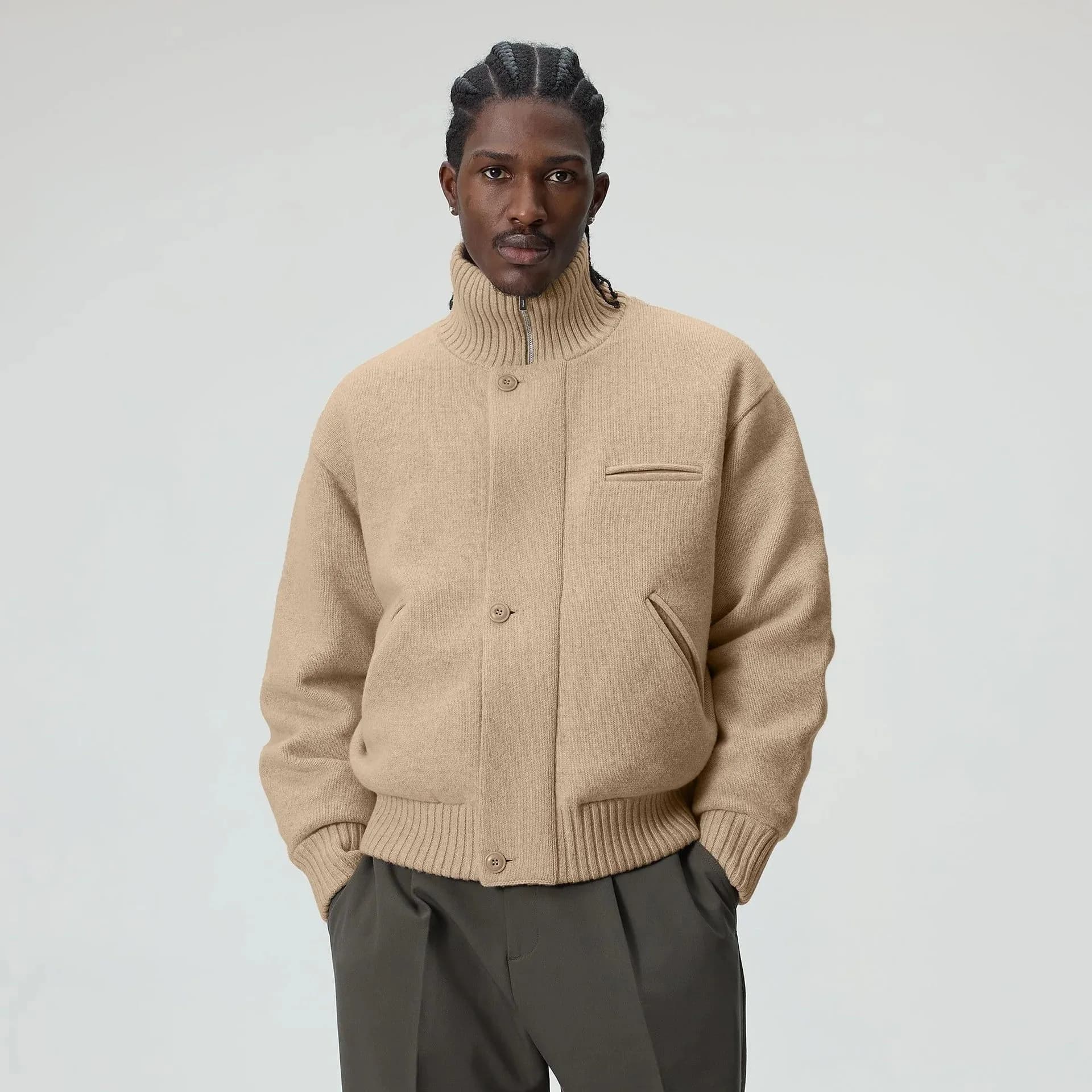
We are reporting both because the honest read is that neither has won. What is worth noticing is that a zip closure is present in roughly four of every ten cardigans we publish — which is a long way from the mid-layer cardigan that dominates trend imagery, and much closer to the cardigan-as-light-outerwear that buyers keep describing in briefs.
What it changes commercially:
A zip is a trim decision with a lead-time tail. Metal zips in a custom length or a branded puller need their own sourcing window, and that window sits *before* knitting, not after. Button-front styles have no equivalent dependency.
A zip changes the front-band construction. The band has to be knitted to a stable width and tension so the zip does not ripple after washing. On a fine gauge this is the hardest part of the garment to get right, and it is the most common reason a cardigan sample comes back looking wrong when the fabric itself is fine.
A zip is harder to grade across sizes. Zip lengths are discrete; body lengths are not. Size runs get resolved by rounding somewhere, and it is worth deciding where before sampling rather than after.
If a range carries both, the practical order is to develop the zip style first. It is the one that will surface problems.
Gauge: 44 of 71 sit in one band
Gauge band
Published styles
7GG–12GG (confirmed per design)
44
3GG–5GG (chunky)
9
7GG
6
5GG–7GG
5
12GG
3
Other / confirmed per design across the 3GG–18GG range
4
Two things are worth reading out of that distribution.
The volume sits in the middle, not at the chunky end. Heavy 3GG–5GG cardigans photograph well and dominate mood boards, but they are 9 of 71 in an actual production range. Chunky yarn is heavier per piece, slower on the machine, and more expensive to ship — a cardigan that looks like the season can cost noticeably more to land than the one that sells through.
"Confirmed per design" is not evasion. A cardigan's gauge is a consequence of the yarn count and the intended fabric weight, and quoting a band before the yarn is fixed is the honest answer. We run 3GG to 18GG in house, so the band narrows once there is a tech pack or a reference garment — not before.
One thing we will not tell you: that a finer gauge automatically costs more. It does not. 7GG and 12GG land close to each other on unit cost far more often than buyers expect — what moves the number is stitch complexity and fibre, not the gauge figure on its own.
The fibre moves the number 4.4×, not the silhouette
Our published index median for cardigans as a category is USD 19.73, at MOQ 30 per colour, FOB. That single figure is what a cardigan costs in the middle of our range — and on its own it is close to useless for budgeting, because the fibre underneath it does almost all the work.
The fibre-family medians carried on those same published cardigans:
Fibre family
Index median
Styles in our cardigan range
Cotton blend
USD 14.98
2
Wool blend
USD 17.36
46
Mohair / alpaca
USD 26.48
2
Cashmere blend
USD 31.48
7
Cashmere on a wool base
USD 66.05
1
Bottom to top that is a 4.4× range, and it is entirely a fibre decision. The silhouette does not move it. "Cardigan, AW27, mid-market" is not a costable brief; "wool-blend cardigan, 7GG–12GG, two colours" is.
Two practical readings:
46 of 58 priced cardigans are wool blend. That is where the category actually sits, and it is why USD 17.36 is a more useful planning anchor than the all-category median.
The jump to cashmere is roughly 1.8× off the wool blend, and cashmere on a wool base roughly 3.8×. If a range needs a cashmere hero, cost it as a separate line rather than as a variant of the volume style.
These are index medians from our own yarn cost index. They move with yarn prices and they are a starting point, not a quotation.
Heritage details are a minority, and that is the point
Cable and Fair Isle dominate trend coverage every autumn, and they are a small fraction of what actually ships. That is not an argument against them — it is an argument for costing them separately.
Fair Isle and jacquard change the machine time per panel and the yarn-end count. A four-colour yoke is a different garment to knit than a plain body, even when the silhouette is identical.
Cable changes the yarn consumption, because the cable pulls the fabric in and the panel has to be knitted wider to finish at the same measurement.
Both change the sampling risk. A pattern that reads well on a swatch can read as noise at garment scale, and that only shows up on a full sample.
The workable pattern in a range is a small number of pattern-led hero styles carried by plain-bodied volume styles in the same yarn, so the yarn is booked once.
Yarn: wool leads, cotton is closer than the season suggests
Across the published cardigans: wool 61 · cotton 41 · cashmere 10 · acrylic 3 · mohair 2 · merino 1 · silk 1. (Styles count in more than one row where the composition is a blend.)
Cotton appearing in the blend of 41 of 71 autumn-weight cardigans surprises people. Most of those are wool-cotton blends rather than cotton-dominant garments — our pricing classifier reads only 2 as cotton blend outright — but the cotton is doing real work. It reflects where the orders come from: transitional cardigans for markets that do not get a hard winter, and for retail floors that need an autumn story in September when the weather has not turned yet.
Sourcing reference — cardigans at a glance
MOQ
30 pieces per colour (plain and striped styles in the same yarn and colour can be combined) — the same 30 across all 71 published cardigans, chunky and Fair Isle included
25 zip · 25 button on the construction field (29 · 26 including garment names) · balance shawl/open-front
Where the volume sits
44 of 71 styles in the 7GG–12GG band
What to book now, what to hold for AW27
Book now
Zip styles and their trims. The zip is the longest-lead component in a cardigan and the only one that can hold a finished garment hostage. Confirm length, weight, tooth type and puller finish before the yarn.
Any patterned yarn. Fair Isle, jacquard and intarsia need every colour of the yarn in hand before the first correct sample. Booking these late is the most common reason an AW range slips.
Cashmere and cashmere-blend base yarn. Base-yarn choice moves the unit cost by more than any other single decision in the fibre.
Hold
Final colour beyond the pattern colours. Solid-body colours can be confirmed later without moving the critical path.
Gauge, until the fabric weight is agreed. Fixing a gauge figure first and a weight second gets the order backwards; the weight decides the gauge.
Size grading for zip styles, until the first zip sample confirms the band behaves.
How to get a usable quotation back
Send whichever of these you have — none is mandatory, and a photo alone is enough to start:
1. A reference garment or image, front and back
2. Intended fibre and rough weight (or the garment you want it to feel like)
3. Closure: zip or button, and any branding on the trim
4. Colour count and quantity per colour
5. Target landed price, if there is one
We reply with a gauge, a fibre and a price band per style, plus a sample plan. Samples run 15–25 days.
What is the minimum order for a custom cardigan?
30 pieces per colour per style. That is the figure on all 71 of our published cardigan styles, including the chunky and Fair Isle ones — the pattern does not raise the minimum.
Is a zip cardigan more expensive than a button one?
Usually a little, and the difference is in the trim and the front-band construction rather than the knitting. The bigger practical difference is lead time: a custom zip has to be sourced before knitting begins.
Does a finer gauge cost more?
Not reliably. 7GG and 12GG often land close together on unit cost. What moves the price is stitch complexity, fibre and colour count — the gauge number alone is a poor predictor.
How much does a custom cardigan cost?
Our published FOB floors run from USD 14.98 for cotton blends to USD 31.48 for cashmere blends, and the highest cardigan in our range is USD 66.05. Expect a spread of roughly 4× inside the category depending on fibre and pattern.
How long does an AW27 cardigan programme take?
Samples 15–25 days, bulk 30–45 days after approval, then freight. Working back from a store date, three to four months for a first order is realistic; patterned yarn should be booked earlier than that.
Can you match a reference cardigan I already have?
Yes — a physical reference is the fastest brief there is. Send the garment or clear photos of the front, back and the front band, and we will come back with the gauge, a fibre proposal and a price band.
They are level. On the construction field alone it is 25 zip and 25 button; counting garment names as well it is 29 zip and 26 button, with the balance shawl-collar or open-front.
44 of our 71 published cardigans sit in the 7GG-12GG band. Chunky 3GG-5GG cardigans dominate mood boards but are only 9 of 71 in the actual range.
Zip styles and their trims, any patterned yarn for Fair Isle, jacquard or intarsia, and cashmere or cashmere-blend base yarn. Solid-body colours beyond the pattern colours can be confirmed later without moving the critical path.
Because it is the one that surfaces problems. A custom zip has its own sourcing window before knitting, the front band has to be knitted to a stable width and tension so the zip does not ripple after washing, and zip lengths are discrete, so size runs have to be rounded somewhere.
Wool blend: 46 of the 58 priced cardigans in our range, at a published index median of USD 17.36. That is a more useful planning anchor than the all-cardigan median of USD 19.73.
We focus on men's sweaters, cardigans, knit jackets, jacquard knitwear and private label knitwear. We support B2B buyers with OEM/ODM development, sampling and bulk production planning.
B2B Knitwear Manufacturer | OEM/ODM & Private Label | Exporting Worldwide to North America & EuropeEmail: info@lcgarment.cn | Tel: +86 151 7024 4792
MOQ, lead time, cost ranges, gauge selection and QC checkpoints across typical OEM/ODM knitwear programs in NA + EU. Enter your email — we'll send you the report link in 30 seconds.
No spam. Unsubscribe with one reply. We use your email only to send you the report and follow up if you want a sourcing conversation.
Brand names shown are previously serviced OEM/ODM partners. Logos are decorative and do not imply current endorsement.