Custom Knit Accessories: What 30 Published Styles Say About Gauge, Sizing and Cost
Updated 10/13/202612 min readBy Simon Liu · Licheng Knitwear
An accessory sourcing read counted from our own published range: 13 of 30 styles are 12GG or finer - the opposite balance to our garment book - 18 are one size, and the USD 2.83 category median is a range-level figure that should never be used as a per-style price.
Accessories are usually the last line added to a knitwear range and the first one costed badly. They get treated as filler — a hat to round out the lookbook — and then the sock sizing, the glove grading and the gift packaging all turn up as surprises after the price has been agreed.
This is a count of our own published accessory range: 30 styles live on lcsweater.com right now, across hats, scarves, gloves, socks, blankets and berets. Every figure below comes from that count.
The gauge balance is the opposite of our garment book
Gauge band
Styles
3GG – 5GG (chunky)
10
7GG – 12GG
7
12GG and finer
13
13 of 30 accessory styles are 12GG or finer — the largest band here. In our menswear book, fine gauge is only about 4% of the range. The reason is the product mix: every sock in the range is 12GG, and fine scarves and liner gloves sit there too. Chunky 3GG–5GG covers beanies, wrap scarves and blankets at the other end.
This matters commercially because fine-gauge and chunky-gauge work compete for different machine time. If a range carries both a chunky throw and a 12GG sock programme, they do not queue behind each other — which is one of the few places accessories are easier to plan than garments.
Sizing is simpler than you think, except where it is not
Size basis
Styles
One size (custom sizing on request)
18
Adult S/M/L
6
Standard 120×150 cm blankets/throws
6
18 of 30 styles are one size. That removes the grading work, the size-run risk and most of the forecasting problem that makes a garment programme hard — a genuine reason to add accessories rather than another sweater.
The exception is socks and gloves. Both are graded S/M/L in our range and both have to actually fit, because a sock that is a size out is unwearable in a way an oversized beanie never is. Treat those two as garments, not as accessories, when you plan them.
Fibre spread: the same ladder as our garments, compressed
Counted across the 30 published styles: wool in 13, cotton in 7, acrylic in 6, cashmere in 5, nylon in 4, merino in 4, plus alpaca, lambswool, bamboo viscose, chenille and recycled wool on individual styles.
Two observations from that spread:
Nylon and polyamide appear more often than in our garment range. Four styles carry nylon and several socks carry polyamide, because a sock or a glove takes abrasion a sweater never does. If a supplier quotes you a 100% natural-fibre sock, ask about the reinforcement at heel and toe.
Cashmere shows up on 5 of 30. Accessories are where cashmere earns its place in a range: a cashmere beanie or a lined glove puts the fibre on the shelf at a fraction of what a cashmere sweater costs the customer, which is why gift ranges lean on them.
What the published range actually contains
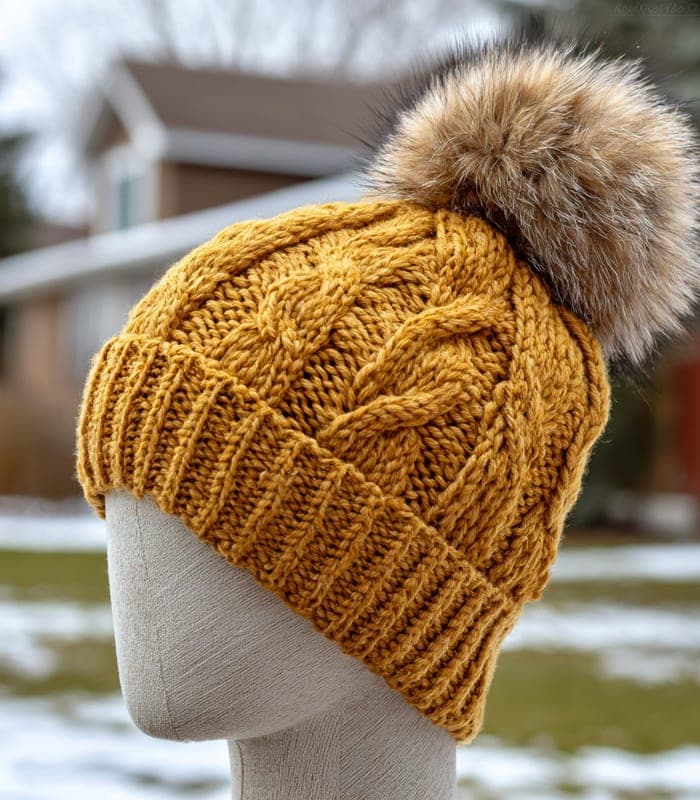
Hats and berets — chunky cable pom-pom, slouchy striped, cashmere beanie, extra-fine merino beret, an animal-ear beanie
Hybrid — a convertible balaclava-hood in merino-nylon
Costing: which of our published numbers to actually use
Our published index median for accessories is USD 2.83 per piece, FOB, at MOQ 30 per colour — by a wide margin the lowest entry point in our catalogue.
But read that number with the same care we would want you to apply to any median. It is the median across the whole accessory range, and that range runs from a cotton sock to a cashmere travel blanket. Socks pull it down; a cashmere wrap sits far above it.
Our product pages also print a yarn-family median beside it — USD 17.36 for a wool blend, USD 31.48 for a cashmere blend, USD 66.05 for cashmere on a wool base. Those are catalogue-wide figures for that yarn across all garment types, not the price of the accessory on the page. A cashmere beanie is not a USD 31.48 piece and it is not a USD 2.83 piece.
The workable rule: use USD 2.83 to sanity-check whether an accessory line fits your margin model at all, then quote each style individually. For anything in cashmere, alpaca or merino, go straight to a per-style quote.
The two mistakes that cost the most
Deciding packaging after the price. Gift boxes, belly bands and header cards for socks and gloves are a material share of the unit cost at this price point — at USD 2.83 a piece, a printed box can cost more than the product. Quote them with the piece, not after.
Running the accessory separately from the garment programme. If a hat is meant to match a sweater, it has to be booked on the same yarn and the same lab dips. Splitting them across lots is the single most common reason a matching set reads as two different shades on the shop floor — and nobody notices until it is on the rail.
Sourcing reference — knit accessories at a glance
Published accessory styles
30
MOQ
30 pieces per colour (plain and striped styles in the same yarn and colour can be combined) — same as our garment range
Category index median
USD 2.83/pc FOB at MOQ 30 — a range-level figure, not a per-style price
Gauge range in house
3GG–18GG · 13 of 30 accessory styles at 12GG or finer
Sizing
18 styles one size · 6 graded Adult S/M/L · blankets 120×150 cm
Sample lead time
15–25 days from confirmed tech pack and yarn
Bulk lead time
30–45 days after sample approval
If you are adding an accessory line, the cheapest way to do it well is to book it on a yarn you are already using. Browse the published accessory range, request a quote, or send a photo of the reference piece on WhatsApp.
30 pieces per colour, the same as our garment range, even though the unit value is far lower. 18 of our 30 published accessory styles are one size, so that minimum covers the whole style rather than being split across a size run.
Our published accessory index median is USD 2.83 per piece FOB at MOQ 30 - the lowest entry point in our catalogue. Read it as a range-level figure: it spans a cotton sock to a cashmere travel blanket. Our product pages also print a yarn-family median beside it, and that figure is a catalogue-wide median for that yarn across all garment types, not the price of the accessory. Use USD 2.83 to sanity-check whether the line fits your margin model, then quote each style individually.
Finer than our garments. 13 of 30 published accessory styles are 12GG or above - every sock in the range is 12GG, along with fine scarves and liner gloves. 10 styles are chunky 3GG-5GG for beanies, wrap scarves and blankets, and 7 sit at 7GG-12GG. For comparison, fine gauge is only about 4% of our menswear range.
Hats and berets, scarves and wraps, gloves and mittens, socks, blankets and throws, plus hybrids such as a convertible balaclava-hood. Blankets run to a standard 120x150 cm with custom sizes on request. Socks and gloves are graded Adult S/M/L and should be planned like garments rather than like accessories, because a sock a size out is unwearable.
Yes, and they should be booked on the same yarn and the same lab dips. Running the accessory separately is the most common reason a matching hat and sweater read as two different shades on the shop floor, and it is usually noticed only once the product is on the rail.
We focus on men's sweaters, cardigans, knit jackets, jacquard knitwear and private label knitwear. We support B2B buyers with OEM/ODM development, sampling and bulk production planning.
Ready to Start Your Project?
Get a free catalog or submit an RFQ today. Our team will respond within 24 hours.
MOQ, lead time, cost ranges, gauge selection and QC checkpoints across typical OEM/ODM knitwear programs in NA + EU. Enter your email — we'll send you the report link in 30 seconds.
No spam. Unsubscribe with one reply. We use your email only to send you the report and follow up if you want a sourcing conversation.
Brand names shown are previously serviced OEM/ODM partners. Logos are decorative and do not imply current endorsement.