Nordic apparel buyers have a particular relationship with winter knitwear. The end customer is wearing the garment in real weather — cycling commutes in Copenhagen, weekend hikes outside Bergen, school runs in Helsinki at minus fifteen degrees Celsius. That changes the specification conversation from the first call. At Licheng, our Nordic accounts ask narrower, more technical questions than buyers from milder markets, and they expect the factory to push back when something is wrong. This guide collects the patterns we have observed working with Nordic outdoor and lifestyle brands sourcing wool blend winter knits, and what we recommend buyers in Sweden, Denmark, Norway, Finland and Iceland confirm before signing off on bulk.
Why The Nordic Market Matters For Knitwear Sourcing
The Nordic region is small in headcount — roughly 27 million people across the five countries — but the per-capita spend on outerwear and quality knitwear is among the highest globally. The buying culture is also unusually consolidated. Nordic procurement teams tend to work with a short list of trusted suppliers across multiple seasons rather than re-tendering every order, which means the first programme is effectively an audition for a multi-year relationship.
For a manufacturer, that has two practical consequences. First, sample quality has to be right early — a Nordic buyer will rarely give you three chances. Second, the commercial assumptions imported from larger markets do not always apply. Nordic brands are often smaller-volume but higher-margin, so a 30 pieces per colour catalogue MOQ is genuinely useful to them; a 500-piece minimum is not. Our experience is that the procurement teams we work with read tech packs carefully, ask specific questions about construction and finishing, and expect the factory to flag risk early rather than discover it at the PP sample stage.
The product itself sits in a defined zone: wool-led, structured, often heavier gauge, with a strong design vocabulary inherited from Fair Isle, Aran, Lopi and modernist Scandinavian knitwear. Pure decoration is out. Pattern, texture and yarn choice are expected to do work — visual, thermal and tactile — at the same time. Our Fair Isle and Nordic pattern knitwear guide covers the pattern construction side in more depth. From a manufacturing standpoint, Licheng has been operating since 2018 out of Dongguan in Guangdong, China, and the OEM/ODM mix we run on a typical month skews heavier toward wool and wool blends in the months leading into Northern Hemisphere autumn and winter.
Sample Lead Time And Bulk Production Realities
Sample Lead Time And Bulk Production Realities
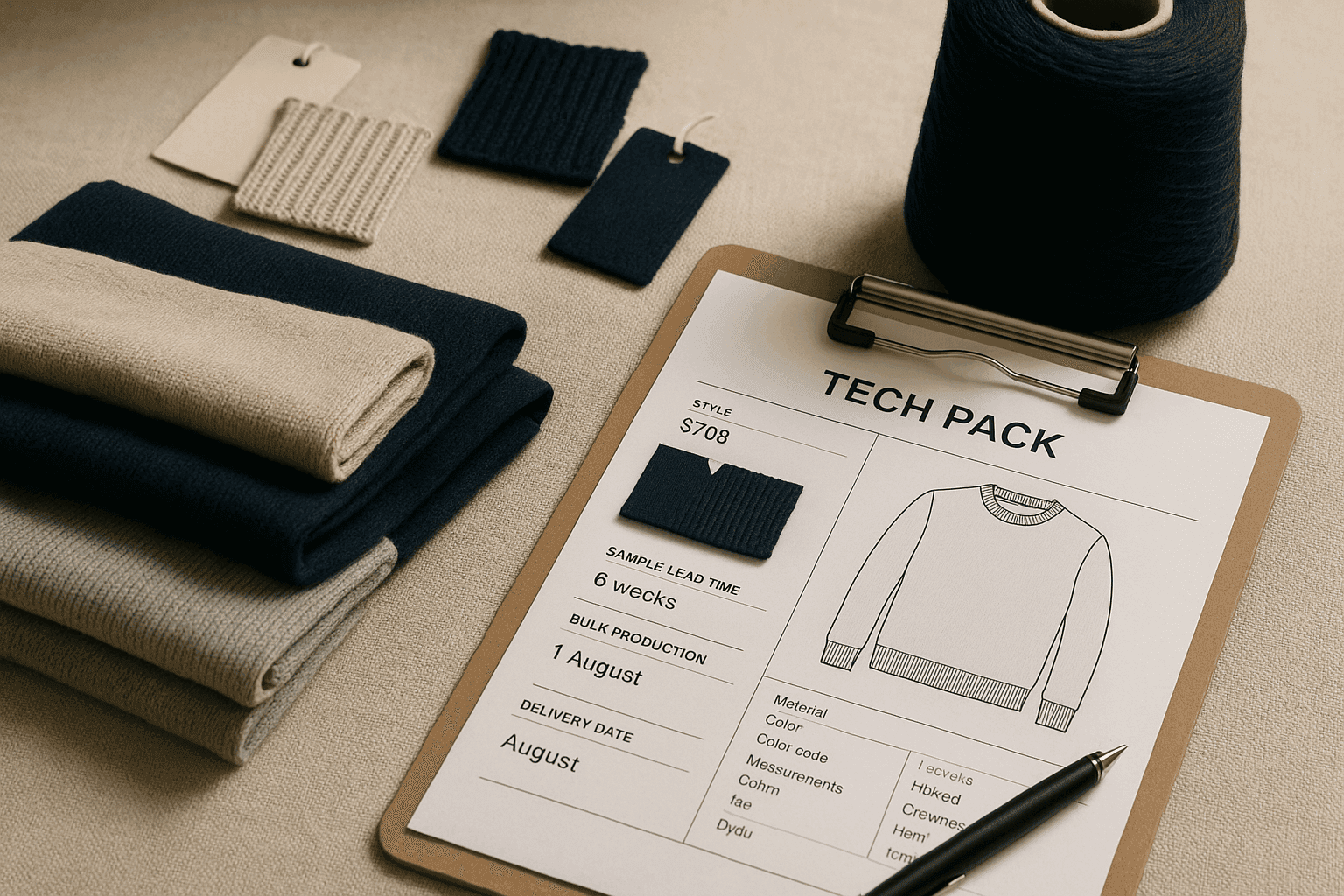
Nordic FW launches typically front-load deliveries between July and early September, with reorder windows running through November. Working backward from a 1 August store delivery into Stockholm or Oslo, the real procurement calendar looks tight, and the schedule depends on three honest numbers.
At Licheng our published lead times are:
Sample lead time: 7–25 days, depending on yarn availability, gauge, pattern complexity and how many revisions a design needs.
Bulk lead time: 30–45 days from approved PP (pre-production) sample and confirmed PO, again depending on gauge, colour count and finishing.
For Nordic wool programmes specifically, plan toward the upper end. Heavier-gauge structures (3GG–5GG chunky knits, fisherman cables, dense jacquards) take longer on the machine and more time in linking and hand-finishing than fine 12GG jersey. A 3GG chunky cardigan with shawl collar and horn buttons is not the same production unit as a 12GG plain crew.
A realistic Nordic FW calendar from a factory's side:
February: tech pack lock and yarn sourcing kicked off
March: first samples (proto + lab dips)
April: fit/PP samples and bulk yarn ordered
May: bulk PO confirmed, bulk production starts
June: production, finishing, AQL inspection
Early July: ex-works / FOB Shenzhen, then ocean freight
Mid-August: arrival at Nordic warehouse
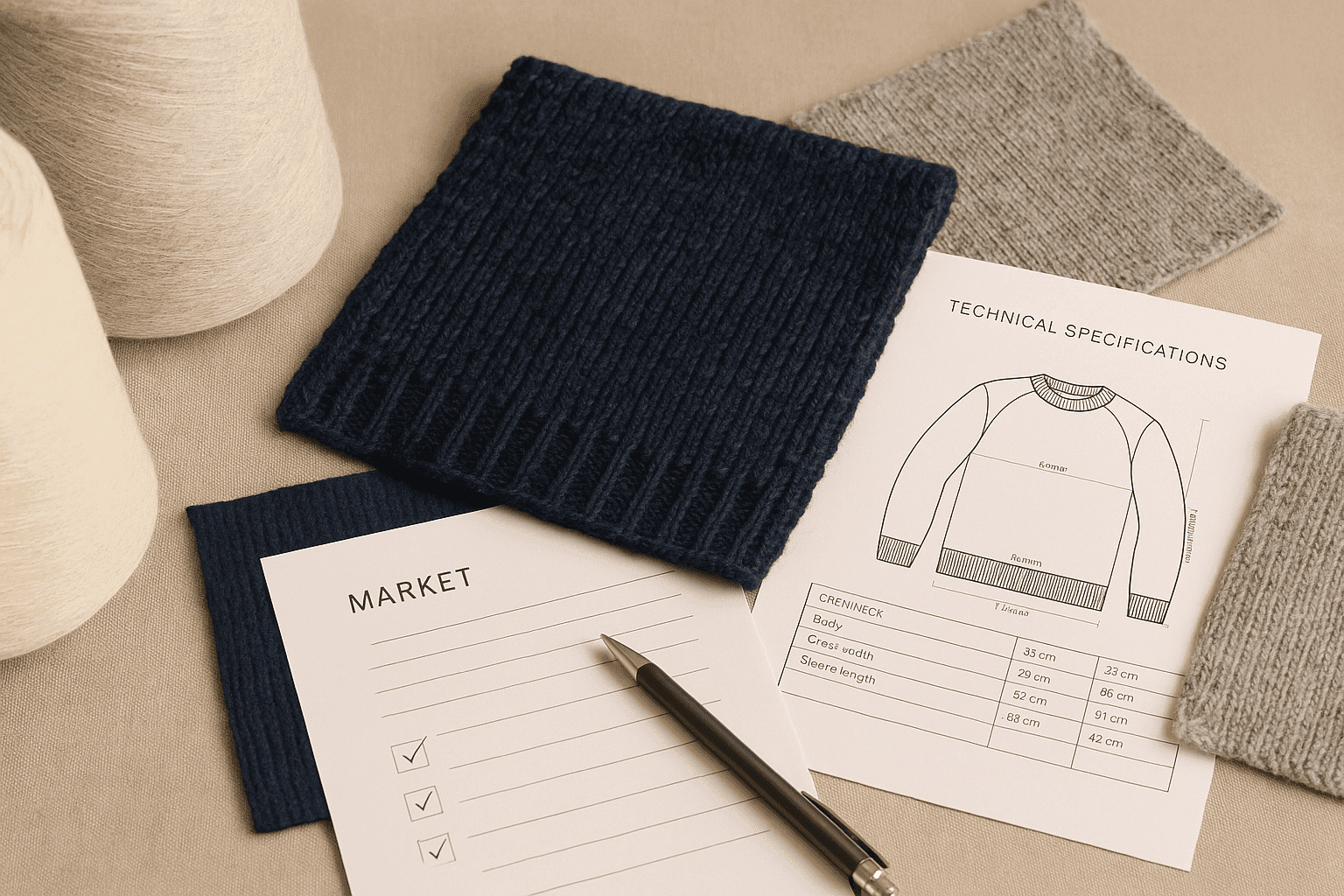
If the buyer signs off the design only in April, hitting an August delivery by sea becomes very tight. For more on building the timeline, see our seasonal knitwear planning guide and the sweater sampling lead time guide. We also recommend building one buffer week into the calendar for lab dip and strike-off approval rounds, which is where Nordic accounts tend to be more demanding than average and where extra time pays off in the final product.
MOQ And Commercial Terms For Nordic Brand Sizes
Many Nordic outdoor and lifestyle brands are independent or founder-led, with annual collection volumes in the low thousands rather than tens of thousands. That makes MOQ a real conversation rather than a formality.
Our catalogue MOQ is typically 30 pieces per colour. For full custom development with a custom yarn or specific dye lot, MOQ scales up — usually because the yarn mill has its own minimum dye-lot quantity. As a practical guide for a Nordic brand launching a focused FW capsule:
Catalogue or near-catalogue construction with stock yarn: 30 pcs/colour, size run XS–3XL.
Custom pattern (Fair Isle, intarsia, jacquard) in a stock yarn palette: typically 100–150 pcs/colour to amortise programming and sampling.
Full custom yarn (specific micron merino, recycled blend, exclusive marl): yarn mill minimums usually push to 200–300 pcs/colour at least.
We accept OEM (your tech pack), ODM (we adapt one of our development blocks) and private label arrangements. Brand label, neck label and care label can be your own from the first PO; for hangtags and packaging we can either follow your supplied artwork or quote a small-volume print partner. The private label knitwear packaging guide walks through what to specify. For Nordic accounts we encourage planning the size curve from XS to 3XL based on the actual end consumer rather than a flat per-size split, because a brand pitched at outdoor men's audiences will skew very differently to a unisex lifestyle line.
Yarn And Gauge Directions Nordic Buyers Favour
This is where Nordic specifications diverge most sharply from milder-climate markets. The yarn brief is rarely just "wool blend" — it is a specific weight and hand for a specific use occasion.
Nordic use case
Typical gauge
Yarn direction we run
Notes
Heavy outdoor / fisherman cable
3GG–5GG
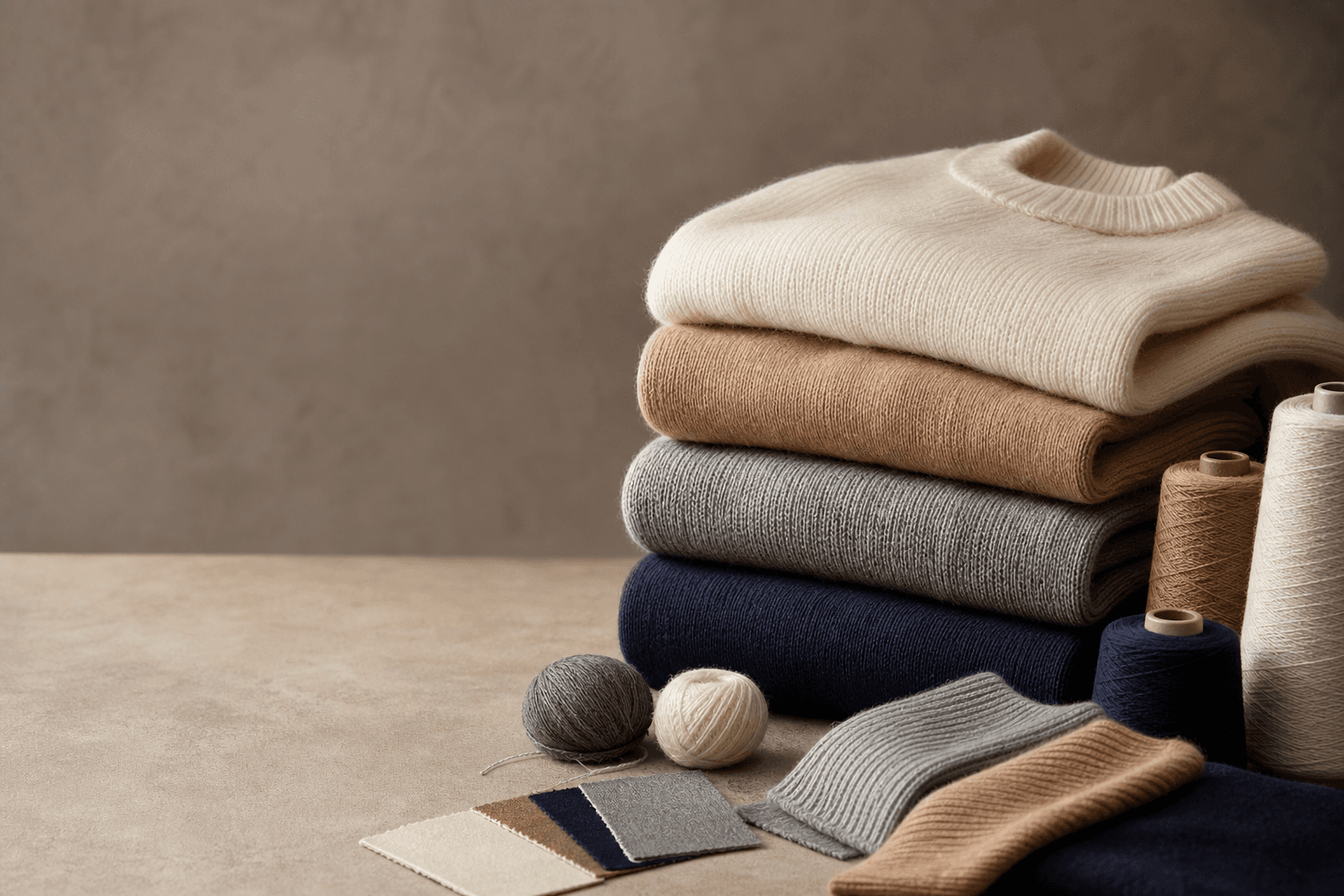
Wool blend or wool/alpaca, 200–280 g/m² fabric weight
Lower-itch, easier to label as next-to-skin comfort
Premium next-to-skin base layer adjacent
12GG
Fine merino, 17.5–18.5 micron
Plain jersey or fine rib; demanding finishing
Cardigan / heritage outerwear hybrid
5GG–7GG
Wool/cotton blend with structure
Easier care, less shrinkage risk
Fair Isle / Nordic jacquard pullover
7GG
Wool blend, 2–3 yarn colour jacquard
Floats need clean linking; rear of fabric matters
Brushed mohair statement piece
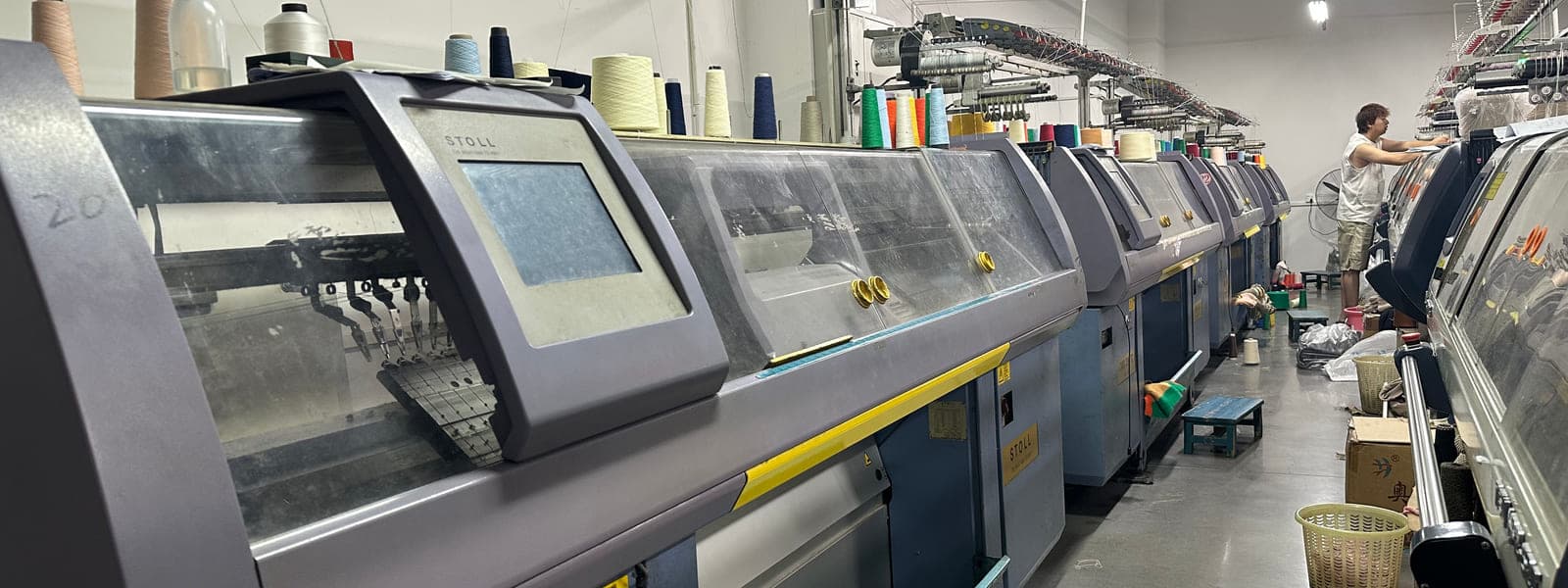
We run 3GG to 18GG in-house, with 5GG, 7GG and 12GG covering the majority of Nordic FW orders. A few practical notes from our floor:
True chunky 3GG–5GG is heavier and pricier than buyers sometimes assume — both the yarn and the labour content increase, and freight cost per piece rises with weight.
Merino at 18.5 micron is the sensible default for next-to-skin Nordic styles; pushing below 17.5 micron is a premium positioning choice and a different yarn cost band entirely.
For Fair Isle, plan colour count carefully. Each additional yarn carrier adds machine time and rejects.
Nordic consumers — and Nordic retail buyers — are unforgiving on quality. We see three checks come up consistently in Nordic POs that show up less often elsewhere.
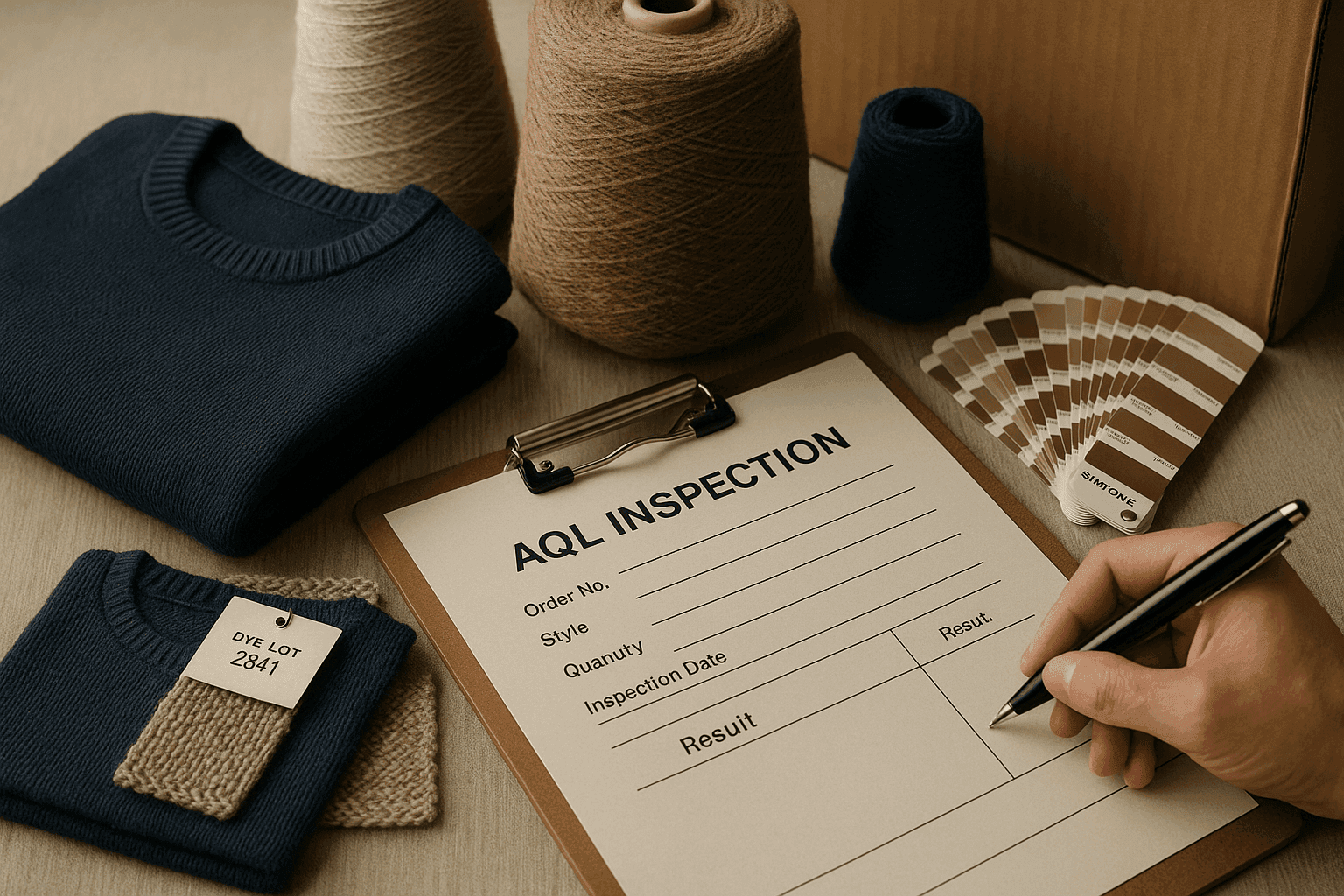
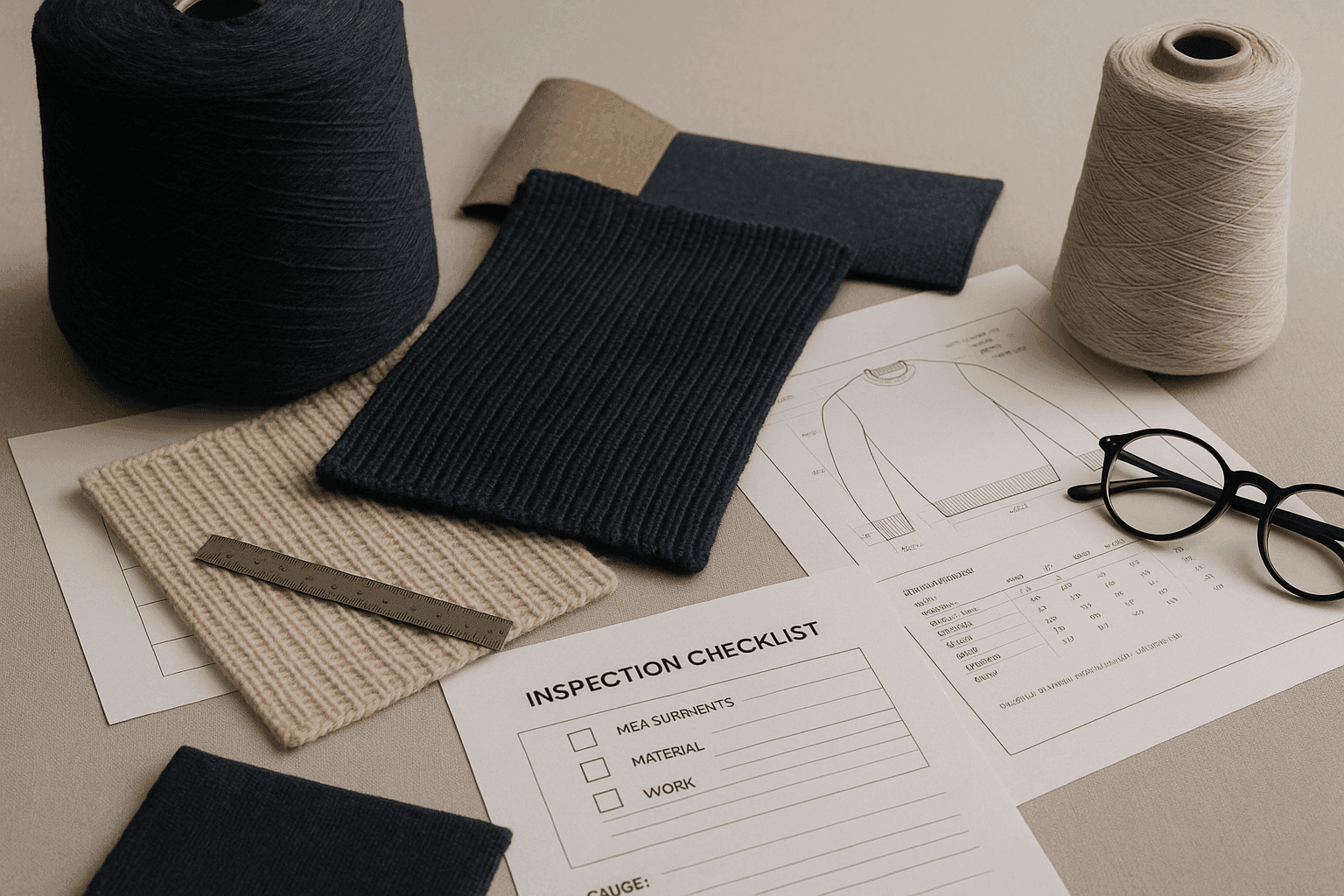
1. AQL inspection on a defined plan. Every Licheng bulk order is inspected to AQL standards before it leaves the factory. For Nordic accounts we recommend agreeing the AQL levels (commonly 2.5 major / 4.0 minor for apparel) in the PO so there is no debate at goods-in. Buyers can also instruct a third-party inspection on top; our third-party inspection guide covers how to plan that.
2. Needle and metal detection on finished goods. We run needle/metal detection as standard. This matters in Nordic markets because retail and e-commerce platforms there frequently require it, and any children's-adjacent SKU absolutely must pass.
3. Care labelling for the actual country of sale. EU care symbol convention (Ginetex) is well-understood, but each Nordic country has language expectations and, depending on retailer, fibre composition order. We follow what you brief, but the brief has to be specific. The knitwear care, washing and labelling guide is a useful starting point.
On certifications: we have test reports and documentation available on request for fibre composition, colourfastness and similar standard apparel tests. We are happy to support buyers' own RWS, OEKO-TEX or GRS chain-of-custody requirements where the brand has nominated a yarn that carries those certificates — see knitwear certifications explained for how transaction certificates flow through. We do not publish certificate logos on the website that are not actively held; treat any factory that does as a yellow flag. Nordic accounts in our experience read certificate scope carefully and prefer a supplier that is honest about what is held at the yarn level versus the factory level, rather than one that displays a wall of logos without scope.
Logistics, Payment And Incoterms For The Nordic Route
The last leg matters disproportionately for Nordic brands because the geography is unforgiving and the seasonal window is narrow.
Sea freight from South China (Yantian / Shekou) to the main Nordic gateway ports — Gothenburg, Aarhus, Helsingborg, Oslo, Helsinki — typically runs 30–40 days port-to-port, plus customs and inland. For an FW programme this means cargo wanting to be on the water by early-to-mid July at the latest for safe August arrival.
Air freight is a viable rescue option for first-drop SKUs or sample shipments. Hong Kong / Shenzhen / Guangzhou into Stockholm Arlanda or Copenhagen Kastrup is 3–6 days door-to-door with a freight forwarder, at roughly 5–8x the per-kg cost of sea. We do not recommend it as a planned channel for chunky knits — they are bulky and weight-heavy.
Incoterms. Most of our Nordic accounts work on FOB Shenzhen / FOB Yantian, taking control of the freight at the Chinese port through their own forwarder. This gives the buyer best visibility on freight cost and customs clearance into the EU/EEA. EXW is possible for buyers with strong China-side logistics. DAP is possible but rarely the most cost-efficient for established Nordic importers.
Payment. Typical structure on a new account is 30% T/T deposit on PO confirmation, 70% T/T against copy B/L before vessel sails. For repeat accounts we discuss net terms case-by-case. We do not require L/C for catalogue-level POs. The knitwear payment terms and trade conditions guide gives the broader picture, and the knitwear shipping and logistics guide covers freight planning in more detail.
Nordic buyers tend to plan well, ask sharp questions, and reward suppliers who are direct about what is and is not possible. That is the relationship we try to run. If you are sourcing wool blend winter knitwear for a Nordic outdoor or lifestyle brand and want a quote against a tech pack — or a development conversation about a Fair Isle, fisherman or merino programme — we are happy to start from your real numbers. We are equally happy to talk through a single-style trial order before any commitment to a wider programme — for many Nordic brands that is the most useful first step.
---
Talk to our team about this
If you're planning a real project around any of the points above, we'd be glad to take a quick look. Send a short brief and we'll come back within one business day with a practical direction, MOQ + lead time estimate, and a sample plan if it makes sense.
→ [Request a free quote](/request-quote) · [WhatsApp us](https://wa.me/8615170244792) · info@lcgarment.cn
MOQ, lead time, cost ranges, gauge selection and QC checkpoints across typical OEM/ODM knitwear programs in NA + EU. Enter your email — we'll send you the report link in 30 seconds.
No spam. Unsubscribe with one reply. We use your email only to send you the report and follow up if you want a sourcing conversation.
Brand names shown are previously serviced OEM/ODM partners. Logos are decorative and do not imply current endorsement.