Norwegian, Icelandic and Fair Isle Knitwear: A Decoder for Brands
Updated 9/24/202612 min readBy Simon Liu · Licheng Knitwear
Lusekofte, Setesdal, selburose, the banded-yoke ski sweater, lopapeysa and Fair Isle are six design traditions and one production technique. What each name means, and the four decisions - colour count, gauge, closure and yarn - that actually move cost and lead time.
Fair Isle and Nordic patterns are among the most recognizable in knitwear, evoking heritage, winter and craftsmanship. For brands, patterned knits command attention and premium pricing, but they require specific development knowledge.
Most briefs for this kind of sweater arrive naming a tradition rather than a technique - a Norwegian lusekofte, a Setesdal jacket, an Icelandic lopapeysa, "a Fair Isle". This guide decodes what those names mean, what they share on the machine, and which decisions actually move cost and lead time.
A great Fair Isle sweater looks effortless and feels like heritage. Achieving that takes deliberate choices about technique, color and gauge.
These names describe different design traditions, not different machines. Knowing which one a buyer means saves a sampling round.
Name
Origin
What it looks like
What it is on the machine
Lusekofte
Norway
"Lice jacket" — dense black-and-white dotting over the body, with patterned bands at yoke, cuffs and front placket
Two-colour jacquard
Setesdal
Norway (Setesdal valley)
The regional lusekofte: dotted body, geometric bands at yoke and wrists, often with a clasped or buttoned placket
Two-colour jacquard
Selburose
Norway (Selbu)
The eight-petal rose — the single most recognisable Nordic motif, used alone or repeated
A jacquard motif, not a garment type
Banded-yoke ski sweater
Norway, 1950s
Blue/red/white banded yoke and cuffs, plain body — the modern Norwegian classic
Two-colour jacquard, yoke placement
The practical point: all six are the same production technique. They are two-colour jacquard, with intarsia brought in only for large single-colour blocks. What differs is the motif, where the pattern sits on the garment, and the yarn — not the machine. A factory that runs one runs all of them.
That also means a brand is free to take the construction of one and the motif of another. A banded ski-sweater yoke in a contemporary palette, or a selburose motif at a scale no traditional garment used, are ordinary development requests.
Fair Isle and Nordic motifs are built with jacquard knitting, repeating color bands carried across the full width.
Technique: Why Jacquard
Because these designs use repeating multi-colour patterns, jacquard is the natural technique: the unused colours float across the back of the fabric. This makes the knit warmer and heavier (double yarn in patterned areas), which suits their autumn/winter positioning. Very large single-colour areas are unsuitable for jacquard because the floats get too long, so these patterns favour small, dense, repeating motifs — which is exactly what the traditions above are made of. See our jacquard vs intarsia guide.
Colour count per course is the binding constraint, not pattern complexity. As a working guide, two to four colours per row keeps the reverse clean and the fabric stable. Once floats get long, a lining or a birdseye backing is needed to stop them catching. This is why Fair Isle in the strict sense uses only two colours in any one row: the tradition is a solution to the float problem, not a stylistic rule.
Gauge Decides How Much Detail Survives
Pattern resolution follows gauge. A motif that reads cleanly at 12GG can lose its edges at 5GG — and fine Nordic motifs are the first casualty: the points of a snowflake and the petals of a selburose blur before the bands around them do.
The consequence for a tech pack is simple: fine pattern detail is proved on a swatch before it goes into production, not after. A chunky 5GG sweater and a fine 12GG sweater carrying "the same" motif are two different development problems. See our gauge guide.
Pullover or Cardigan: Closure Is a Specification
This is decided more often by assumption than by brief, and it is worth stating explicitly.
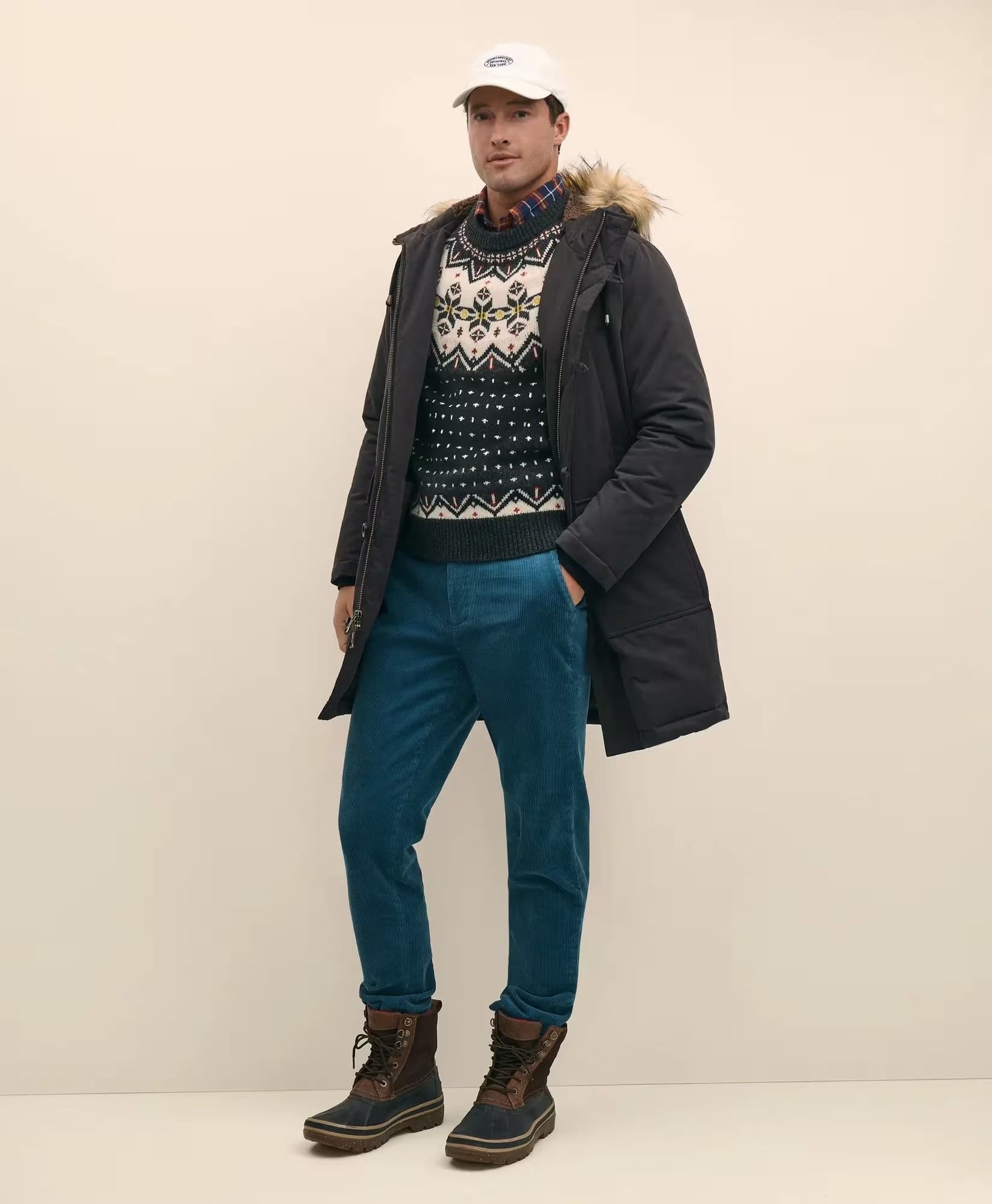
The traditional lusekofte is a cardigan, not a pullover — historically clasped with pewter fasteners, today more often buttoned or zipped. A "Norwegian sweater" brief therefore needs one more line than it usually carries: pullover, button-through, or full zip.
Of the fifteen Fair Isle styles we publish, five carry a full zip front. A zip through an all-over jacquard also changes the pattern planning: the motif has to be drawn so it reads across the break, or deliberately interrupted by a plain placket. Both are normal; they are just not the same tech pack.
Contemporary: tonal or monochrome Fair Isle for a modern minimalist take
Statement: bold contrast colours for fashion-led pieces
Placement: all-over pattern, or a yoke/chest band for a lighter, cleaner look
Specify colours precisely with Pantone or swatches, and provide clear artwork, as covered in our tech pack guide.
Yarn: The Handfeel Is Chosen, Not Inherited
The traditions differ in yarn as much as in motif, and this is where a sample most often misses expectation.
Merino — soft, next-to-skin, even colour take-up; the usual choice for a contemporary range. Thirty-two of our published styles are merino.
Unspun lopi — what a true lopapeysa is knitted in: light, airy, and noticeably rougher than merino. If a brief says "Icelandic" and the sample comes back in merino, it will feel wrong even though nothing was made incorrectly.
Wool–cashmere blends — where a heritage pattern meets a premium price point. Thirty-seven of our published styles are cashmere or cashmere-blend.
Wool–acrylic — stability and price for volume programmes, with pilling expectations agreed to ISO 12945-2 up front.
Say which handfeel you are after in the brief. It costs one sentence and saves a sampling round.
Yoke vs All-Over: A Commercial Choice
How much pattern you use is a cost, weight and styling lever:
All-over pattern — maximum heritage impact and warmth, but the most yarn, the longest sampling and the highest price; best reserved for a hero winter or holiday piece. Every course carries floats, and the garment gains weight where a wearer notices first: shoulders and upper sleeve.
Yoke-only (star/snowflake/banded yoke) — pattern concentrated around the shoulders with a plain body; lighter, cleaner, more contemporary and more affordable to produce.
Border / chest band — a single band of motif on an otherwise plain sweater; the most accessible entry into patterned knits.
For a first patterned launch, a yoke or border design captures the look at lower cost and risk than all-over pattern.
Development and Cost Considerations
Gauge: higher gauges (7GG+) give cleaner pattern detail and colour edges
Yarn cost: jacquard uses more yarn (carried colours), raising material cost, see our cost factors guide
Sampling: patterned knits add sampling time to perfect colour and registration, plan your timeline
Colour count: more colours increase complexity and sometimes MOQ
MOQ and timing: 30 pieces per colour, with sizes mixable inside the 30; sampling 15–25 days from confirmed artwork and yarn; bulk 30–45 days
Three Things Buyers Get Wrong
"Fair Isle" is not a synonym for "Nordic". Strictly, Fair Isle is the Shetland tradition of no more than two colours per row. Used loosely it covers everything above — which is fine in conversation and a problem in a tech pack, because it leaves the actual motif unspecified.
Placement scale matters more than pattern complexity. An intricate motif on a yoke is a smaller job than a simple motif run across the whole body, both sleeves and a full back panel. Ask about coverage before you ask about the drawing.
A "custom print" on a knit is usually not printed. Pattern on knitwear is normally *knitted in* — jacquard or intarsia — not applied to the surface afterwards. Printing on a knitted ground is possible but behaves differently on stretch and wash. If a design was drawn as a print, say so, because it changes the route entirely. See our knitted-in or applied decoder.
Positioning Fair Isle Knitwear
These patterns sell strongly for autumn/winter, holiday and heritage-positioned ranges. They read as craftsmanship and warmth, justifying premium pricing. A yoke-only design offers a lighter, more contemporary alternative to all-over pattern for brands wanting a subtler take.
Common Questions
Why is Fair Isle more expensive? Jacquard carries multiple yarns across the back, so it uses more yarn and adds sampling time to perfect colour registration.
Can I do a subtle, modern Fair Isle? Yes — tonal or monochrome palettes and yoke-only placement give a minimalist take on the technique.
What is the key quality check? Colour registration and even tension — confirm the pattern is crisp with no puckering or distortion on the sample.
Can a Norwegian-style sweater be made as a full-zip cardigan? Yes, and historically that is the more traditional construction. Five of our fifteen published Fair Isle styles have a full zip front. Specify whether the pattern should read across the zip or be interrupted by a plain placket.
How many colours can one row carry? Two to four is the working guide. Beyond that, floats lengthen and the reverse needs a lining or birdseye backing.
We have a photograph, not artwork. Is that enough to start? Yes. Send the photograph and we will come back with what is knittable as drawn, what needs redrawing, and which route — jacquard or intarsia — gives the handfeel you want.
Licheng Knitwear produces Fair Isle, Nordic and jacquard-pattern knitwear with clean colour work and heritage or contemporary palettes. Browse our products or request a quote.
---
Talk to our team about this
If you're planning a real project around any of the points above, we'd be glad to take a quick look. Send a short brief and we'll come back within one business day with a practical direction, MOQ + lead time estimate, and a sample plan if it makes sense.
Strictly, Fair Isle is the Shetland tradition of no more than two colours in any row. Nordic covers Norwegian and Icelandic traditions such as the lusekofte, Setesdal, selburose and lopapeysa. On the machine they are all the same technique: two-colour jacquard.
Traditionally unspun lopi wool - light, airy and noticeably rougher than merino. If a brief says "Icelandic" and the sample comes back in merino it will feel wrong, so name the handfeel you want in the brief.
Yes. A yoke-only design concentrates the pattern around the shoulders on a plain body, so it is lighter, cleaner and more affordable to produce. All-over pattern uses the most yarn, the longest sampling and carries the highest price.
A cardigan - historically clasped with pewter fasteners, today more often buttoned or zipped. A "Norwegian sweater" brief should state pullover, button-through or full zip, because a zip through an all-over jacquard changes the pattern planning.
Merino for soft, next-to-skin contemporary ranges; unspun lopi for a true Icelandic handle; wool-cashmere blends for a premium price point; and wool-acrylic for stability and price in volume programmes, with pilling expectations agreed to ISO 12945-2.
We focus on men's sweaters, cardigans, knit jackets, jacquard knitwear and private label knitwear. We support B2B buyers with OEM/ODM development, sampling and bulk production planning.
Ready to Start Your Project?
Get a free catalog or submit an RFQ today. Our team will respond within 24 hours.