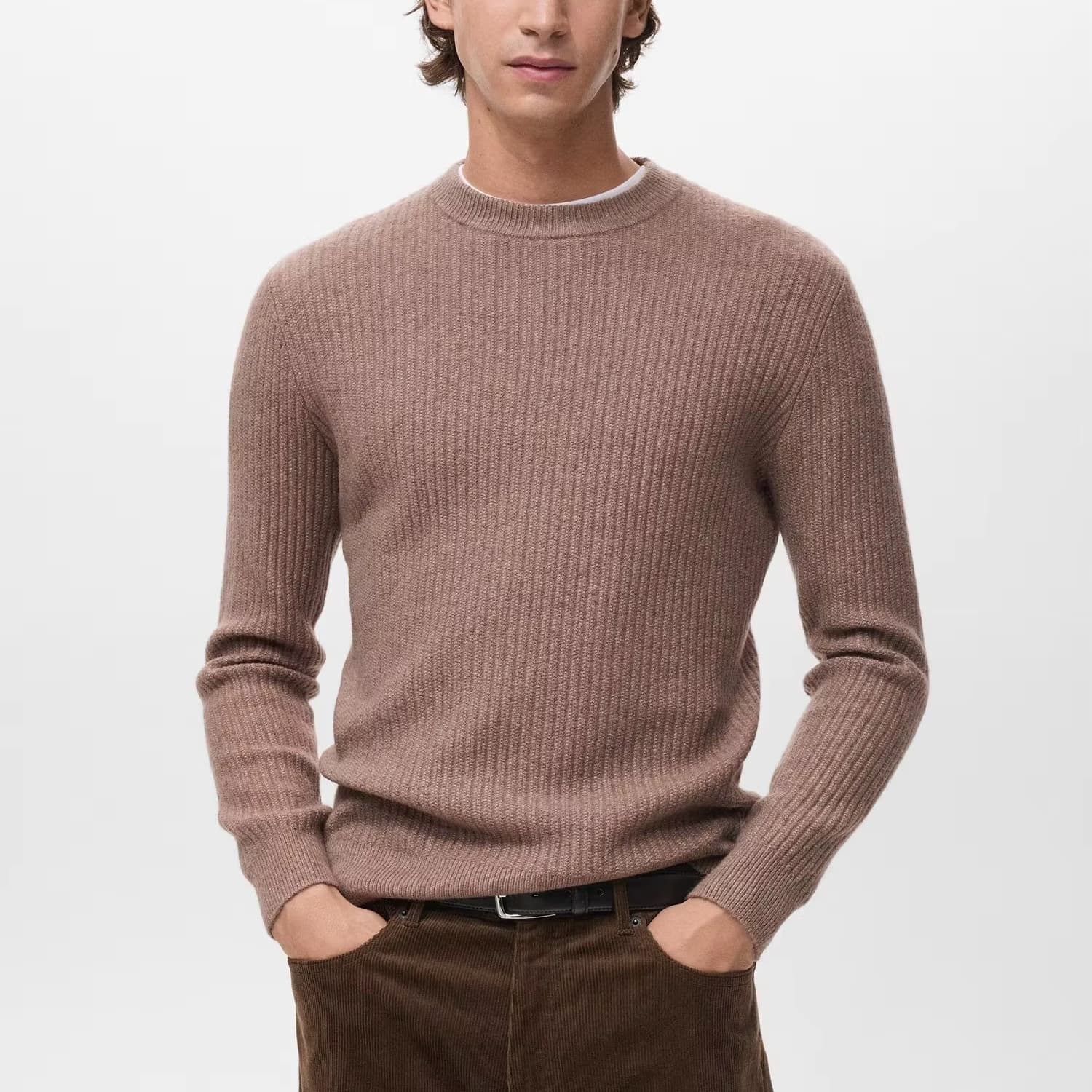
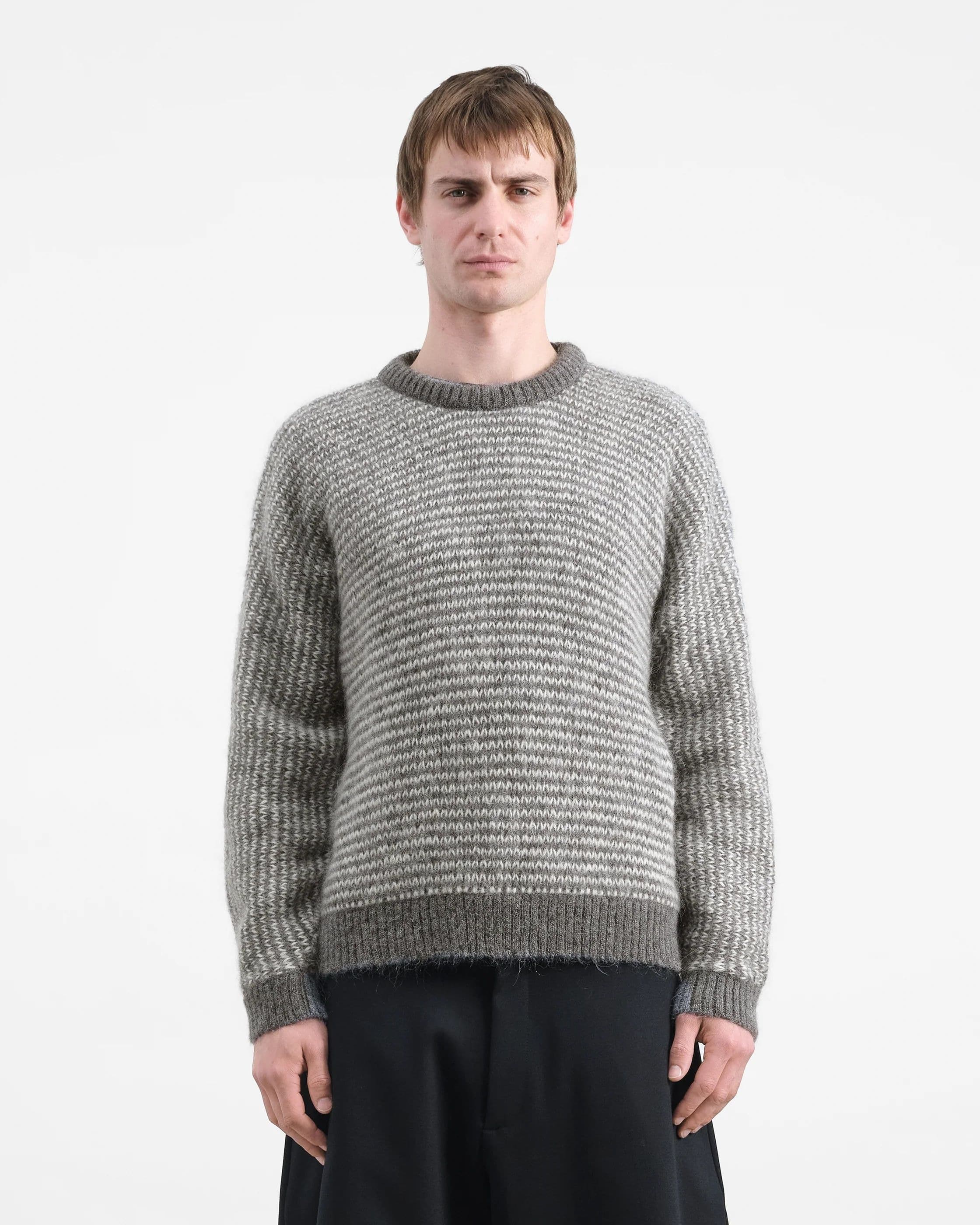
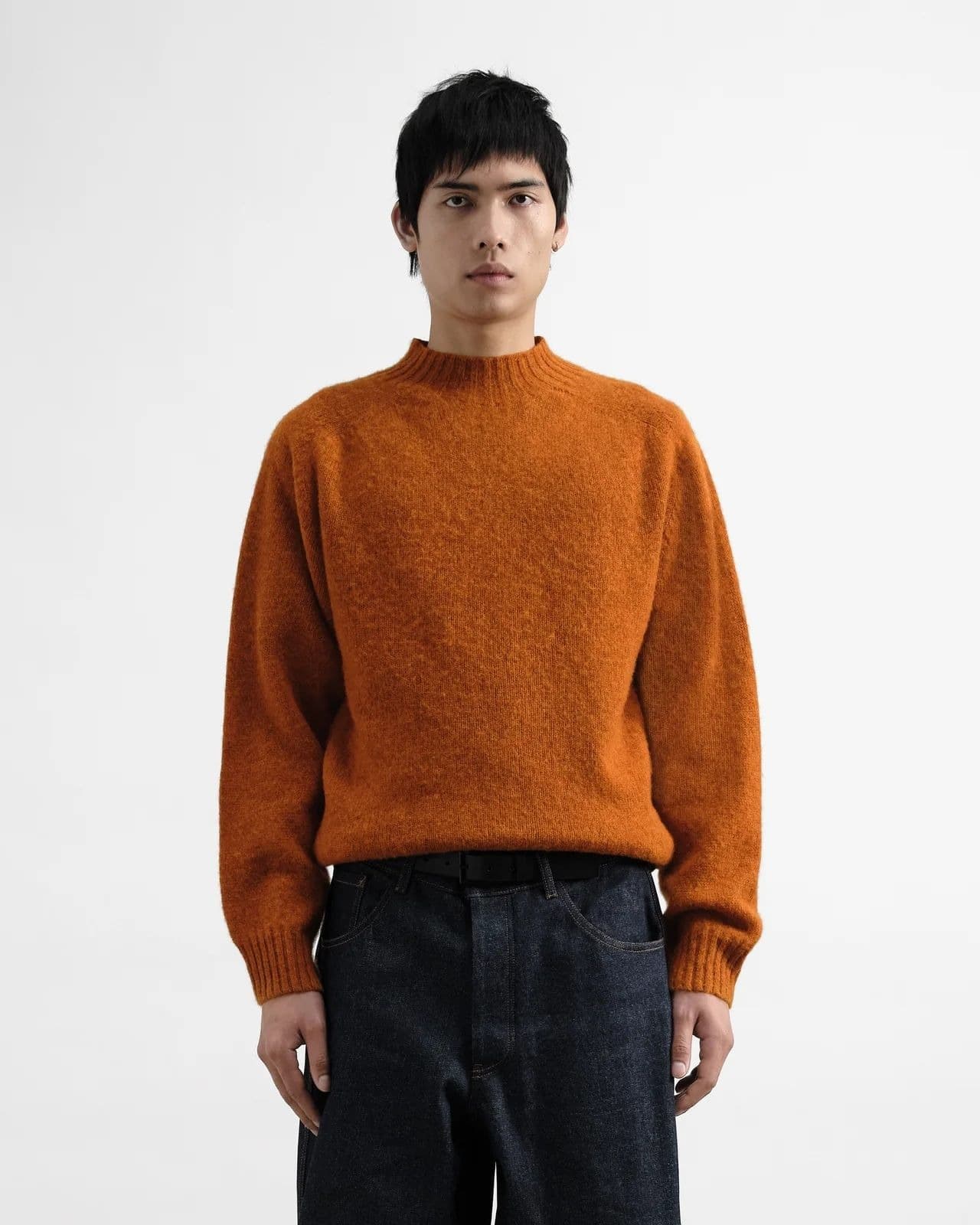
Every AW brief we receive describes a mood. Very few describe a closure, a gauge band or a fibre — and those three decide what the programme costs, how long it takes, and whether it can be reordered in season.
This is not a runway forecast. It is a count of our own published menswear range: 241 men's styles live on lcsweater.com right now. Every figure below is counted from that range, or taken from figures already published elsewhere on this site. Where a number is only partly available, we say so.
AW2027 yarn gets committed between roughly October 2026 and January 2027. What follows is what our own book says about the decisions that get locked in that window.
Of the 241 published men's styles, 92 carry a front closure or a shawl front at all. Within those:
|
| Zip (any type) | 57 |
| Button-front | 33 |
| Shawl collar | 6 |
No style names both a zip and a button, so these do not overlap.
That headline needs one honest split before it is useful. Of the 57 zip styles, 13 are quarter- or half-zip pullovers — a different garment decision entirely, closer to a crew neck with a placket than to a front-opening layer. Setting those aside leaves 44 full-length zips against 33 buttons.
This is worth flagging because it does *not* match what we found counting cardigans alone: across our 71 published cardigans, zip and button are effectively level. The zip lead in menswear overall comes from knit jackets, zip-front bombers and quarter-zips — categories that barely exist in a cardigan-only cut. If your AW27 range is cardigan-led, plan for a tie. If it is layering-led, plan for zips to dominate. The published men's cardigans and men's knit jackets are the two ranges where that decision actually lands.
What that changes commercially:
- **A zip is a trim with a lead-time tail that sits *before* knitting.** Custom lengths, branded pullers and colour-matched tape each need their own sourcing window. Buttons have no equivalent dependency.
- A zip changes the front band. The band has to knit to a stable width and tension so it does not ripple after washing. On finer gauges this is the single hardest part of the garment, and the most common reason an otherwise good sample reads as wrong.
- A zip is harder to grade. Zip lengths are discrete; body lengths are not. Somebody rounds somewhere — decide where before sampling, not after.
Develop the zip style first. It is the one that surfaces problems.
|
| Mid 7GG–12GG | 152 | 63.1% |
| Spans 3GG–18GG (confirmed per design) | 34 | 14.1% |
| Spans 5GG–7GG | 31 | 12.9% |
| Chunky 3GG–5GG | 14 | 5.8% |
| Fine 12GG and above | 10 | 4.1% |
Chunky knitwear owns the mood boards and 5.8% of the range. Heavy 3GG–5GG styles photograph well, but they are heavier per piece, slower on the machine, and more expensive to ship. A hero that looks like the season can land at a materially higher cost per unit than the style that actually sells through.
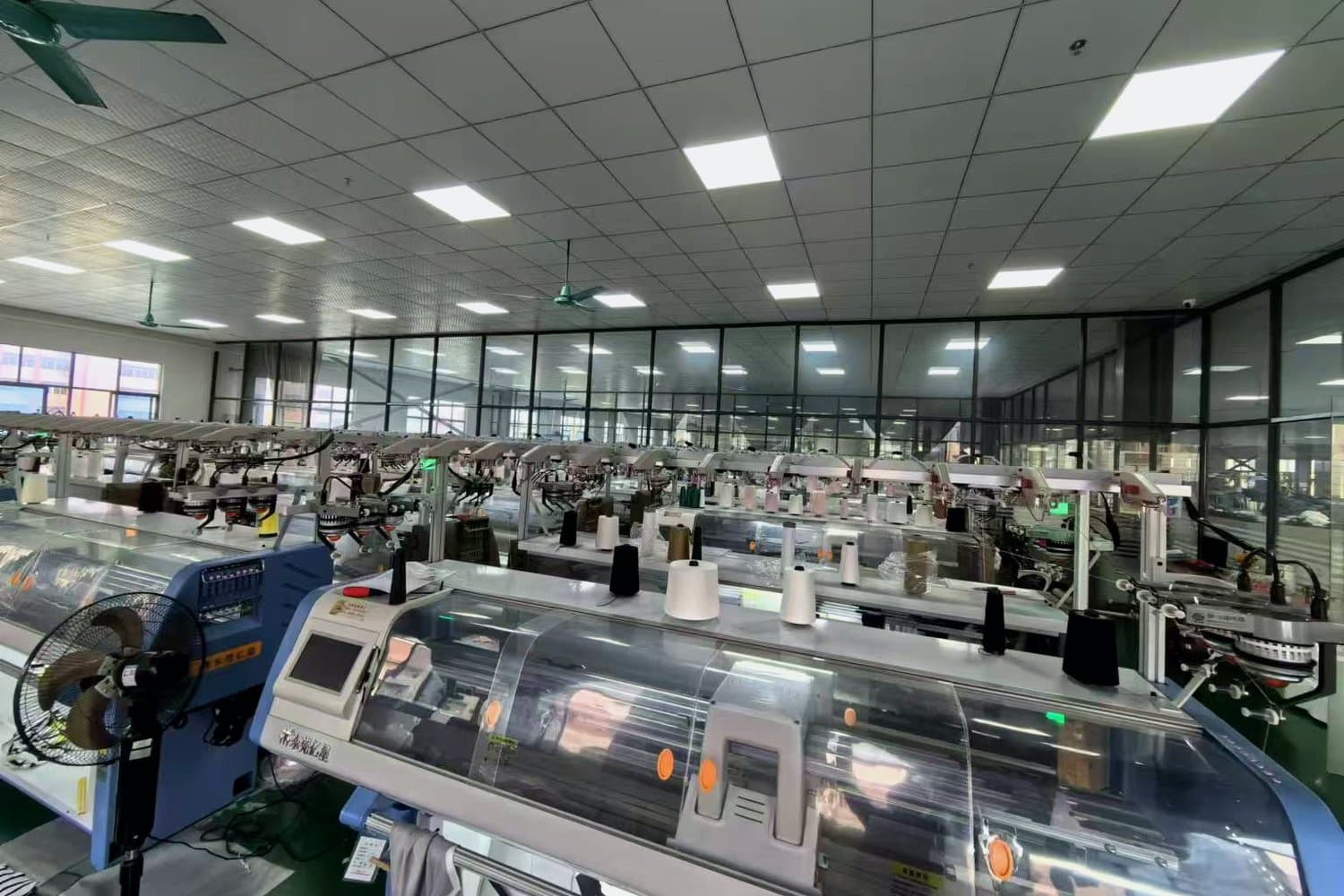
At the other end, fine 12GG and above is 4.1% — a specialist band, not a volume one. We run 3GG to 18GG in house, and the 18GG end has economics worth reading separately before it goes into a mainline range.
One thing we will not claim: that a finer gauge automatically costs more. It does not. Stitch complexity and fibre move the number far more than the gauge figure on its own.
Fibres present across the 241 styles, counting a style once for each fibre named in its composition:
|
| Wool | 191 | 79.3% |
| Cotton | 145 | 60.2% |
| Cashmere | 17 | 7.1% |
| Mohair | 14 | 5.8% |
| Merino | 13 | 5.4% |
| Acrylic | 8 | 3.3% |
The number that surprises buyers: 122 of 241 styles — 50.6% — name both wool and cotton in the same composition. Only 69 styles are wool without any cotton.
That is not a compromise or a cost-down. It is what the order book asks for. Autumn/winter retail floors need a story in September, before the weather turns, and a large share of our North American and European volume ships to markets that never get a hard winter at all. A wool–cotton blend at 7GG–12GG is the garment that works in both situations — and it is, by count, the single most common thing we make.
Cashmere, mohair and merino together account for fewer than one style in five, and most of those are blends rather than pure. Luxury fibre is a hero line, not a volume line, and it should be costed as its own programme.
Published index medians per piece, FOB, at MOQ 30 per colour. These parse cleanly on 185 of the 241 styles; the remaining 56 carry a tiered quantity range instead, so read the table as covering roughly three-quarters of the book.
|
| 100% cotton | USD 13.98 | 1 |
| Cotton blend | USD 14.98 | 11 |
| Wool blend | USD 17.36 | 136 |
| Mohair / alpaca | USD 26.48 | 12 |
| Cashmere blend | USD 31.48 | 8 |
| 100% merino | USD 44.27 | 10 |
| Cashmere on a cotton base | USD 45.77 | 4 |
| Cashmere on a wool base | USD 66.05 | 3 |
136 of the 185 priced styles sit on the wool-blend median. That makes USD 17.36 a far more useful planning anchor than any all-category average — and it means a budget built on a category average will be wrong in both directions, depending on which fibre the design lands on.
The step from wool blend to cashmere blend is roughly 1.8×. To 100% merino, roughly 2.5×. To cashmere on a wool base, roughly 3.8×. None of that is a silhouette decision.
These are index medians that move with yarn prices. They are a starting point for budgeting, not a quotation.
|
| Sweater vests | USD 11.78 | 3 |
| Polo sweaters | USD 19.48 | 14 |
| Cardigans | USD 19.73 | 52 |
| Knit jackets | USD 21.61 | 10 |
| Sweaters / pullovers | USD 22.73 | 103 |
| Knit bottoms / sets | USD 40.03 | 2 |
A knit polo has a collar and a placket. A plain pullover has neither. Yet the polo median sits USD 3.25 below the pullover median — and the cardigan, which adds a full front band and hardware, sits below it too.
The reason is not that plackets are free. It is that the category median mostly reports which fibres get used in that category, not how hard the garment is to build. Our pullovers skew toward heavier wool-rich constructions; our polos skew toward lighter cotton-rich ones. Read these medians as a description of our book, not as a construction cost ladder.
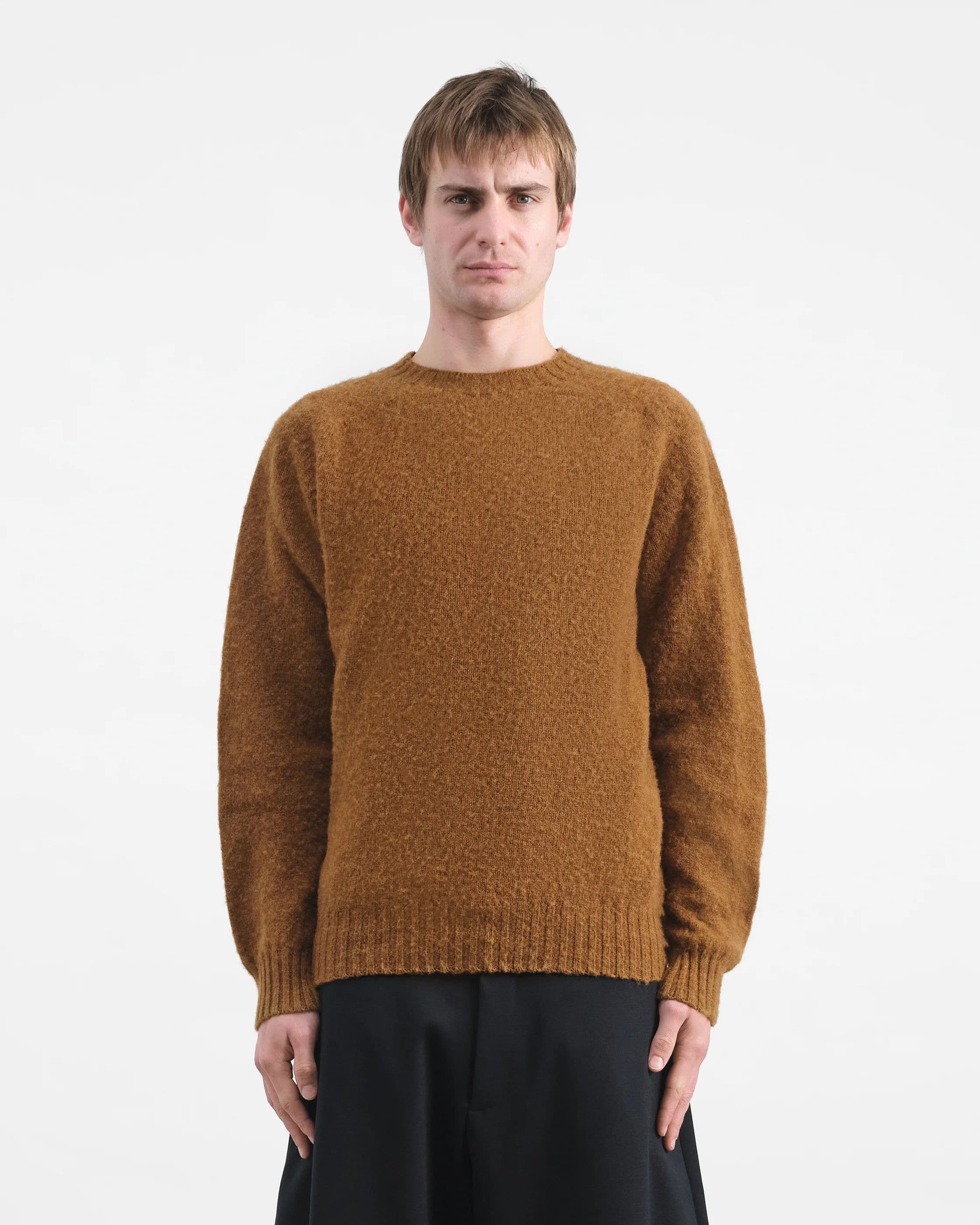
The practical consequence: do not budget a style by looking up its category. Budget it by its fibre, then adjust for construction. "Men's pullover, AW27, mid-market" is not a costable brief. "Wool-blend pullover, 7GG–12GG, two colourways, plain body" is.
Necklines, counted across all 241 styles:
|
| Crew neck | 64 | 26.6% |
| V-neck | 28 | 11.6% |
| Polo collar | 23 | 9.5% |
| Mock / turtle neck | 23 | 9.5% |
| Hooded | 11 | 4.6% |
Crew outnumbers V-neck better than two to one. Mock and turtle necks have pulled level with the polo collar — worth noting for anyone still treating the mock neck as a niche.
Pattern and texture work:
|
| Striped | 25 | 10.4% |
| Cable | 23 | 9.5% |
| Ribbed | 22 | 9.1% |
| Brushed / fuzzy | 17 | 7.1% |
| Argyle / diamond jacquard | 13 | 5.4% |
| Fair Isle | 12 | 5.0% |
| Waffle | 7 | 2.9% |
| Intarsia | 6 | 2.5% |
Cable and Fair Isle dominate autumn trend coverage every year, and together they are 35 of 241 styles. That is not an argument against them — it is an argument for costing them separately from the volume programme:
- Fair Isle, argyle and jacquard change machine time per panel and the yarn-end count. A four-colour yoke is a different garment to knit than a plain body, even at an identical silhouette.
- Cable changes yarn consumption, because the cable pulls the fabric in and the panel has to be knitted wider to finish at the same measurement.
- Both raise sampling risk. A pattern that reads well on a swatch can read as noise at garment scale, and only a full sample shows it.
The pattern that works in a range: a small number of pattern-led heroes carried by plain-bodied volume styles in the same yarn, so the yarn is booked once.
225 of the 241 men's styles are tagged all-season. Only 12 are tagged autumn/winter specifically, and 4 spring or spring/summer.
That tagging is honest rather than lazy: a 7GG–12GG wool–cotton crew neck genuinely sells across three quarters in most of our markets. But it has a consequence for AW27 planning that is easy to miss — the same yarn booking can serve a transitional programme and an AW programme, which is exactly why booking it once, early, at a slightly larger quantity usually beats splitting it across two windows at two prices.
If a range has one decision worth making in the October–January window, it is that one.
|
| Published men's styles | 241 |
| MOQ | 30 pieces per colour (plain and striped styles in the same yarn and colour can be combined) — the same 30 across all 241, chunky and Fair Isle included |
| Gauge range in house | 3GG–18GG · 63.1% of the range sits at 7GG–12GG |
| Sample lead time | 15–25 days from confirmed tech pack and yarn |
| Bulk lead time | 30–45 days after sample approval |
| Volume construction | Wool–cotton blend, 7GG–12GG, crew neck — 50.6% of the book names both wool and cotton |
| Published FOB anchors | USD 14.98 cotton blend · USD 17.36 wool blend · USD 31.48 cashmere blend · USD 66.05 cashmere on wool |
| Closure split | 57 zip · 33 button · 6 shawl, across the 92 styles that carry a front closure |
If you are building an AW2027 men's range, the fastest way to get a real number is to send a tech pack or a reference garment with the fibre and gauge band named. Request a quote or ask for a sample — and if it is easier to describe the programme in a message, WhatsApp is on every page of this site.