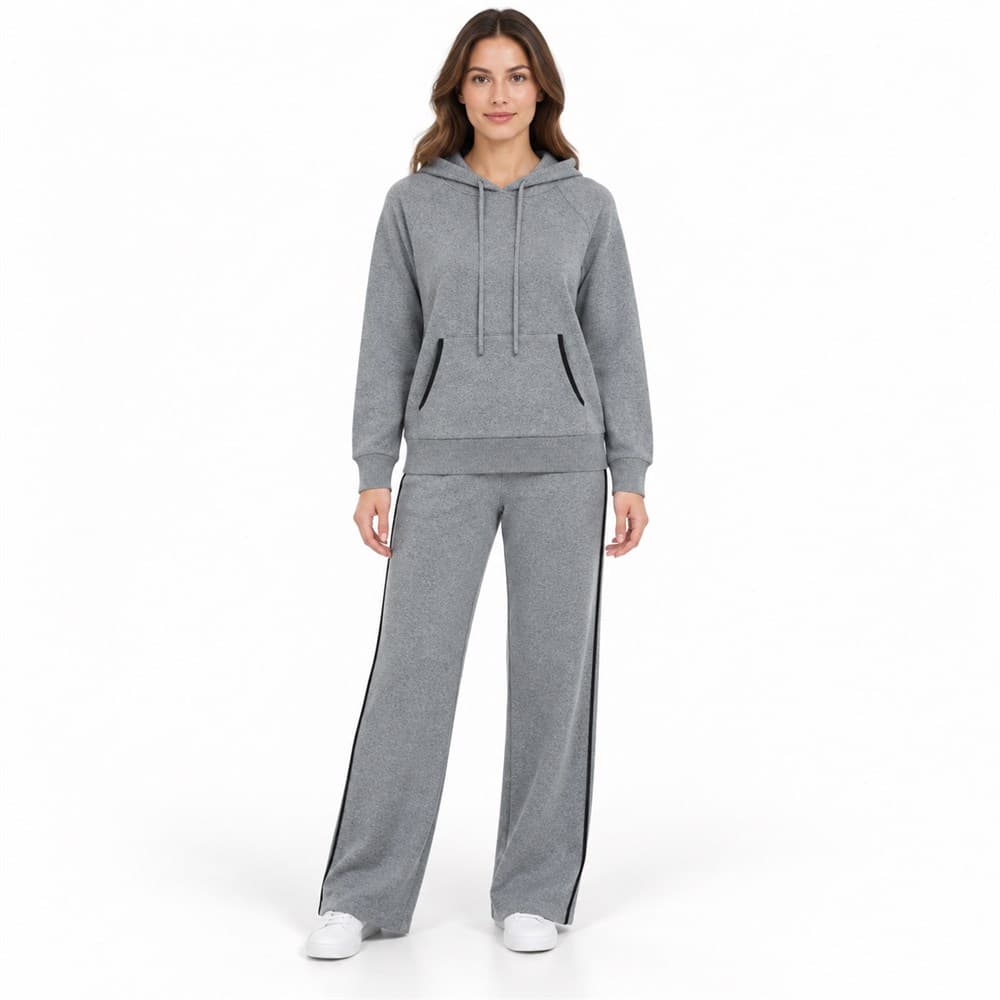
The short answer. Three brands wrote to us this September about the same season from three different directions: a women's label wanting a belted, fringed cardigan covered in mountain motifs; a premium label asking for a black half-zip smart enough to wear off the slope; and a new label planning a December drop of a knitted tracksuit with a matching beanie. None of them said "après-ski". All three were describing a wardrobe for the mountain — and between them they cover most of what that wardrobe is built from. Across the 462 styles published on this site, the pieces that wardrobe is made of resolve into five buildable routes.
|
| Nordic yoke and snowflake jacquard | Two-colour jacquard, 5GG–12GG | Float length on the reverse | Colours per row, motif area |
| Lodge cable and shawl-collar cardigan | 3GG–7GG, heavy yarn | Garment weight pulling the button band | Yarn weight per piece |
| Ski half-zip mid-layer | 7GG–12GG, merino or wool blend | Zip rippling the placket | Fibre choice, far more than knitting |
| Belted fringe wrap cardigan | Full-body jacquard at 3GG–5GG | Fringe shedding and uneven length | Hand labour on the fringe |
| Beanie, scarf and glove set | Several gauges, one colour story | Colour drift between pieces | Minimum per style, not per set |
How we count. A style counts toward a route here if the term appears in its product name, knit-structure field or description. Styles overlap — a Fair Isle quarter-zip counts in two routes. On that definition: Fair Isle, Nordic, snowflake or alpine motifs on 23 styles; cable on 44 and chunky on 26; a half- or quarter-zip on 16 and a mock, turtle or roll neck on 41; fringe on 6 and a belt, tie or wrap on 6; knitted hats on 6, scarves on 8 and gloves or mittens on 6.
The core of the category, and the route with the deepest shelf: 23 published styles. Of those, 15 are menswear and only 2 are womenswear — which says more about who has asked us so far than about what the technique can do.
The engineering problem. Jacquard carries every colour it is not showing as a float across the back of the fabric. The more colours in a row and the wider the gap between them, the longer the float — and a long float snags on a ring, a watch or a ski glove. That is why colour count per row, not motif complexity, is the binding constraint.
Fix on the sealed sample: colours per row (two to four is the working guide), whether long floats need a birdseye backing or a lining, and motif scale proved on a swatch at the actual gauge. A snowflake that reads cleanly at 12GG loses its points at 5GG. Our 23 published motif styles run from 3GG to 12GG; the most common specification is 7GG–12GG, on 7 of them.
Cost. Jacquard adds knitting time and yarn — the floats are yarn you pay for and never see. Our published index median for sweaters and pullovers is USD 22.73 per piece at MOQ 30 per colour. For the traditions themselves — lusekofte, Setesdal, selburose, lopapeysa and Fair Isle — see our Nordic and Fair Isle decoder.
The piece that is worn after the lifts close: a heavy cable or chunky body, very often a shawl collar, buttoned rather than zipped. 44 published styles carry cable and 26 are described as chunky; 8 have a shawl collar.
The engineering problem. Weight. A 3GG–5GG cardigan in a heavy yarn hangs, and everything it hangs from stretches — the shoulders, the button band, the roll of the collar. Cables add a second problem: they draw the fabric in, so a cable panel knitted to the same stitch count as a plain panel comes out narrower.
Fix on the sealed sample: finished weight in grams, the button band construction and whether it carries a stabiliser, and collar depth. Weigh the sample; that number is what bulk will be checked against.
Cost. Yarn weight per piece is the lever — a 3GG body uses far more yarn than a 12GG one of the same size. Our published index median for cardigans is USD 19.73; for mohair and alpaca yarns it is USD 26.48. Browse the chunky and cable styles.
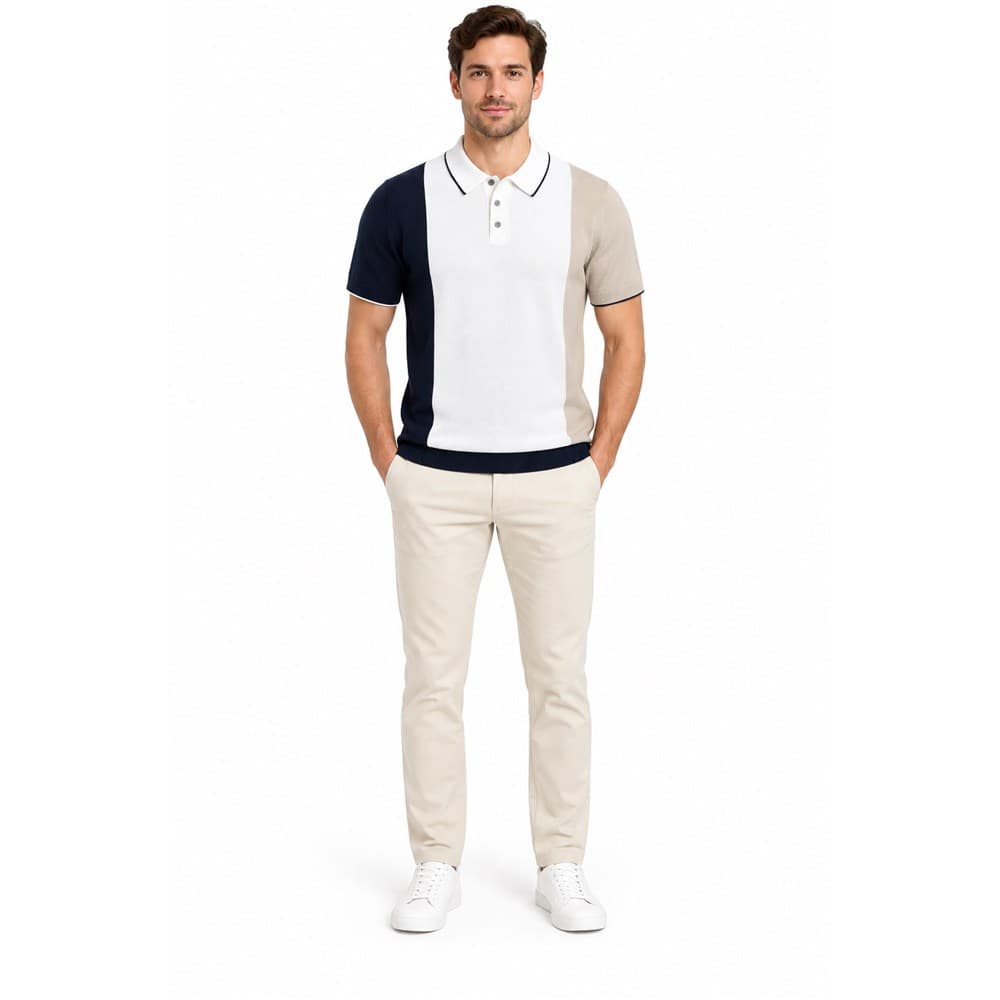
The most wearable piece in the category, because it leaves the mountain: a half- or quarter-zip, usually with a mock or stand collar, fine enough to go under a shell. 16 published styles carry the zip; 14 of them are menswear.
The engineering problem. A zip is a rigid tape set into a fabric that stretches. Set it slightly tight and the placket ripples; set it slack and the zip waves. On a merino body, which relaxes after the first wash, both can appear on bulk even when the sample was flat.
Fix on the sealed sample: zip length, tape type and the placket stabiliser, then re-check after the intended care cycle — dimensional stability after domestic washing to ISO 6330 — because the knit and the tape will not move by the same amount. For anything worn against the skin all day, ask for pilling results to ISO 12945-2 on the chosen yarn.
Cost. Here the fibre decides the price, not the knitting. Our published yarn index medians run from USD 17.36 for wool blend to USD 44.27 for 100% merino — the widest spread of any decision in this article. Metal zips in prolonged skin contact fall under REACH Annex XVII entry 27 for nickel release, tested to EN 1811; ask the trim supplier for that declaration with the price. See trims and hardware and our merino guide.
The women's après-ski piece: long, wrapped, belted, finished with fringe, and usually covered edge to edge in jacquard. It is also the thinnest route on our shelf — one published womenswear style combines all three, alongside two men's fringe styles that share the finishing.
The engineering problem. Fringe is either hand-knotted onto the finished edge or knitted as long loops and cut open. Knotted fringe is even but slow; cut fringe is fast but sheds and settles unevenly. Underneath it, full-body jacquard at 3GG–5GG makes a heavy garment, and the belt adds a strap of weight at the waist.
Fix on the sealed sample: the fringe method, its length and the tolerance on that length, the belt construction and its loops, and total garment weight.
Cost. Fringe is hand labour, priced per piece, and it does not get cheaper with quantity the way knitting time does. The jacquard body prices as a cardigan (index median USD 19.73) before the fringe is added. See jacquard and intarsia and the women's cardigans we publish.
The après-ski drop is often sold as a set, and the set is where a small order quietly becomes a large one. We publish 6 knitted hats (including a convertible balaclava hood), 8 scarves (one sold as a sweater-and-scarf set) and 6 pairs of gloves or mittens in the knit accessories category.
The engineering problem. Colour. A beanie, a scarf and a sweater are usually knitted at different gauges, sometimes in different yarns, and often from different dye lots. Laid side by side on a shop table, "the same navy" is three navies.
Fix on the sealed sample: approve lab dips for every piece against one Pantone TCX reference, and book all pieces of the set on the same yarn lot. See colour matching.
Cost. The minimum applies per style, per colour — not per set. A four-piece set in two colours is eight style-colours, which is 240 pieces at 30 each. Plan the set around that number, not around the sweater alone.
- Minimum order stays 30 pieces per colour per style, sizes mixed inside those 30 — see low-MOQ production.
- Sampling runs about 15–25 days from a confirmed tech pack and confirmed yarn; bulk runs 30–45 days depending on quantity and complexity. Lab dips and nominated trims add days *before* that clock starts — work backwards from your delivery date.
- Our index figures are published medians, not quotes. Final price moves with yarn lot, gauge, colour count and quantity.
Do not put a resort name or a national emblem on the chest because it looks right. Mountain and resort names can be registered trademarks, and the Swiss cross is a protected sign: under the Swissness rules in force since 2017 it signals Swiss origin on a product, which a garment knitted in Dongguan does not have. On your own order we knit artwork you hold the rights to. Snowflakes, peaks, pines, chalets and edelweiss belong to everyone.
Do not choose the colour count before the gauge. The gauge decides how much detail a motif can hold and how long its floats will run. Buyers who fix a five-colour motif first and a 5GG body second spend an extra sampling round almost every time.
Do not launch a new motif, a new fibre and a new set in the same first order. Each is its own approval. Thirty pieces is enough to prove one new thing well; it is not enough to prove three.
A reference photo is enough to start — a sketch, a photo of a garment you already own, or a full tech pack. We will come back with what is buildable, what needs redrawing, and which of the five routes gets you there.