Men's Knit Polos: What 28 Published Styles Show About Gauge, Collar and Cost
Updated 10/13/202612 min readBy Simon Liu · Licheng Knitwear
A knit polo replaces a woven shirt, not a sweater, and that decides gauge, fibre and collar. Read from 28 published knit polo styles: the four gauge bands and what each produces, the four collar and placket constructions with what each needs at sampling, published index medians per fibre, and the two gaps our own shelf does not cover.
The short answer. A knit polo replaces a woven shirt in a wardrobe, not a sweater, and that one fact decides the gauge, the fibre and the collar construction. Across the 28 knit polo styles published in our catalogue, cotton appears in 22 and wool in 14, twelve are built for spring/summer, and the collar treatments split into four constructions that cost different amounts to sample. Prices below are given per fibre rather than as a single range, because the spread from a cotton blend to a cashmere-on-wool base is more than four times and a single range would mean nothing.
These are figures from our own published catalogue and yarn cost index, not quotations. Final cost moves with yarn lot, gauge, colour count and quantity.
Gauge decides whether it reads as a shirt or as a jumper
Gauge band
Styles
What it produces
Typical use
12GG fine
9
Flat, shirt-like surface; collar holds its shape without bulk
Spring/summer, worn alone
7GG–12GG confirmed per design
13
The working middle; most textures and jacquards sit here
12GG fine gives a flat, shirt-like surface and a collar that holds its shape without bulk. At 5GG-7GG a polo reads as knitwear - effectively a sweater with a collar - so it suits autumn/winter layering instead.
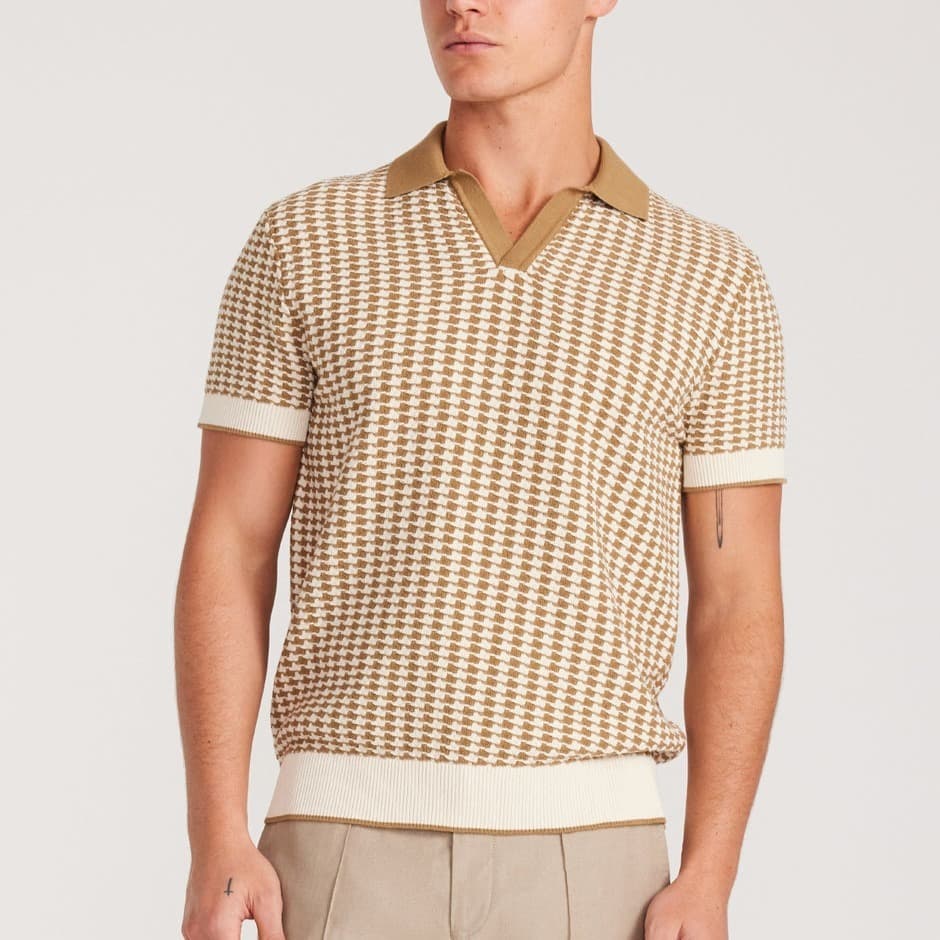
Four constructions: a two- or three-button placket, a Johnny or open collar with no placket, a camp collar, and a quarter- or half-zip front. Each needs something different at sampling - a square placket, a separately specified collar rib, or a zip tape matched to gauge.
Published index medians at MOQ 30 per colour run from USD 14.98 for a cotton blend and USD 17.36 for a wool blend to USD 19.48 for the polo category, USD 26.48 for mohair or alpaca and USD 66.05 for cashmere on a wool base. Pick the fibre first; the price follows.
Less than most knits. Of our 28 published knit polos, 12 are spring/summer and 16 are all-season, which is why the polo is worth building a programme around rather than treating as a seasonal add-on.
A button placket that pulls. The placket has to be knitted or linked square, and it is the first thing to check on a polo sample.
We focus on men's sweaters, cardigans, knit jackets, jacquard knitwear and private label knitwear. We support B2B buyers with OEM/ODM development, sampling and bulk production planning.
Ready to Start Your Project?
Get a free catalog or submit an RFQ today. Our team will respond within 24 hours.
If a buyer asks for "a knit polo" without naming a gauge, the sample almost always comes back too heavy. A polo at 5GG is a sweater with a collar. The decision is worth making before the tech pack, not after the first sample.
Cotton appears in 22 of the 28 published styles and wool in 14 — the two overlap in blends. Mohair, cashmere, silk, linen and viscose each appear on one or two styles as the character fibre rather than the body.
Twelve of the 28 are published as spring/summer, sixteen as all-season. That ratio is the honest shape of the category: a knit polo is one of the few knit silhouettes that genuinely sells in both halves of the year, which is why it is worth building a programme around rather than treating as a seasonal add-on.
The four collar and placket constructions
Read from the published styles, the category divides into four:
Construction
Styles
What it needs at sampling
Button placket (two or three button)
5 with a stated placket, 5 button-front
Placket must be knitted or linked square; the commonest sample failure is a placket that pulls
Johnny / open collar, no placket
3
Collar rolls rather than folds; needs the collar rib specified separately from the body
Camp collar
1
Flat collar, no stand; reads most like a woven shirt
Zip front (quarter or half zip)
3
Zip tape must be matched to gauge or it ripples
The remainder are stated as a plain polo collar without a further closure detail.
Pattern work is where the category shows range: 12 styles carry a stated texture, 6 are striped, 3 are jacquard, and there is one each of herringbone, houndstooth, Fair Isle and argyle. Whether a pattern is knitted in or applied changes cost and lead time considerably — our knitted-in or applied decoder covers which route to take.
What a knit polo costs
Published index medians at MOQ 30 per colour, on the styles that carry each fibre:
Fibre
Published index median
Styles
Cotton blend
USD 14.98
4
Wool blend
USD 17.36
7
Polo sweaters (category median)
USD 19.48
14
Mohair / alpaca
USD 26.48
1
Cashmere blend on a wool base
USD 66.05
2
Deliberately not expressed as one range. The high is four times the low, so a single "USD 15–66" figure would be useless for planning. Pick the fibre first; the number follows from it.
MOQ is 30 pieces per colour, sizes may be mixed within that 30, samples run about 15–25 days from a confirmed tech pack and yarn, and bulk 30–45 days. Twenty-five of the 28 publish a size range of XS–3XL.
What our shelf does not cover
Two gaps worth stating rather than hiding:
Short sleeve is under-represented. Six of the 28 are published as short sleeve and six as long sleeve, with the rest not stating a sleeve length. For a warm-climate programme that ratio is thinner than it should be, and short-sleeve knit polos are a development conversation for us rather than a shelf selection.
One camp collar. The camp collar is the construction that reads most like a woven shirt and it appears on exactly one published style. We knit it; we have not published much of it.
*Figures in this article are read from the 28 knit polo styles published in our own catalogue as of 11 September 2026, and from our published yarn cost index. They are reference figures, not quotations.*
MOQ, lead time, cost ranges, gauge selection and QC checkpoints across typical OEM/ODM knitwear programs in NA + EU. Enter your email — we'll send you the report link in 30 seconds.
No spam. Unsubscribe with one reply. We use your email only to send you the report and follow up if you want a sourcing conversation.
Brand names shown are previously serviced OEM/ODM partners. Logos are decorative and do not imply current endorsement.