Custom Pet Knitwear Manufacturing: What 17 Published Dog and Cat Styles Show
Updated 11/19/202612 min readBy Simon Liu · Licheng Knitwear
A pet knitwear sourcing read counted from our own published range: two separate size runs rather than one stretched chart, acrylic on 12 of 17 styles for wash durability, 10 of 17 at 7GG-12GG, and why the harness opening has to be on the tech pack before knitting.
Most pet-knitwear briefs we receive are a human sweater with the measurements scaled down. That is the single most common reason a first sample comes back unusable: a dog is not a short human, and the three things that decide whether the garment actually works — the size system, the harness opening and the wash behaviour — are all decided before knitting, not after.
The analysis below uses an earlier snapshot of 17 published pet styles. Its counts, fibre shares and pricing references describe that historical sample, not the current catalogue or proof that a style has passed physical fit, skin-contact or wash testing.
Two size systems, not one stretched chart
Size run
Styles
Ready to Start Your Project?
Get a free catalog or submit an RFQ today. Our team will respond within 24 hours.
We grade these as two separate runs. The reason is not tidiness — it is that breed shape varies far more than human body shape. A dachshund and a French bulldog can share a chest measurement and need completely different back lengths and leg placements. One chart stretched from XS to 2XL produces a garment that fits the middle of the range and nothing else.
Both runs carry custom sizing on request, which in practice is what most brands end up doing once they know which breeds their customers actually own.
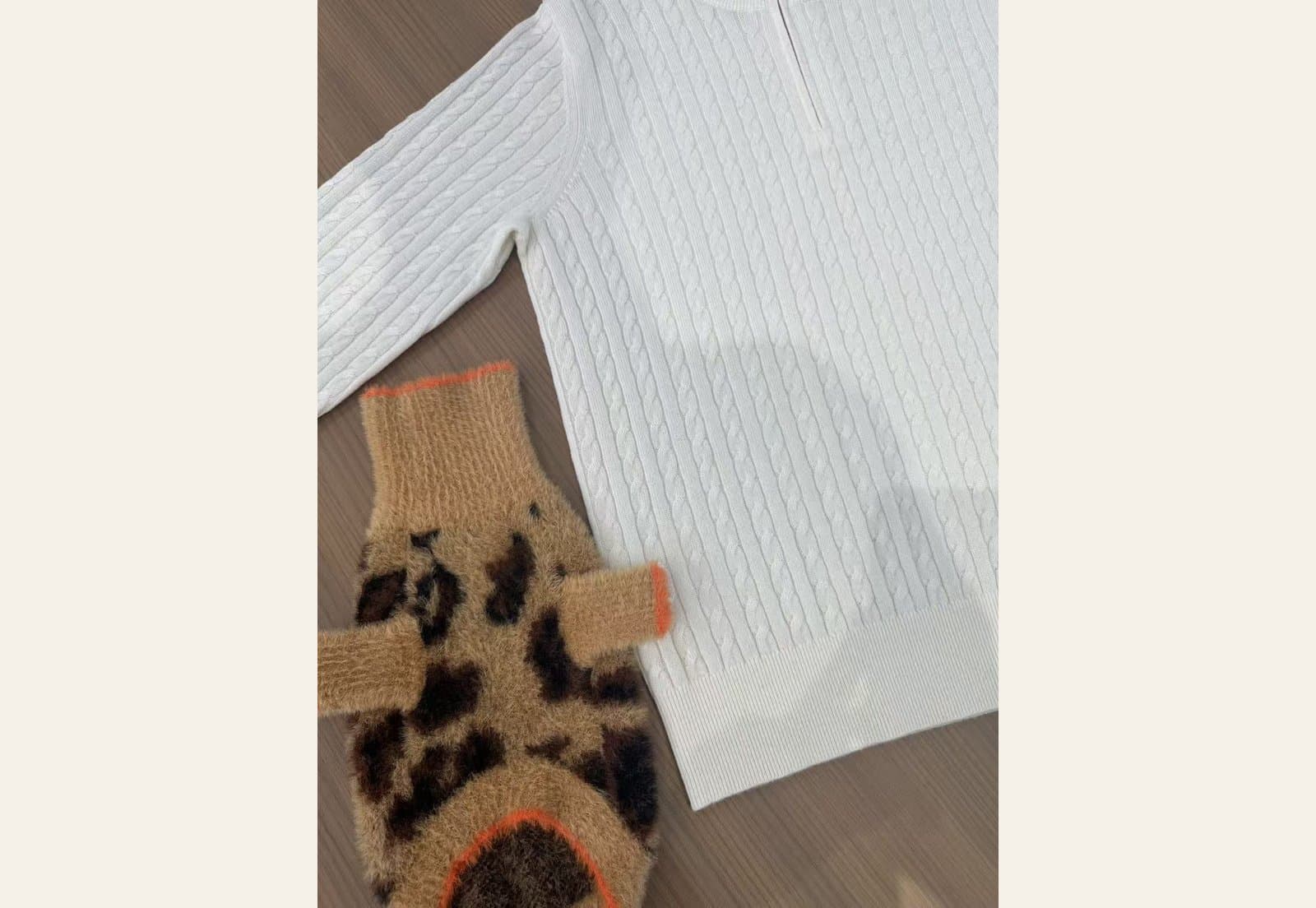
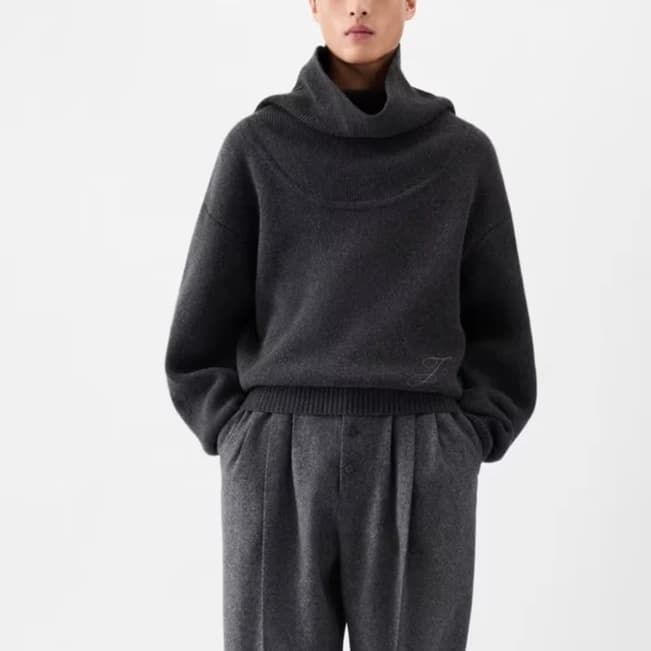
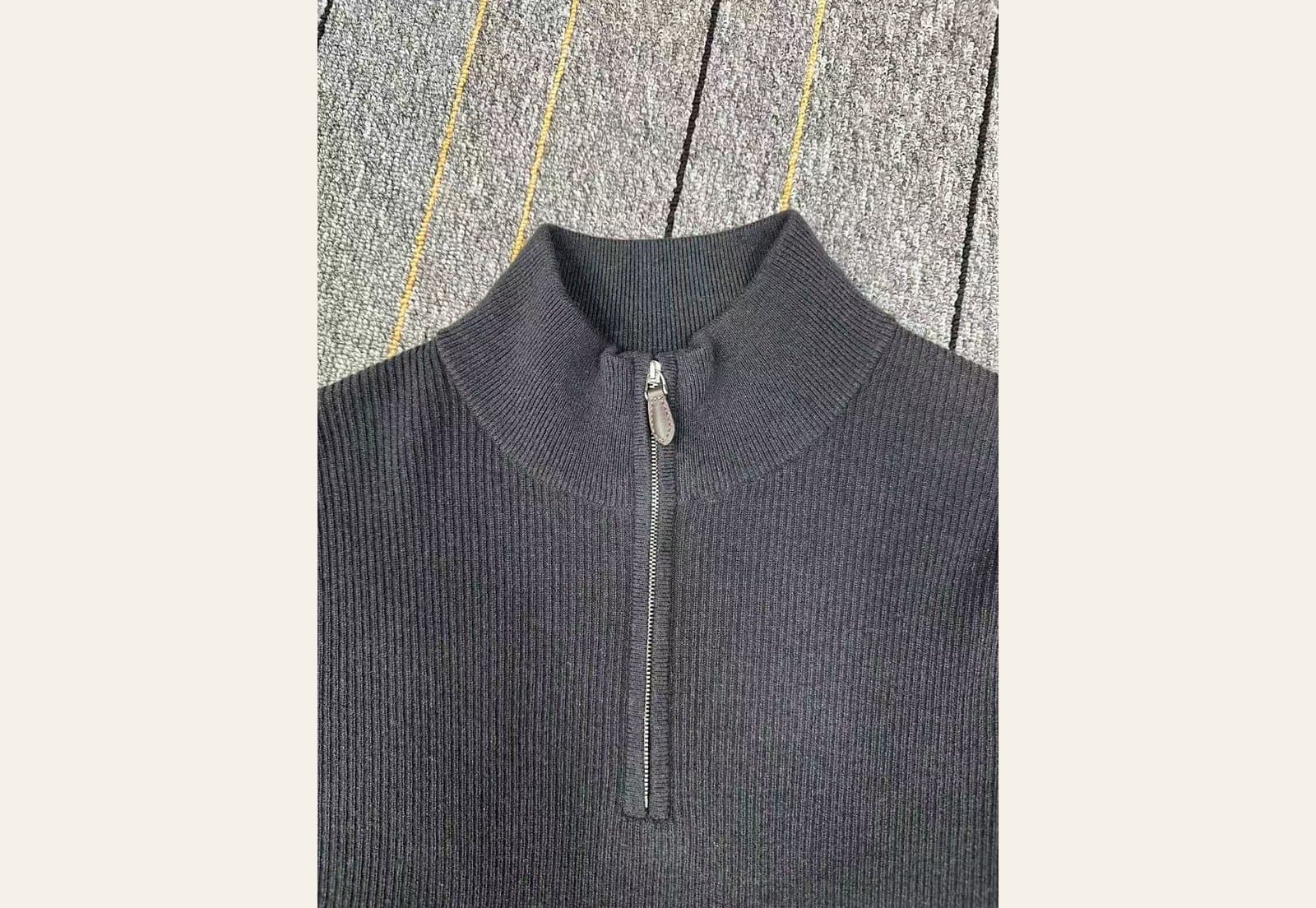
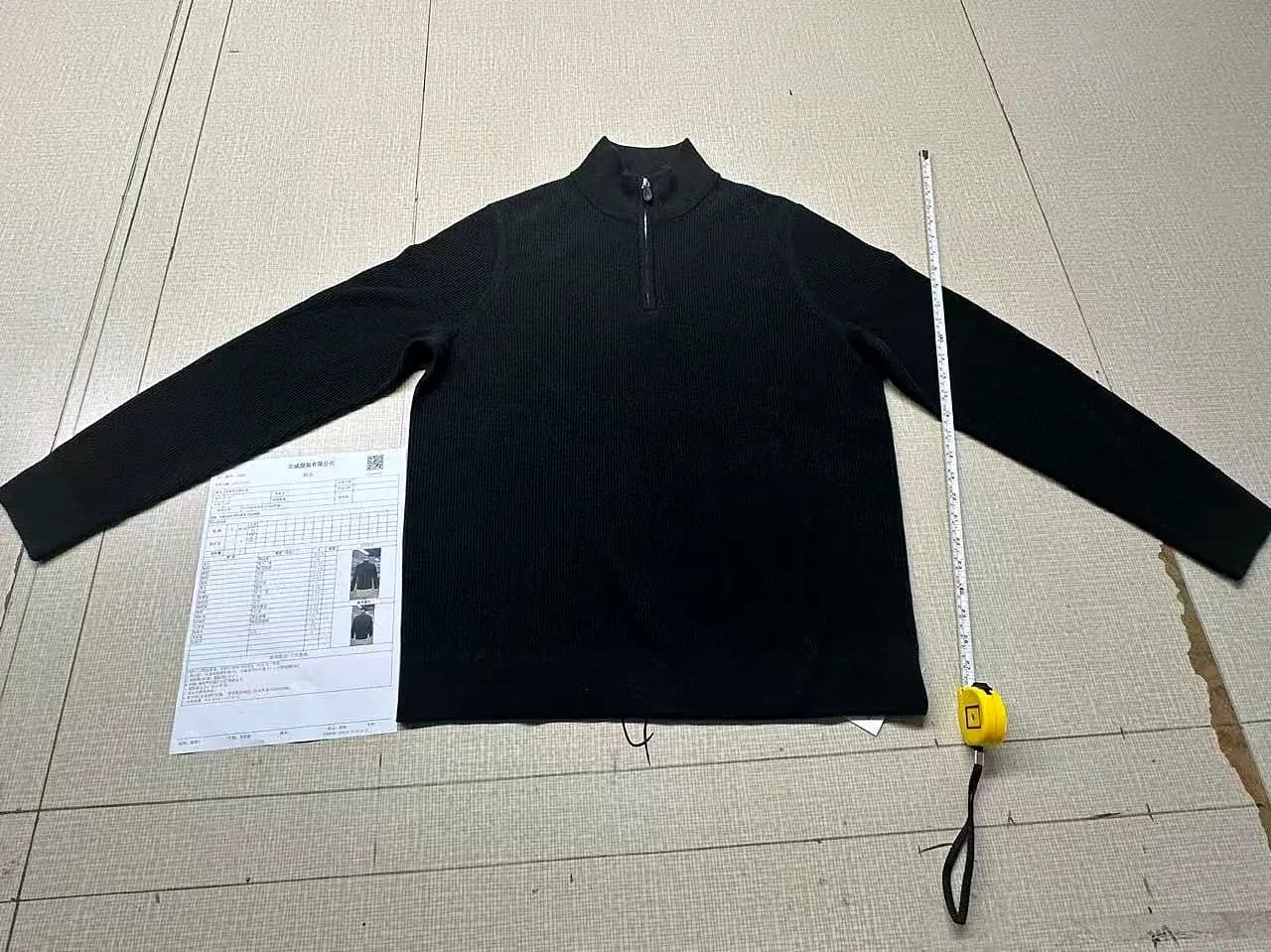
A dog sweater beside an adult cable-knit half-zip, for scale. In-house development piece, photographed in our Dongguan factory, November 2026.
Acrylic leads the range, and that is a functional choice
Fibre
Styles
Share
Acrylic
12
71%
Wool
5
29%
Cotton
5
29%
Merino
2
12%
Polyester
2
12%
Cashmere
1
6%
(A style counts once for each fibre named in its composition, so the column adds to more than 17.)
Buyers sometimes read an acrylic-led range as a cost-down. It is not. Pet product is washed far more often than human knitwear — a dog sweater goes through mud, rain and the machine on a schedule no sweater ever sees. Colour, shape retention and pilling must be checked on the actual yarn, stitch and wash procedure. An acrylic fibre label alone does not establish those results.
Where the owner buys on fibre rather than on function, the range does carry natural options: 5 wool styles, 2 merino, 1 cashmere blend, plus an organic-cotton hoodie for brands with a sustainability line. Those are premium positions, not the volume.
One thing worth saying plainly: wool next to a cat's skin is a returns risk. We publish four cat styles, and the one where the garment does real thermal work rather than styling — a Sphynx sweater — is the one specified in merino rather than coarse wool, for exactly that reason. The other three are acrylic or cotton blends.
Gauge: mid-weight holds up, chunky photographs well
Gauge band
Styles
3GG – 5GG (chunky)
6
7GG – 12GG
10
12GG and finer
1
10 of the 17 historical styles sit at 7GG–12GG. Gauge alone does not establish wash durability; agree the wash procedure and check dimensional change on the sample. Chunky 3GG–5GG cable knits photograph beautifully and are a legitimate hero piece, but they hold water, take longer to dry and are heavier to ship.
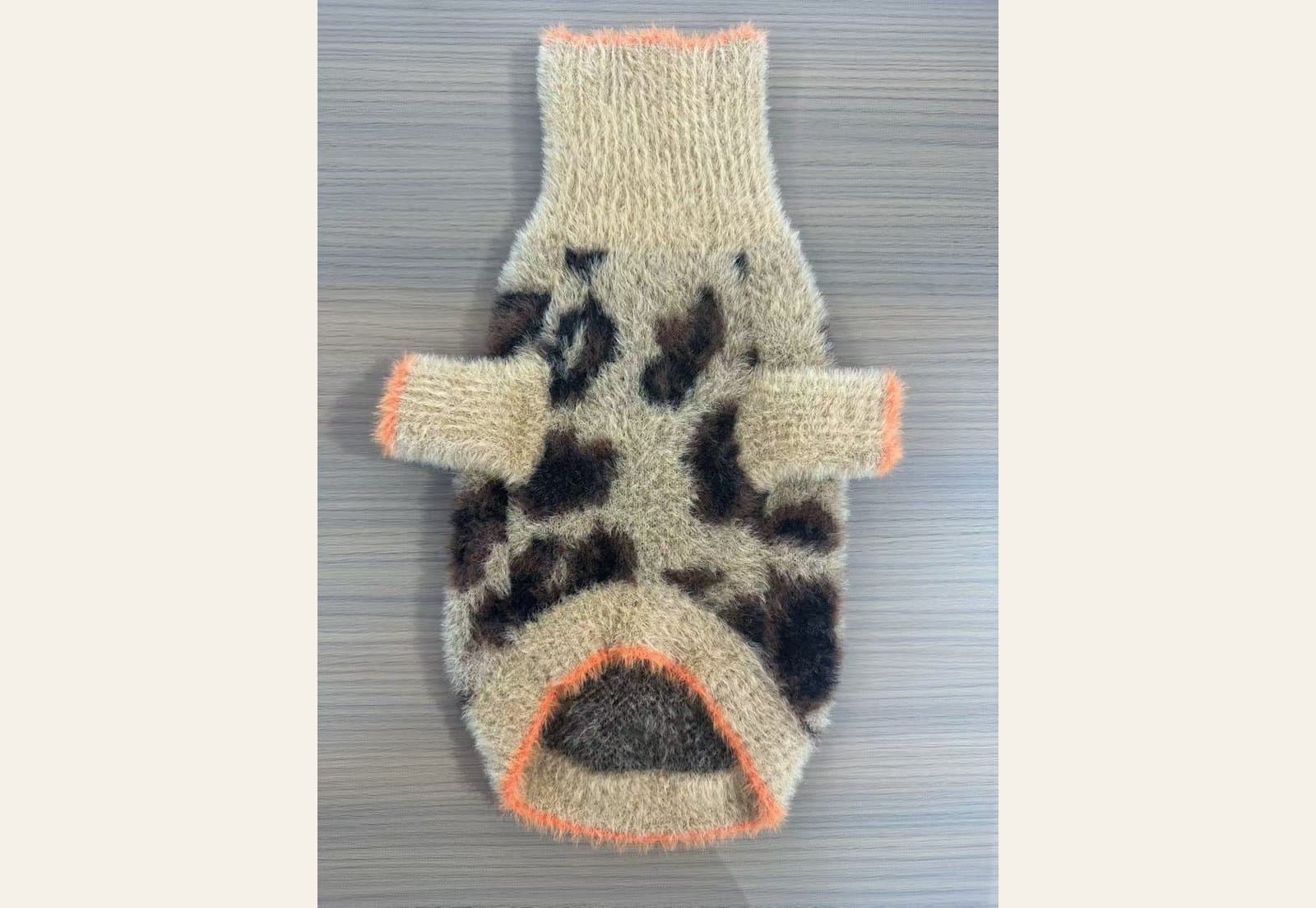
Rib collar, leg openings and orange tipping on a leopard-pattern dog sweater. In-house development piece, photographed in our Dongguan factory, November 2026.
The harness opening is a construction decision
Six of our published styles use a dedicated small-dog sweater construction rather than an adapted human block. What that means concretely: the leg openings, the back length and the harness or lead opening are part of the panel shaping, specified on the tech pack before knitting starts.
Retrofitting a harness hole after the fact — cutting into a knitted panel — is how you get a garment that ladders on the first walk. If your product is sold to owners who walk their dogs, the opening is not a detail. It is the reason the garment gets worn or left in a drawer.
Three things to fix on the tech pack before sampling:
Harness or lead opening: position, size, and whether it is finished with rib or bound.
Leg openings: front-only or four-leg, and the rib depth on each.
Back length vs chest girth: state both. A chest measurement alone does not describe a body.
What the range actually covers
Counted across the 17 published styles: turtleneck and high-neck pullovers, hoodies (dog and cat), a cable-knit heritage piece, a Nordic wool sweater, argyle, plaid, jacquard cartoon graphics, an ombré, a bohemian fringe piece, a performance striped sweater in polyester-elastane, and cat-specific fits including a Sphynx sweater.
That spread is worth noting because it tells you what pet buyers ask for: the range is a fashion range, not a utility range. Argyle, plaid, Y2K starry-night and cow-print all appear, which is the same pattern language a menswear range carries — the customer is buying an object that matches their own wardrobe.
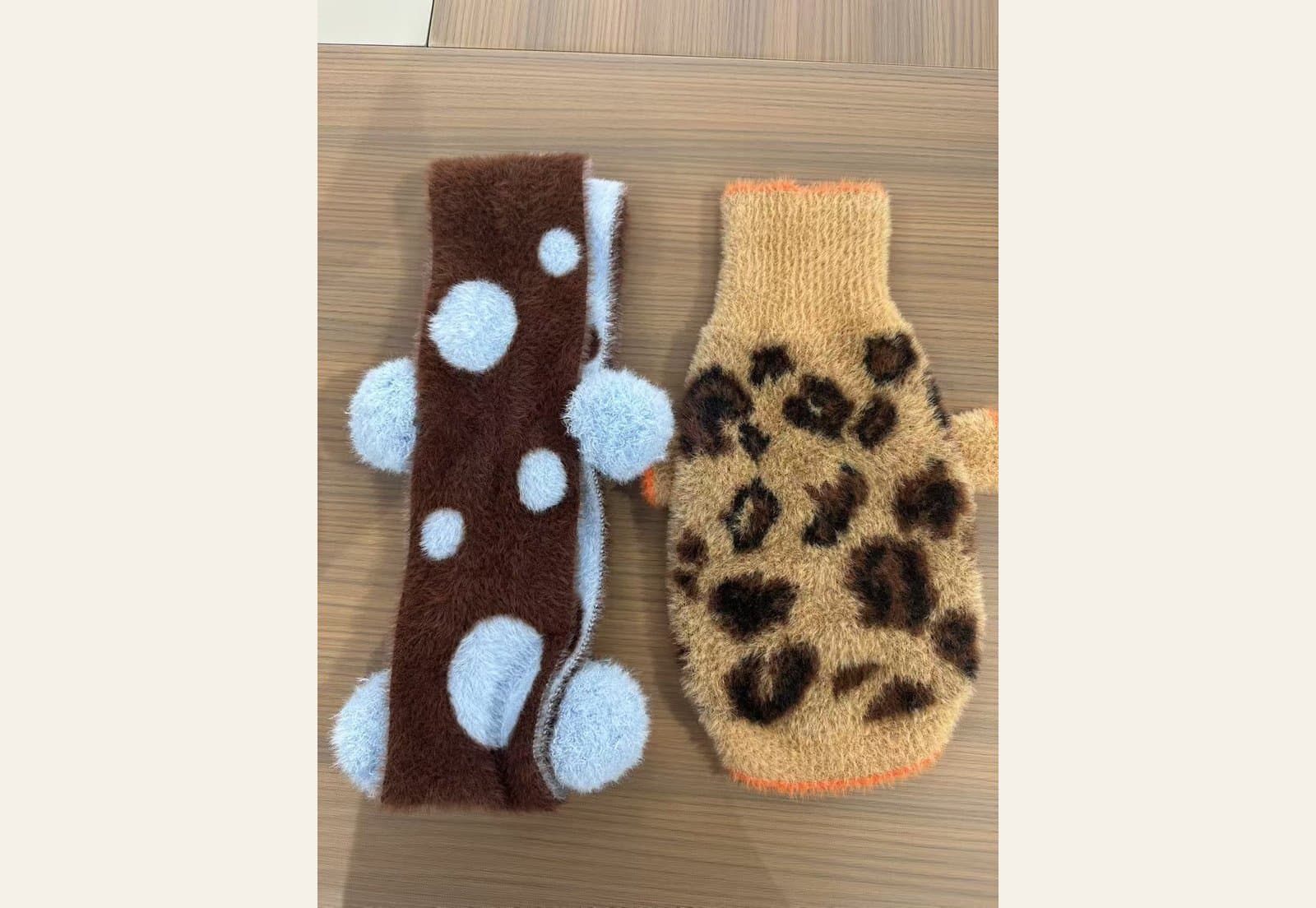
A brown and sky-blue polka-dot piece with pompom trims beside a leopard-pattern dog sweater. In-house development piece, photographed in our Dongguan factory, November 2026.
Pricing: read our published figures carefully
In that historical snapshot, 10 of the 17 pet styles carried a yarn-family index figure; the other 7 were quoted individually.
Those figures — for example USD 17.36 for a wool blend, USD 14.98 for a cotton blend — were catalogue-wide yarn-family medians across garment types in that snapshot. They are not current quotations or an indication of the price shown on every current product page. They are not the price of a dog sweater. A small-dog sweater uses a fraction of the yarn a men's pullover does, and unlike our garment categories, pet knitwear does not carry a published category median.
The honest answer on price is that pet knitwear is quoted per style against a tech pack. Send the style, the fibre, the gauge and the size run and we price it directly.
Sourcing reference — pet knitwear at a glance
Pet styles in the historical snapshot
17
Current MOQ rule
50 pieces per colour; only plain/striped styles in the same yarn and colour may be combined. Jacquard/intarsia: 50 pieces per pattern, no combining different patterns.
Size runs
XS/S/M (11 styles) and L/XL/2XL (6 styles), custom sizing on request
Gauge range in house
3GG–18GG · 10 of 17 pet styles at 7GG–12GG
Sample lead time
15–25 days from confirmed tech pack and yarn
Bulk lead time
30–45 days after sample approval
Dominant fibre
Acrylic, on 12 of 17 styles, chosen for wash durability
Pricing
Per style against a tech pack — no published category median for this range
If you are developing a pet line, the fastest way to a real number is a tech pack or a reference garment naming the fibre, the gauge band and which size run you need. Browse the published pet range, request a quote, or send a photo of the style on WhatsApp — it is on every page of this site.
Compare cat fit and dog branding development routes
For a B2B pet-clothing programme, select a body shape and development route before choosing a size label. D11 and D12 use AI-generated development images; none of the catalogue images substitutes for physical fit and wash testing.
Chunky 3GG merino-blend Sphynx reference — This existing catalogue style is machine-knit and hand-finished. Request current physical-sample evidence, composition confirmation and garment measurements before deciding whether it suits the intended cats.
Fine-gauge Sphynx development (D11) — Compare this proposed 12GG direction with the chunky reference. Neck/chest/back measurements, seam contact, movement and wash behaviour must be checked on physical samples; the image does not prove fit or skin compatibility.
Dog logo jacquard development (D12) — Combine the original logo dimensions with dog measurements. Approve reverse floats, belly opening, neck stretch and washing performance; the pictured motif is a placeholder.
A brand may request a paid development sample before committing to bulk; agree the number of samples, price, freight, timing and any sample-fee credit before proceeding. Ask for garment measurements and current physical-sample photos, then assess fit, seam contact and washing. Single-order blind shipping is a separate fulfilment question and is not implied by these development pages.
Plain and striped styles may share the 50-piece minimum only when using the same yarn and colour; sizes may be mixed. Jacquard/intarsia require 50 pieces per pattern, with no combining different patterns. Other stitch structures and decoration details must be reviewed in the quotation.
A brand can commission one paid development sample before deciding on bulk production. For a miniature dachshund or another long-bodied breed, provide neck and chest circumference, back length, the intended belly coverage, leg-opening position and reference photos. Breed names alone are not a size specification. Review movement, stretch recovery, seams and fit on the sample before confirming the size range. Ask for the sample cost and destination-specific shipping separately; one development sample is not a promise of retail stock or single-order fulfilment.
Compare the current pet knitwear catalogue, then prepare a pet-brand sampling brief. Use the existing logo-pattern examples above to discuss artwork placement; the final construction must be confirmed for the chosen yarn and fit.
50 pieces per colour, the same minimum as our human garment range. Pet product is not treated as a side line with a different floor. The two size runs - XS/S/M and L/XL/2XL - are graded separately, so a style offered in both is two styles.
Acrylic leads our published range at 12 of 17 styles, and that is a functional choice rather than a cost one: pet product is washed far more often than human knitwear and needs to hold colour and shape through it. Several of our acrylic styles are specified anti-pilling. Wool appears on 5 styles and merino on 2 for premium programmes where the owner buys on fibre.
With two separate graded runs rather than one chart stretched from XS to 2XL - 11 published styles are graded XS/S/M for small breeds and cats, 6 are L/XL/2XL for larger dogs. A dachshund and a French bulldog can share a chest measurement and still need different back lengths. Both runs carry custom sizing on request, and your tech pack should state back length and chest girth, not chest alone.
Yes, and it has to be specified on the tech pack before knitting because it changes the panel shaping. Six of our published styles use a dedicated small-dog sweater construction built around exactly these openings. Cutting a hole into a finished knitted panel is how a garment ladders on the first walk.
It is quoted per style against a tech pack. Unlike our garment categories, the pet range does not carry a published category median - a small-dog sweater uses a fraction of the yarn a men's pullover does. The yarn-family figures printed on the product pages, such as USD 17.36 for a wool blend, are catalogue-wide medians for that yarn across all garment types, not the price of the pet garment. Send the style, fibre, gauge and size run and we price it directly.
We focus on men's sweaters, cardigans, knit jackets, jacquard knitwear and private label knitwear. We support B2B buyers with OEM/ODM development, sampling and bulk production planning.
MOQ, lead time, cost ranges, gauge selection and QC checkpoints across typical OEM/ODM knitwear programs in NA + EU. Enter your email — we'll send you the report link in 30 seconds.
No spam. Unsubscribe with one reply. We use your email only to send you the report and follow up if you want a sourcing conversation.
Brands We've Worked With
Brand names shown are previously serviced OEM/ODM partners. Logos are decorative and do not imply current endorsement.