Knitted-In or Applied? A Decoder for Pattern, Colour and Artwork on Knitwear
Updated 10/14/202612 min readBy Simon Liu · Licheng Knitwear
Knitted-in or applied: which route a pattern, logo or motif should take on a knit garment, what each costs, the gauge and colour-count limits, and the tests that catch failures late.
The short answer. Every pattern, logo or motif on a knit takes one of two routes, and the choice is made before anything else: it is either *knitted in* — built by the machine as the panel is made — or *applied*, stitched onto a finished panel afterwards. For knitted-in artwork, confirm programming, colour joins or floats, and washing performance on the selected construction. For applied artwork, review the backing, placement and additional operation. Area alone does not determine the route. Getting this backwards is the most expensive avoidable mistake in patterned knitwear, because it is usually discovered on the first sample.
Route
Techniques
Best for
Binding constraint
Adds to cost
Knitted in
Jacquard, intarsia, Fair Isle, argyle, stripe
Large areas, all-over pattern, colour blocks
Colours per row; gauge sets resolution
Yarn and machine time
Applied
Embroidery, appliqué, patches
Logos, crests, fine detail, placed motifs
Backing, and areas that lie flat
Artwork colour count, an extra operation
Knitted in: what the machine can and cannot do
Jacquard carries every colour across the full row, so the unused colours travel as floats on the reverse. That makes colour count per course the binding constraint, not the size of the motif. As a working guide, two to four colours per row keeps the reverse clean and the fabric stable; once floats get long you need a lining or a birdseye backing, and the garment gains weight. A four-colour Fair Isle body behaves differently from a two-colour one at the same gauge.
Intarsia uses a separate yarn carrier for each colour block and leaves no floats at all, so the fabric stays single-thickness and light, and the number of colour blocks is far less restricted. The trade-off is slower knitting and a higher piece cost. If your artwork is blocks of solid colour rather than a repeating pattern, this is usually the route.
Resolution follows gauge. A motif that reads cleanly at 12GG can lose its edges at 5GG. Fine text and small brand marks have to be proved on a swatch before they go into a tech pack — the stitch is the resolution limit, and no amount of file quality changes that.
In the earlier catalogue snapshot used for this article, the keyword counts were jacquard 18, Fair Isle 15, intarsia 9, argyle 8, knitted stripe 36 and cable 41. The count used product names, knit-structure fields and descriptions; it is not a current catalogue count or independent validation of each construction.
Applied: what stitching onto a finished knit demands
Embroidery on a knit needs backing. Without it the stitching pulls the ground fabric out of shape. The backing is chosen against the gauge and the fibre, and it is confirmed on a swatch before the sample — not assumed from a previous style.
Placement is limited to areas that lie flat during production — left chest, centre front, upper back, sleeve — and the work is done on the flat panel before the pieces are linked, not after the garment is assembled. If your artwork crosses a seam, say so early; it changes the order of operations.
Colour count in the artwork drives cost more than size does. A large single-colour crest is often cheaper than a small four-colour one.
Appliqué and dimensional details — patches, applied shapes, raised florals — sit here too. They are quoted per piece with their own minimum, and where a specialist workshop is involved the sampling clock starts when that workshop confirms, not when we do.
Which one your artwork wants
A repeating all-over pattern → knitted in, jacquard. Decide colours per row before anything else.
Blocks of flat colour, few repeats → knitted in, intarsia. Lighter than jacquard, slower to knit.
A logo, crest or club mark → compare knitted-in and applied routes after checking size, detail and the chosen stitch. Supply vector artwork (AI, EPS, or a PDF with live paths) or a clean high-resolution image.
Fine text or a gradient → applied, and expect to simplify. Fine text, thin outlines and gradients are the three things that lose definition on a knit.
A dimensional or textured motif → appliqué. Confirm feasibility before it goes in the tech pack.
The tests that actually catch problems
On multi-colour knits the failures arrive late, so the test set is not optional:
Colourfastness to washing, ISO 105-C06, and to rubbing, ISO 105-X12. Dye migration between adjacent colour blocks is the most common late-stage failure on patterned knitwear — and it does not show on a solid ground colour, so test the actual colour combination.
Pilling to ISO 12945-2 (Martindale) where floats sit against the body.
Colour is worked to Pantone TCX references with lab dips approved before bulk.
Final inspection is AQL 2.5 under ISO 2859-1, with needle detection on every carton before packing.
What does not change
Jacquard/intarsia require 30 pieces per pattern; different patterns cannot be combined. Plain and striped styles may share a 30-piece minimum only when the yarn and colour are the same; sizes may be mixed. Confirm embroidery, appliqué, trims and any specialist-process minimum separately. Development sampling normally takes about 15–25 days from confirmed artwork and yarn; bulk timing is typically 30–45 days after sample approval, subject to the project. Review the gauge options with the actual artwork.
The sequence that avoids re-sampling: confirm colour count per course and repeat size against the chosen gauge; knit a patterned swatch before the full sample; approve lab dips against Pantone TCX; then check ISO 105-C06 and ISO 105-X12 on the real colour combination.
What we would tell you not to do
Do not put fine text or a small brand mark into a knitted pattern unless it has been proved on a swatch. It is the single most common reason a patterned sample comes back wrong, and it is entirely avoidable.
Do not choose the route from a reference photo alone. A photograph cannot tell you whether a pattern was knitted in or embroidered on, and the two price and behave completely differently. Send the photo — we will tell you which it is and which route gets you closer.
Connect your artwork brief to a development reference
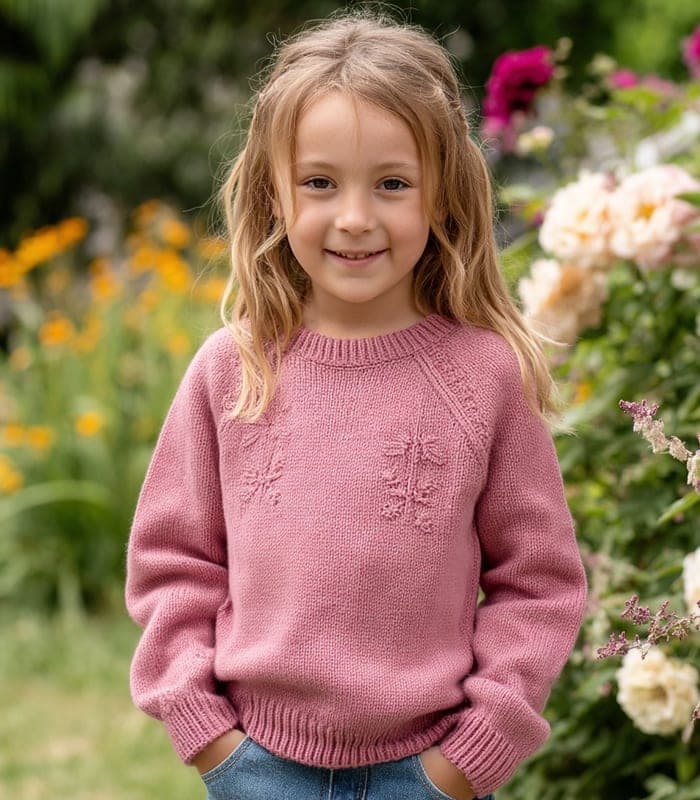
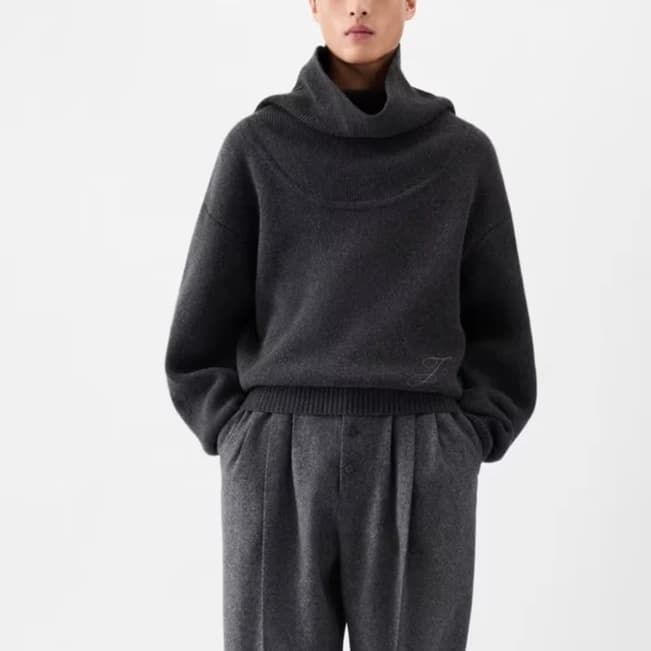
These examples illustrate different artwork and garment directions. Their AI-generated images are not finished-sample photographs or proof that a particular logo can be knitted at the displayed size. Supply artwork you are authorised to use, its dimensions and placement, and the intended yarn and quantity.
All-over jacquard full-zip jacket development (J15) — Use the jacket construction as a starting reference; provide the intended artwork and check repeat matching across the zipper. A reference image does not establish the final pattern or yarn.
Large-motif intarsia sweater development (E10) — A placed floral reference for comparing large colour blocks. Agree motif dimensions, placement, yarn joins and reverse-side finish before the full sample.
— The same artwork review also needs pet-specific measurements, reverse-side comfort and stretch checks.
Plain and striped styles may share the 30-piece minimum only when using the same yarn and colour; sizes may be mixed. Jacquard/intarsia require 30 pieces per pattern, with no combining different patterns. Other stitch structures and decoration details must be reviewed in the quotation.
Jacquard carries every colour across the row as floats on the reverse, so colour count per row is the constraint. Intarsia uses a separate yarn carrier for each colour block and leaves no floats, so the fabric stays single-thickness and light, but it knits more slowly and costs more.
Colourfastness to washing to ISO 105-C06 and to rubbing to ISO 105-X12, tested on the actual colour combination, because dye migration between adjacent colour blocks does not show on a solid ground.
On areas that lie flat during production - left chest, centre front, upper back and sleeve - because it is worked on the flat panel before the pieces are linked. Artwork that crosses a seam changes the order of operations.
Not reliably, and the two routes price and behave completely differently. Send the photo and we will say which it is and which route gets you closer.
AQL 2.5 under ISO 2859-1, with needle detection on every carton before packing, and colour worked to Pantone TCX references with lab dips approved before bulk.
We focus on men's sweaters, cardigans, knit jackets, jacquard knitwear and private label knitwear. We support B2B buyers with OEM/ODM development, sampling and bulk production planning.
Ready to Start Your Project?
Get a free catalog or submit an RFQ today. Our team will respond within 24 hours.
MOQ, lead time, cost ranges, gauge selection and QC checkpoints across typical OEM/ODM knitwear programs in NA + EU. Enter your email — we'll send you the report link in 30 seconds.
No spam. Unsubscribe with one reply. We use your email only to send you the report and follow up if you want a sourcing conversation.
Brand names shown are previously serviced OEM/ODM partners. Logos are decorative and do not imply current endorsement.