Knitwear Sourcing Benchmark Report 2026: MOQ, Lead Time, Cost & QC
Updated 10/9/202612 min readBy Simon Liu · Licheng Knitwear
Reference benchmark ranges for B2B knitwear procurement in 2026 — MOQ, lead times, cost structure, gauge, quality control and commercial terms — to help buyers sanity-check quotes and plan with confidence.
Headline figures for B2B buyers sourcing custom sweaters and knitwear from China (OEM/ODM, factory-floor data, Dongguan):
Benchmark
2026 figure
MOQ — stock yarn colour
30 pcs per colour (plain and striped styles in the same yarn and colour can be combined)
MOQ — custom-dyed colour
30 pcs with a small-lot dyeing surcharge; no surcharge from 100–300 pcs (mill dye lot)
MOQ — jacquard / intarsia
30 pcs per colour (plain and striped styles in the same yarn and colour can be combined)
Sample lead time
15–25 days
Bulk lead time
30–45 days
Same-colour reorder
~30 days
Yarn as % of FOB
40–60% (the dominant cost lever)
Gauge range
3GG–18GG
QC standard
AQL 2.5
Compliance
OEKO-TEX 100 · ISO 9001 · GRS · GOTS; EU EPR / GPSR-ready
Full methodology and per-category detail follow.
Quick answer — 2026 reference ranges for custom knitwear manufactured in China for North American & European brands: trial MOQ starts around 30 pieces per colour on stock yarn, and custom-dyed colours start there too with a small-lot dyeing surcharge that falls away at 100–300 pieces (the mill's dye lot); sampling takes 15–25 days and bulk production 30–45 days, plus roughly 25–35 days sea freight to NA/EU; yarn accounts for 40–60% of the unit cost — the single biggest price lever; common machine gauges run 3GG (chunky) to 18GG (fine); and standard commercial quality is inspected at AQL 2.5. As a price anchor, observed FOB bands for men's knitwear run roughly $9–34 (sweaters), $12–38 (knit polos), $18–58 (cardigans), $10–43 (knit vests) and $23–58 (knit jackets). New for 2026: EU compliance is now a hard gate — the GPSR applies since 13 Dec 2024 (EU Responsible Person required) and the packaging PPWR applies from 12 Aug 2026. The seven benchmark tables below break each of these down by scenario.
Sourcing custom knitwear means making decisions on MOQ, pricing, lead time and quality with surprisingly little public data to anchor them. Most buyers rely on scattered quotes and gut feel. This benchmark report compiles realistic reference ranges for B2B knitwear procurement in 2026, drawn from common industry practice and our own production experience as a Guangdong knitwear manufacturer, so you can sanity-check quotes, plan timelines, and negotiate from a position of knowledge.
These are reference ranges, not fixed prices. Every program varies with yarn, complexity and quantity. Use them to spot outliers and ask better questions, not as a substitute for a real quote.
The figures below reflect typical ranges for custom men's and women's knitwear produced in China for North American and European brands. They assume standard commercial quality, FOB terms, and conventional construction unless noted. Premium fibers, complex patterns and very low volumes push every number toward the high end.
Benchmark 1: Minimum Order Quantity (MOQ)
MOQ is quoted per color, per style — not as a single total. The biggest driver is yarn: custom-dyed colors force higher minimums to consume a dye lot, while stock yarn keeps them low.
Scenario
Typical industry MOQ (per color/style)
Stock yarn, simple style
100–300 pcs
Trial / ready-style order
30–50 pcs
Custom-dyed or blended yarn
300–500 pcs
Complex jacquard / specialty yarn
500+ pcs
Our own floor for custom development is around 30 pcs per color (plain and striped styles in the same yarn and color can be combined) on stock yarn for trial orders — deliberately low to let emerging brands test the market. A custom-dyed colour starts at the same 30 pieces with a small-lot dyeing surcharge and 7-15 extra days for the lab dip; the surcharge falls away at the mill's full dye lot of 100-300 pieces per colour. See our MOQ guide and low-MOQ guide.
Benchmark 2: Lead Times
Lead time is the most common cause of missed launches — usually because development started too late, not because production was slow. Plan backwards from your in-store date.
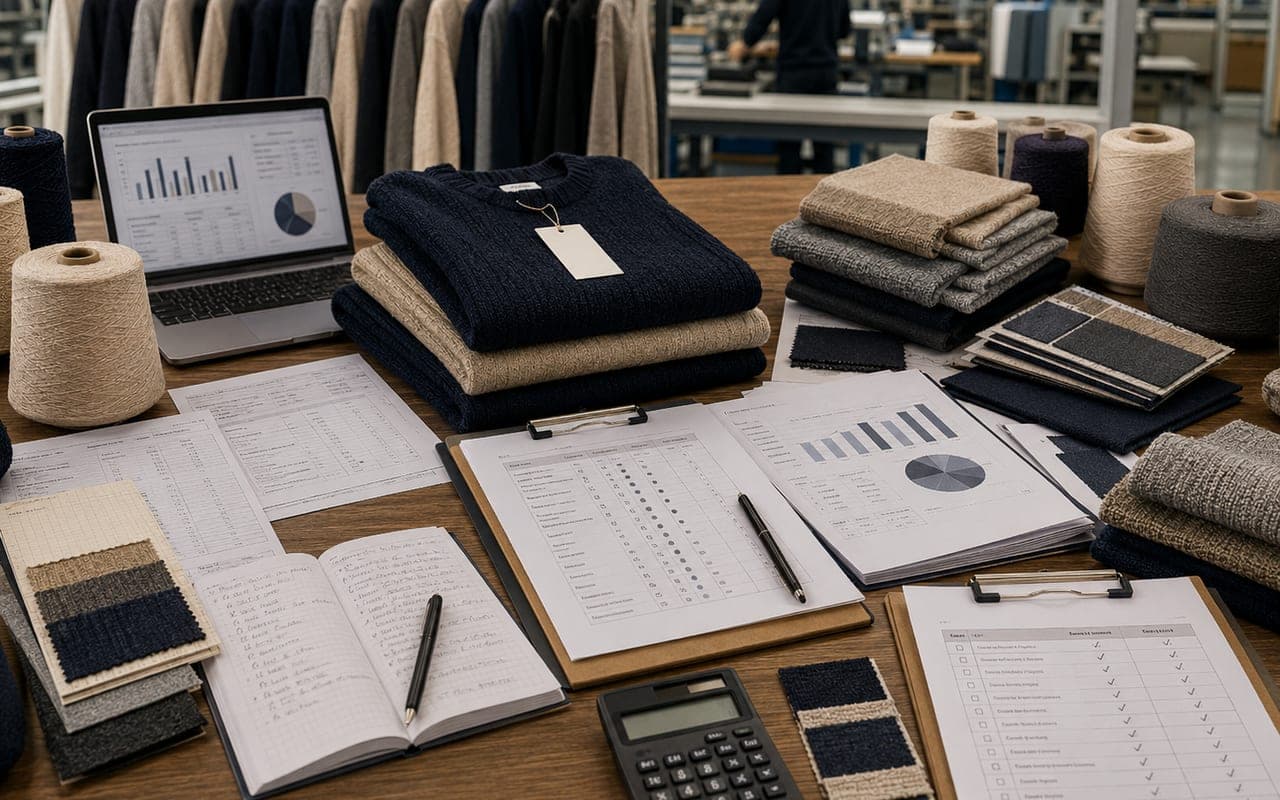
Benchmark ranges help buyers sanity-check quotes and plan realistic timelines for custom knitwear.
Benchmark 3: Cost Structure
Yarn dominates the cost stack — typically 40–60% of the unit price. The same style can vary several-fold across fibers. These are relative cost bands, not absolute prices, which depend on yarn, gauge, complexity and quantity.
Fiber
Relative cost band
Acrylic / acrylic blend
Lowest
Cotton / cotton blend
Low–medium
Lambswool / wool blend
Medium
Merino
Medium–high
Cashmere & cashmere blend
Highest
Unit price also falls as quantity rises, because setup and dye-lot costs spread across more pieces: small runs (100–200 pcs) carry the highest unit cost, mid runs (300–500) see a meaningful drop, and large runs (1,000+) reach the best pricing. See our cost factors guide.
Observed FOB price bands by category
To put real numbers on the cost stack, these are the FOB price ranges we currently see across our own men's knitwear catalogue (USD, per piece, before quantity negotiation). They are observed ranges, not a price list — fiber, gauge, colour count and quantity move every figure.
Category
Observed FOB band (USD/pc)
Main drivers of the spread
Knit polos
$12 – $38
Yarn (lambswool/merino), gauge, jacquard
Sweaters / pullovers
$9 – $34
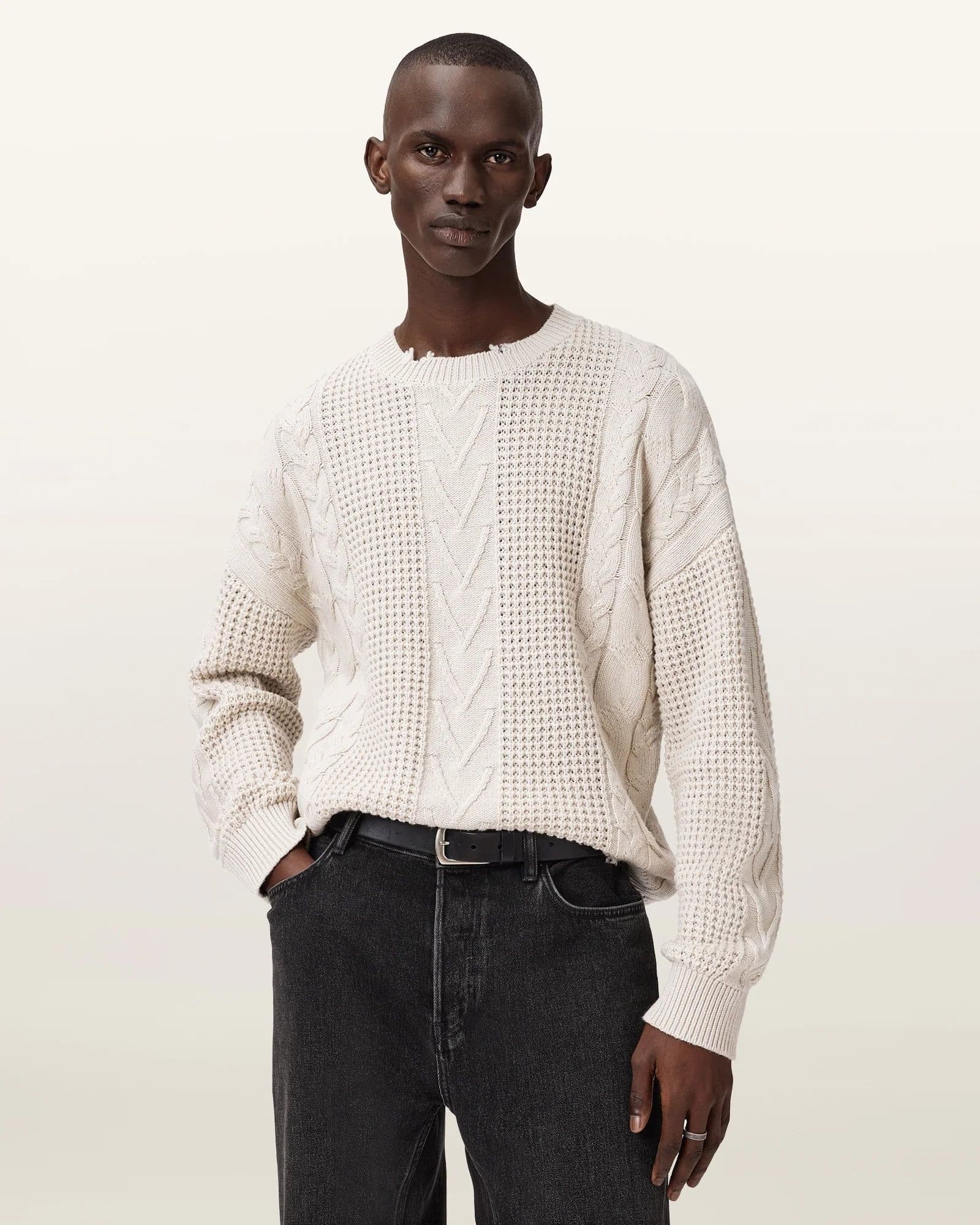
Fiber, gauge, pattern (cable, jacquard, boucle)
Knit vests
$10 – $43
Wool/tweed vs plain, detachable trims
Cardigans
$18 – $58
Wool/cashmere blends, zips, faux-fur collars
Knit jackets / outerwear
$23 – $58
Heavy wool, suede panels, padding, hardware
The cheapest end is acrylic/cotton, plain, at volume; the top end is wool/cashmere, heavy-gauge or detailed outerwear at trial quantities. Use the band to position a quote, then drive the unit down with quantity and fiber choice.
Benchmark 4: Gauge and Construction
Gauge sets weight, stitch definition and season. Most men's sweater programs live at 5–7GG, with finer 12GG for lightweight/layering and chunky 3–5GG for winter statements.
New since the last edition, and the benchmark most buyers underestimate: selling knitwear into the EU now has hard compliance gates that a supplier must support. The key dates and what each requires:
Requirement
Status / date
What it means for an importer
GPSR (General Product Safety Regulation 2023/988)
Applies since 13 Dec 2024
An EU-based Responsible Person must be named on product, packaging and online listing
Register in each market; marketplaces check the number
PPWR (Packaging & Packaging Waste Reg. 2025/40)
Applies generally from 12 Aug 2026
Recycled-content, right-sizing and recyclability rules for polybags/cartons
REACH (Annex XVII restricted substances)
In force
Azo dyes/amines, CMRs/phthalates, nickel on trims, formaldehyde — test reports
Fibre & care labelling (Reg. 1007/2011)
The practical benchmark: most factories cannot support the GPSR EU Responsible Person, which is the line item that quietly shifts liability to the brand. We cover it — see our EU market compliance guide and the verifiable basis on our Trust Center.
How to Use These Benchmarks
Sanity-check quotes: a number far outside these ranges deserves a question — is the yarn grade, quantity or Incoterm different?
Plan timelines backwards from your launch, with buffers on sampling and yarn.
Design to a target price by choosing fiber first, then gauge and complexity.
Match MOQ to your stage — trial volumes early, custom yarn as you scale.
These benchmarks reflect typical practice; your actual numbers depend on your specific program. For figures tailored to your design, yarn and quantity, request a quote — we provide transparent, itemized quotes for B2B buyers in North America and Europe.
---
Talk to our team about this
If you're planning a real project around any of the points above, we'd be glad to take a quick look. Send a short brief and we'll come back within one business day with a practical direction, MOQ + lead time estimate, and a sample plan if it makes sense.
What is the MOQ for custom knitwear in 2026? About 30 pieces per colour (plain and striped styles in the same yarn and colour can be combined) on a stock yarn colour, jacquard and intarsia included, and a custom-dyed colour also starts at 30 pieces, with a small-lot dyeing surcharge that falls away at the mill's 100–300-piece dye lot. MOQ is per colour, not per total order.
How long does knitwear production take? A development sample runs 15–25 days and bulk production 30–45 days; a same-colour reorder is faster at around 30 days.
What share of a sweater's cost is the yarn? Typically 40–60% of FOB — the single biggest cost lever, which is why fibre choice (acrylic vs cotton vs merino vs cashmere) moves price far more than labour does.
Is China still competitive vs Vietnam or Bangladesh for knitwear? For complex knit, low MOQ, fast development and deep yarn supply, China still leads; Vietnam and Bangladesh can offer duty or labour advantages but with thinner upstream yarn supply, higher MOQs and longer development — and "moving out of China" often still means buying Chinese yarn.
MOQ ranges, sample and bulk lead times, cost drivers and compliance by sourcing country - so buyers can match supplier to order type.
For small brands: from 30 pieces per colour, samples in 15-25 days and bulk in 30-45 days is competitive for custom knitwear.
Compare quotes against typical ranges to spot red flags (e.g. unrealistic 3-day samples) and negotiate from a realistic baseline.
We focus on men's sweaters, cardigans, knit jackets, jacquard knitwear and private label knitwear. We support B2B buyers with OEM/ODM development, sampling and bulk production planning.
Ready sample styles and selected custom programs can support lower-risk trials before larger seasonal orders.
Yes. Brands, including new labels preparing a first collection, can pay for a sample and see it before placing a production order. Two routes: a ready sample of a published style at USD 60 per piece in about 7 days, or a development sample from your tech pack at USD 150 per style, covering yarn sourcing, knit programming, one prototype and one revision round, in 15-25 days. Cashmere and mohair styles are quoted individually and shipping is charged at cost. Production starts only after you approve the physical sample, at our minimum of 30 pieces per colour with sizes mixed inside the 30. A sample does not commit you to a production run; we do not make garments for personal use.
Ready to Start Your Project?
Get a free catalog or submit an RFQ today. Our team will respond within 24 hours.
MOQ, lead time, cost ranges, gauge selection and QC checkpoints across typical OEM/ODM knitwear programs in NA + EU. Enter your email — we'll send you the report link in 30 seconds.
No spam. Unsubscribe with one reply. We use your email only to send you the report and follow up if you want a sourcing conversation.
Brand names shown are previously serviced OEM/ODM partners. Logos are decorative and do not imply current endorsement.