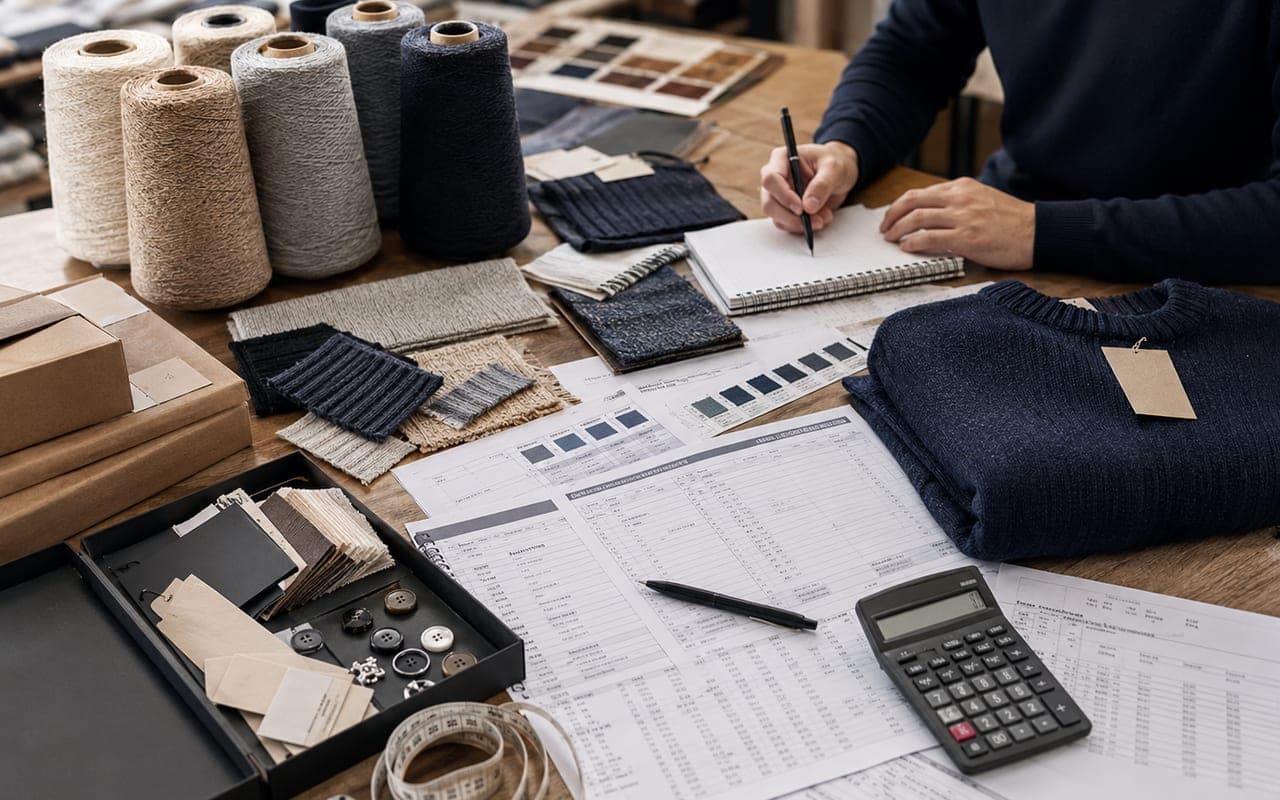
Two factories can quote wildly different prices for what looks like the same sweater, and neither is necessarily cheating you. Custom knitwear pricing is built from a stack of cost drivers, and understanding them turns a confusing quote into a negotiable, predictable number. This guide breaks down what you are actually paying for, so you can plan margins and design to a target price.
You cannot negotiate a price you do not understand. Know the cost stack, and every quote becomes a conversation instead of a guess.
The Cost Stack of a Custom Sweater
Common Questions
What drives the cost of a custom sweater most?
Yarn first, then gauge and structure, then quantity, then customisation and finishing. Yarn is the largest line and is set by the market; gauge and structure decide machine and linking time; quantity spreads the set-up.
Which cost lever does a buyer actually control?
Quantity, and the specification choices. You cannot change what cashmere costs, but you can decide the gauge, the structure, how many colourways you commit to, and how elaborate the trims and packaging are. Those decisions are where a brief becomes affordable or does not.
Does a finer gauge cost more or less?
It uses less yarn but takes longer to knit and to link, so the two partly cancel. Between 7GG and 12GG the difference is small and depends on structure and fibre. Above 12GG fine gauge genuinely costs more, and the gap widens with every needle.
How much does quantity move the price?
Enough to change what is viable, because set-up is spread across the run. That is also why minimums exist: below a certain quantity the set-up dominates the unit price. Our minimum is 30 pieces per colour.
What is the cheapest way to reduce cost without cheapening the garment?
Simplify what the customer does not see. Trims, packaging and finishing extras carry cost and their own minimums; a plainer carton and a stock label rarely affect how the garment is received, while a thinner yarn always does.
Cables, jacquard, intarsia add machine + labor time
Color count
Medium
Each color = dye lot + setup
Quantity
High (inverse)
More units = lower unit price
Labels & packaging
Low-Medium
Custom trims and boxes add up at scale
Yarn is the foundation
Fiber choice is the largest single lever. Cashmere and fine merino sit at the top; lambswool and cotton in the middle; acrylic and acrylic blends at the value end. The same style in cashmere versus acrylic can differ 3-5x in cost.
Fiber choice is the single biggest cost lever; it sets both the handfeel and the floor on your unit price.
To put the fiber lever in rough order (relative to a plain cotton baseline of 1.0):
Fiber
Relative yarn cost
Typical positioning
Acrylic / acrylic blend
0.6–0.9
Value, promotional
Cotton / cotton blend
1.0
Everyday, transitional
Lambswool / wool blend
1.3–1.8
Core winter
Merino
2–3
Premium, performance
Cashmere & blends
4–6+
Luxury
Gauge, weight and structure
A heavy 3GG chunky sweater uses far more yarn and knitting time than a fine 12GG piece, so it costs more even in the same fiber. Complex stitch work such as cables, fair isle and intarsia adds programming and slower machine speeds. A simple jersey or rib is always the most economical construction.
Quantity: The Lever You Control
Unit price drops as quantity rises, because fixed costs such as yarn dye lots, machine setup and sampling spread across more pieces. This is why MOQ and price are linked. See our MOQ guide. A rough illustration:
Small run (100-200 pcs): highest unit price; setup heavy
Mid run (300-500 pcs): setup amortizes; meaningful drop
Large run (1,000+ pcs): best unit price; yarn bought in bulk
Customization and Finishing
Woven labels, custom hangtags, special washes and branded packaging each carry a small per-unit and setup cost. Individually minor, together they can move a quote 5-15%. Decide which touches genuinely matter to your customer and which are nice-to-have.
A Sample FOB Cost Breakdown
It helps to see where the money goes inside a single FOB unit price. The exact split shifts with fiber and complexity, but a mid-range wool-blend sweater often looks roughly like this:
Component
Share of FOB
What it covers
Yarn
45–55%
The single biggest line; fiber and quantity dominate
Knitting & linking labor
20–30%
Machine time + skilled finishing
Trims, labels, packaging
5–12%
Buttons, zips, woven labels, polybags, cartons
Factory overhead & margin
10–18%
Setup, QC, profit
Reading a quote this way tells you which lever to pull: if you are over budget, the answer is almost always yarn or quantity — not shaving the factory's margin.
Costs Buyers Forget to Budget
The FOB price is not your landed cost. Build these into your plan from the start:
Sampling fees — usually charged per sample and often credited back against a bulk order.
Freight & duty — sea vs air changes both cost and timeline; import duty depends on your market and HS code. See our landed cost guide.
Revision rounds — extra sample rounds cost time and sometimes money; a complete tech pack reduces them.
Defect / AQL allowance — budget a small percentage for acceptable-quality-level tolerance.
Compliance testing — pilling, shrinkage and color-fastness reports if your market requires them.
How to Design to a Target Price
Start from your retail price and work backwards to a target FOB cost.
Pick fiber first because it sets the floor for everything else.
Simplify structure if you are over budget before cutting fiber quality.
Consolidate colors and group styles on shared yarn to spread minimums.
Commit to a realistic quantity for the unit price you need.
Share your target price openly with a good factory; the best partners will propose how to hit it rather than just say no. Pair this with our yarn selection guide and manufacturer selection guide.
Common Cost Questions
Why is my quote higher than a competitor's? Usually a different yarn quality or quantity assumption — ask for an itemized breakdown so you compare like for like.
Is cashmere always worth the premium? Only if your customer pays for it. A fine merino or a cashmere blend often delivers most of the handfeel at a fraction of the cost.
What is the fastest way to cut cost without cheapening the product? Raise quantity and consolidate colors before you touch fiber or construction.
Licheng Knitwear provides transparent, itemized quotes and helps B2B buyers design to a target price. Request a quote with your target and quantity to see the full breakdown.
---
Talk to our team about this
If you're planning a real project around any of the points above, we'd be glad to take a quick look. Send a short brief and we'll come back within one business day with a practical direction, MOQ + lead time estimate, and a sample plan if it makes sense.
Yarn composition, gauge, style complexity, color count, quantity, finishing and packaging are major cost factors.
Fixed costs - yarn dye-lot minimums, machine setup and line changeovers - are spread over fewer pieces, so the per-unit cost is higher at low volumes. The trade-off is much lower upfront inventory risk.
Yes. Acrylic and cotton blends are the most economical; merino, alpaca and cashmere blends raise the unit cost significantly.
We focus on men's sweaters, cardigans, knit jackets, jacquard knitwear and private label knitwear. We support B2B buyers with OEM/ODM development, sampling and bulk production planning.
Ready sample styles and selected custom programs can support lower-risk trials before larger seasonal orders.
Yes. Brands, including new labels preparing a first collection, can pay for a sample and see it before placing a production order. Two routes: a ready sample of a published style at USD 60 per piece in about 7 days, or a development sample from your tech pack at USD 150 per style, covering yarn sourcing, knit programming, one prototype and one revision round, in 15-25 days. Cashmere and mohair styles are quoted individually and shipping is charged at cost. Production starts only after you approve the physical sample, at our minimum of 30 pieces per colour with sizes mixed inside the 30. A sample does not commit you to a production run; we do not make garments for personal use.
Ready to Start Your Project?
Get a free catalog or submit an RFQ today. Our team will respond within 24 hours.
MOQ, lead time, cost ranges, gauge selection and QC checkpoints across typical OEM/ODM knitwear programs in NA + EU. Enter your email — we'll send you the report link in 30 seconds.
No spam. Unsubscribe with one reply. We use your email only to send you the report and follow up if you want a sourcing conversation.
Brand names shown are previously serviced OEM/ODM partners. Logos are decorative and do not imply current endorsement.