Case Study Pattern: An AW Launch Postmortem — Three Things That Went Right and Three That Did Not
Updated 10/13/202612 min readBy Simon Liu · Licheng Knitwear
Most AW knitwear postmortems get written in the wrong room. Finance asks why landed cost crept four percent; merchandising asks why the cream cardigan missed the September floor set; QC asks why returns spiked on one linking-heavy style. Each team gets a partial answer, the supplier gets a polite scolding, and the same three mistakes repeat next year. This piece is different. It is an anonymized composite pattern drawn from real AW 2025 launches we worked through with mid-market brands — no single brand, no real names, no invented numbers. The point is the shape of the decisions, not the specific shop. We walk through three calls that paid off: locking the yarn library four weeks before tech-pack handoff, running in-factory AQL-2.5 inspection before container loading, and using DDP terms on smaller secondary SKUs to spare a thin import team. Then we walk through three that did not: introducing a new yarn shade three weeks into sampling, accepting a verbal MOQ flex on a new color, and chasing a small per-piece linking saving that became a returns problem on the retail floor. The pattern that emerges is unglamorous: brand-side discipline at the front of the calendar plus clear commercial terms plus early QC almost always beats clever optimization later. Read this as a checklist for your own AW 2026 brief.
Most AW postmortems happen in the wrong meeting. Finance wants to know why landed cost crept up. Merchandising wants to know why the hero cardigan missed the September floor set. Customer service wants to know why one style returned at double the rate of the rest of the assortment. Each team gets a partial answer, the factory gets a polite scolding, and the same three mistakes quietly book themselves into next year's calendar.
What follows is an anonymized composite — patterns drawn from real AW 2025 launches we worked through with mid-market brands, no single brand named, no invented case numbers. The point is the shape of the decisions, not the shop. Three calls paid off; three did not. The pattern, once you see it, is depressingly consistent.
The Setup: What An AW Launch Actually Looks Like
Common Questions
What is worth reviewing after an autumn/winter knitwear launch?
The decisions, not just the outcomes. Landed cost, on-floor date and return rate are symptoms; the review that changes next season looks at when yarn was locked, when colour was approved, what was inspected and where terms were agreed verbally.
Ready to Start Your Project?
Get a free catalog or submit an RFQ today. Our team will respond within 24 hours.
What tends to go right in a well-run AW programme?
Locking the yarn library early, inspecting in-factory against an agreed AQL rather than on arrival, and choosing terms that match order size - DDP on smaller shipments removes clearance risk that a small brand is not equipped to carry.
What tends to go wrong?
Adding a new yarn late, accepting a minimum or a term verbally, and chasing a small per-piece saving that costs more in calendar than it returns in margin. All three are decisions rather than accidents, which is what makes them fixable.
Why does an AQL inspection belong in the factory rather than at arrival?
Because at arrival the options are acceptance or dispute. In-factory inspection against an agreed AQL leaves time to correct, which is the difference between a quality process and a quality argument.
How should a postmortem be run so it changes anything?
In one room with the people who made the calls, against the calendar rather than the P&L, and with the outputs written into next season's brief. A postmortem that lives only in finance changes nothing upstream.
Assume a mid-market brand doing roughly twelve to eighteen knitwear SKUs for AW, mixed gauges from 5GG chunky cardigans down to 12GG fine merino crews, total buy in the low four-digit-units per style for hero SKUs and a few hundred per color on long-tail items. Sample window opens early March. Bulk PO needs to clear by mid-June for a late-August in-DC date and a September floor set. Sampling lead time is the normal 7 to 15 days per round; bulk runs 30 to 45 days. None of these dates are negotiable on the retail side — the floor set is the floor set.
This is the calendar most of you are already running. The postmortem below is about what happens inside it.
What Went Right #1: Locking The Yarn Library Four Weeks Before Tech-Pack Handoff
The single highest-leverage decision the brand made was unglamorous. Four weeks before tech-packs went to the factory, the design and product development teams sat in a room and signed off a yarn library: every base yarn, every blend ratio, every count, every supplier. That list went to the factory with the tech packs, and nothing was added to it after Day 0 of sampling.
The payoff was invisible, which is the point. Across nine styles and roughly forty colorways, there were zero yarn-substitute conversations in sampling. The factory was not chasing a yarn at the last minute, the brand was not approving lab dips on a base they had not actually touched, and the development calendar moved at the rate the tech packs assumed.
If you want one habit to import from this postmortem, it is this: the yarn library is the long pole, not the silhouette. Lock it early, treat it like a contract, and refuse to amend it once sampling starts. For the framework on how to do the locking conversation, the yarn material guide and the how to choose yarn for men's sweaters piece are the references we point teams at.
What Went Right #2: In-Factory AQL-2.5 Inspection Before Container Loading
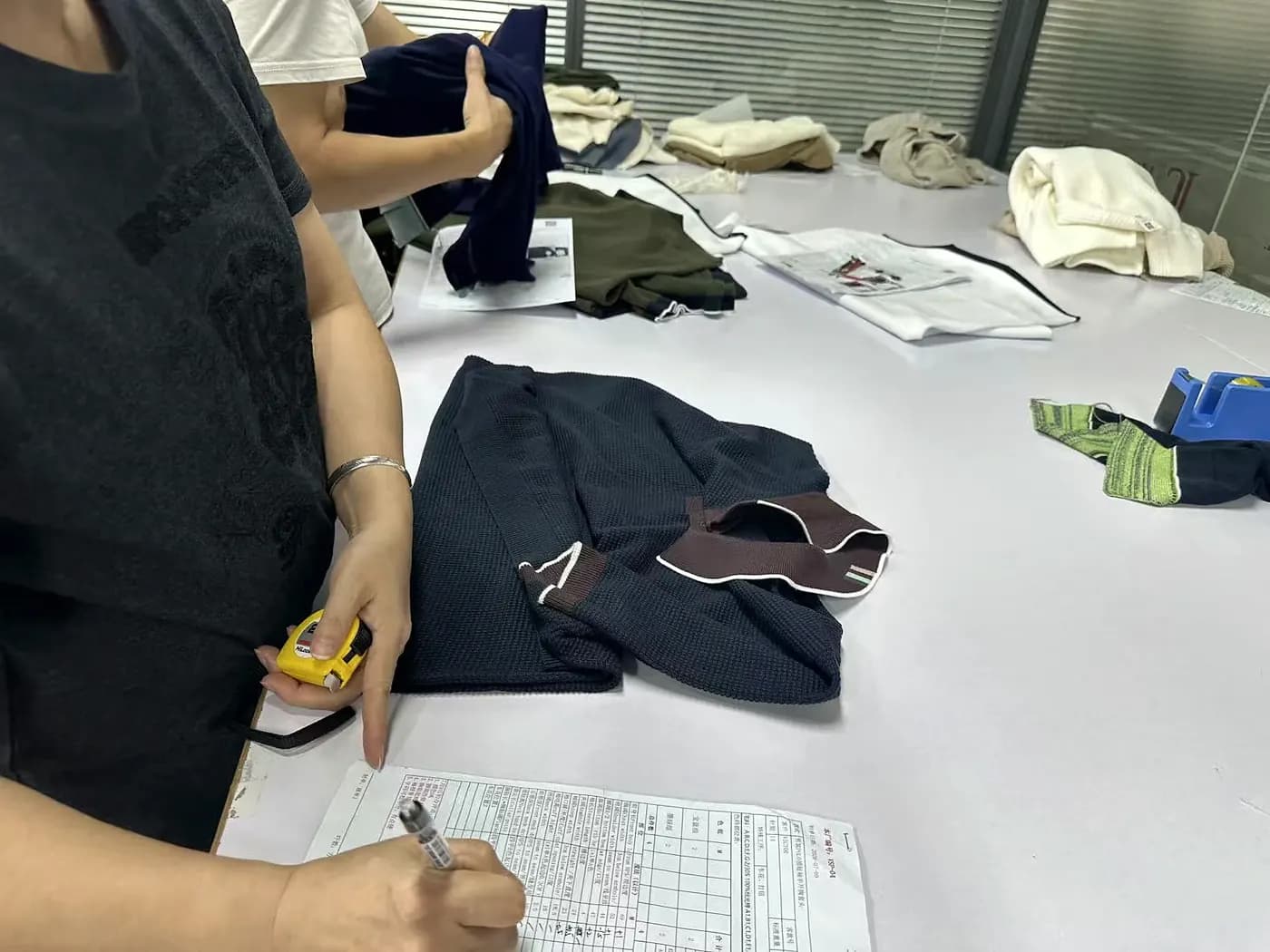
The second decision that paid off was process, not product. The brand budgeted for a single-level normal AQL-2.5 inspection inside the factory before any container loading, on every style, not just the hero ones. This was not the in-line inspection at sewing — this was the final, packed-carton inspection.
On eight of nine styles, the inspection passed cleanly. On the ninth, a cable-knit crew, the inspection found roughly eleven percent of inspected pieces failing on a linking and seam-finishing defect. Because the inspection happened with three weeks of buffer before the container date, the factory could pull the bad pieces, isolate the operator group, re-run the failed quantity on a fresh lot, and ship on time. The brand paid for the re-run on a shared-cost basis with the factory.
The alternative — discovering this at the DC, or worse, at retail — would have been a markdown event plus a return event on a hero SKU. The inspection fee paid for itself many times over. We have written more on what to actually check during a final AQL inspection in 60-minute knitwear supplier audit from your desk, and the broader vetting framework lives in how to vet a knitwear factory.
What Went Right #3: DDP Terms On Smaller Secondary SKUs
The brand in question did not have an in-house US customs broker and was running secondary SKUs at quantities that did not justify spinning up a full FOB-plus-broker flow per style. The call was to use DDP Incoterms on the secondary SKUs — let the supplier handle freight, duties, and clearance, and book a single landed-per-piece number into the P&L.
Is DDP ever the cheapest line on a spreadsheet? Almost never. The supplier prices in risk, currency, and a freight buffer. But on low-volume SKUs the cost of internal complexity — broker fees per entry, customs holds, the ops manager's time — eats the theoretical savings of FOB. DDP on secondary SKUs let a thin import team focus its attention on the hero styles where the volume justified the FOB-plus-broker work.
The relevant trade-off table looks roughly like this for an AW knitwear program at this volume:
What Went Wrong #1: Adding A New Yarn Shade After Day 21 Of Sampling
Three weeks into sampling, the merchandising team fell in love with a new yarn shade seen at a competitor floor set and pushed to add it as a fifth colorway on the hero crew. The product development lead pushed back; the call went to the brand director; the brand director approved the addition.
The consequences played out exactly as the development lead predicted. The new shade was a custom dye against an existing base, which meant a fresh lab dip cycle (three rounds), a fresh strike-off, fresh approval, and a fresh dye lot booking. The yarn mill's lead time on a custom dye against an existing base ran the better part of three weeks. Bulk PO release on that style slipped nine days. Container loading slipped accordingly. The brand missed the planned floor-set date by one week on that one SKU.
One week sounds modest. On a hero knit launching against a fast-fashion competitor's identical shade, one week off the floor is meaningful sell-through lost. The unit-level margin recovered on the new shade did not pay for the markdowns taken at end of season on the units that landed a week late.
The rule we now write into every brief: after Day 14 of sampling, no new yarn, no new shade, no new base. If merchandising wants the shade, it goes into the next drop. The mechanics of why this matters are covered in knitwear color approval lab dips Pantone and sweater sampling lead time guide.
What Went Wrong #2: Accepting Verbal MOQ Flex On A New Color
The second mistake was a commercial-terms mistake, not a technical one. The brand's standard MOQ with the factory is 30 pieces per color. On a long-tail color on a chunky cardigan, the brand wanted to test with just under MOQ. The factory's sales contact agreed verbally, on a WeChat call, without written confirmation.
What happened next is what always happens when a yarn dye lot is booked under MOQ verbally. The mill ran the dye lot at the minimum economic batch size, which was larger than the brand's PO. The factory used the underflow to pad another order at a similar shade. The resulting dye lots, when the brand's pieces and the other order's pieces went through the same finishing line on different days, finished slightly differently. Color migration showed up after the steam-and-press finishing stage on a portion of the cardigan run.
The lesson is not don't ask for MOQ flex — sometimes it is appropriate. The lesson is: get it in writing, get the mill lot allocation in writing, and accept that the per-piece yarn cost on a sub-MOQ color will not be the same as the per-piece on an at-MOQ color. The custom sweater MOQ guide walks through what a clean MOQ-flex conversation looks like in a quotation.
What Went Wrong #3: Chasing Two Percent Per-Piece Savings On Linking
The third mistake is the most expensive in our experience and the one brands repeat most often. Late in negotiations, the brand pushed the factory to switch one cable style from full-fashion linking on the shoulder seam to a faster linking method. The per-piece saving was modest — roughly two percent of garment FOB. The QA team was not in the negotiation. No revised seam-strength or appearance check was added to the AQL.
The finished product looked fine at the AQL inspection. It looked fine on the brand's QA sample. It looked less fine after one wash at the customer's home — visible seam puckering at the shoulder, the kind of defect that does not return a single unit but lowers the perceived quality of the whole label. The returns rate on that style ran higher than the rest of the AW assortment. The cost of those returns and markdowns was a multiple of the savings the linking change unlocked.
The right rule is simple and unfashionable in a margin meeting: any change to construction method requires QA sign-off and a revised AQL appearance and durability check. If QA cannot sign off in writing, the change does not happen. For the technical background on which linking methods are appropriate for which silhouettes, the knit stitch structures buyer guide and knitwear finishing brushing steaming pressing anti-pill pieces are the references we use.
The Pattern, In One Paragraph
Look at the six decisions together. The three that worked were all front-loaded: lock yarn early, inspect before loading, choose Incoterms that match the team's capability. They are unglamorous, they happen weeks before the photogenic part of the calendar, and they are easy to skip when the brand is busy. The three that hurt were all back-loaded and reactive: chase a new shade in the middle of sampling, accept a verbal commercial concession, save two percent on construction without QA in the room. Every one of the three failures cost more than the equivalent win it was chasing.
This is not a moral story about discipline. It is a structural observation about where leverage lives in a knitwear calendar. Front of the calendar: cheap to do right, expensive to skip. Back of the calendar: late changes cost calendar days at the worst possible moment.
What To Take Into Your AW 2026 Brief
A short version of the standing rules we now write into every AW production brief for a mid-market brand:
Yarn library locked four weeks before tech-pack handoff. Signed off in writing by design, PD, and sourcing. Amendments go to the next drop, not this one.
AQL-2.5 in-factory final inspection budgeted on every style. Not just hero SKUs. The marginal cost is small relative to one returns event.
Incoterms matched to internal capability, not to spreadsheet-optimal. DDP on long tail, FOB on hero, no ego involved.
Sampling change-control after Day 14. No new yarn, no new shade, no new construction. Hold the line at the director level.
MOQ flex always in writing, with mill lot allocation specified. A WeChat handshake is not an agreement.
Any construction method change requires QA sign-off and a revised inspection checklist. No exceptions for margin pressure.
None of this is glamorous and none of this is new. The point of writing it down is so that next April, when the same three decisions come back around the table, someone in the room can pull this document and say: we already learned this one.
---
Talk to our team about this
If you're planning a real project around any of the points above, we'd be glad to take a quick look. Send a short brief and we'll come back within one business day with a practical direction, MOQ + lead time estimate, and a sample plan if it makes sense.
For most mid-market brands it is realistic if the design direction is locked before yarn selection starts, not in parallel. The four weeks is measured backward from tech-pack handoff to the factory, not from concept. In practice that means design direction settles in late February, yarn library selection happens through early March, and the lock happens roughly four weeks before tech packs leave in late March. Brands that try to run yarn selection and silhouette design in parallel almost always slip the lock. The discipline is sequencing, not speed.
Yes, in our experience, and the math is almost always in favor of inspecting. A single-level normal AQL-2.5 inspection on a 300-500 piece run is a modest fixed fee — far less than the cost of a single returns event on a defect that ships to DC. The reason brands skip it on small styles is they assume the risk is proportional to volume; it is not. A 15 percent reject rate on a 400-piece style is still 60 returned units, which on a knitwear price point is real money. Inspect everything that ships.
Roughly when the brand has an in-house or contracted customs broker and is moving enough volume on a style that the per-entry brokerage cost amortizes well. For most mid-market brands that means hero SKUs and any style buying in container quantities go FOB, while long-tail styles and small replenishment orders stay DDP. The breakeven is not really about per-piece cost — it is about whether the brand's ops team has the bandwidth to manage clearance without distraction. If the answer is no, DDP is the right call regardless of the per-piece spread.
The mill needs a minimum economic batch size for a custom dye lot, usually larger than a 30-piece MOQ. When a brand orders sub-MOQ verbally, the mill runs the minimum batch and uses the surplus elsewhere — often padding a similar shade for another customer. If those two orders go through the same finishing line on different days with slightly different parameters, the finished pieces can drift apart on shade. The written version of MOQ flex specifies lot allocation, finishing schedule, and shade-tolerance acceptance criteria. Verbal does not.
Build the rule into the development brief at the start of the season, not at the negotiation table. The written rule is simple: any change to construction, linking, finishing, or fiber blend after the gold seal sample requires QA sign-off in writing and a revised AQL inspection plan. Finance does not have to agree with the rule emotionally — they just have to acknowledge that the savings on the spreadsheet are conditional on QA approval. Most of the time, asking QA to sign off in writing kills the bad ideas before they reach the factory.
We focus on men's sweaters, cardigans, knit jackets, jacquard knitwear and private label knitwear. We support B2B buyers with OEM/ODM development, sampling and bulk production planning.
MOQ, lead time, cost ranges, gauge selection and QC checkpoints across typical OEM/ODM knitwear programs in NA + EU. Enter your email — we'll send you the report link in 30 seconds.
No spam. Unsubscribe with one reply. We use your email only to send you the report and follow up if you want a sourcing conversation.
Brand names shown are previously serviced OEM/ODM partners. Logos are decorative and do not imply current endorsement.