Case Study Pattern: Scaling From Pilot to Reorder Calendar — A Knitwear Brand 18 Months In
Updated 9/19/202612 min readBy Simon Liu · Licheng Knitwear
Most knitwear brands hit the same wall around month 14. The first season was a thrill — one pilot PO, a tight tech pack, a handful of stockists. By the second autumn the founder is firefighting between new development and chasing the same three best-sellers that should, by all rights, just reorder cleanly. They don't. Each repeat behaves like a new program: fresh sampling, fresh yarn lot, fresh lead-time fight.
This piece is an anonymized composite drawn from real client work with brands transitioning out of the one-off PO model. The protagonist is a small UK menswear label — chunky lambswool, a fisherman cable, a brushed mohair piece — who went from a 600-piece pilot in year one to a four-PO yearly calendar by month 18. The transformation was not glamorous. It came from separating the engine SKUs from the new development track, locking the tech packs they should not have been touching, and pre-booking yarn at fiber-mill level instead of waiting for the spinner to allocate.
We walk through what changed mechanically: sampling iteration time dropping from six weeks to eleven days, FOB falling roughly eight percent without anyone renegotiating, and lead time tightening to 28 days on repeats. We also cover what disqualifies an SKU from the reorder track entirely — silhouette change, yarn change, anything that breaks the tech pack lineage. The lesson is unglamorous: reorder discipline is a documentation and calendar problem, not a price problem.
Most small brands hit the same wall somewhere around month 14. The first pilot was a thrill — one PO, one season, a handful of stockists, a press hit if you were lucky. By the second autumn the founder is firefighting between developing next year's range and chasing the same three best-sellers that should, by all rights, just reorder cleanly. They don't. Each repeat behaves suspiciously like a new program: fresh sampling, fresh yarn lot, fresh lead-time fight, fresh anxiety. This is the gap between making product and operating a brand, and most of the literature on it is written by consultants who have never paid a sample fee.
What follows is an anonymized composite drawn from real client work — pattern, not a single brand. The numbers are rounded. The protagonist is a UK menswear label working in chunky lambswool, a fisherman cable, and a brushed mohair piece. Founded by a former buyer, sells through about 18 specialty doors plus DTC. Pilot order in year one: 600 pieces across three styles. By month 18 they were running a four-PO yearly calendar with locked engine SKUs and a separate new-development track. The story is in the operating model, not the product.
The State of Play at Month 6
Ready to Start Your Project?
Get a free catalog or submit an RFQ today. Our team will respond within 24 hours.
What changes for a knitwear brand around 18 months in?
The programme splits into two tracks: new development, which behaves like a first order, and reorders of proven styles, which behave completely differently. Managing them on one calendar is what makes a growing brand feel slower than it did at the start.
What does a reorder track actually unlock?
Shorter lead times and fewer sample rounds, because pattern, yarn and colour are already approved. It also makes yarn pre-booking possible, which is the step that removes the longest external dependency from the calendar.
What is fibre-mill level yarn pre-booking?
Committing to yarn quantities ahead of the season rather than at PO time. It shortens the reorder calendar substantially and it trades flexibility for speed, so it suits styles whose demand is proven.
Which SKUs should be excluded from a reorder calendar?
Anything whose sell-through is unproven, anything whose yarn is being discontinued, and anything that still generates fit corrections. A reorder track only works if the styles in it are genuinely settled.
Do commercial terms change as volume grows?
They usually should. Consolidating terms across a reorder programme - payment, incoterm, inspection - removes friction that was tolerable at pilot volume and becomes expensive at scale.
The pilot was, by founder standards, a success. The 600 pieces sold through. Two of the three styles — the lambswool crew and the mohair — were obvious repeats. The third, a cardigan, was fine but not a hero. Year two opened with what the founder reasonably assumed would be a straightforward reorder.
It wasn't. The lambswool came back with a slight handfeel drift from the pilot because the yarn lot had shifted at the spinner. Color on the mohair pulled half a Delta-E unit warmer because the dye lot was new. The factory quoted a 42-day lead time because the brand was, from their slot calendar's perspective, a new program. There was no tech-pack memory because the brand had treated the pilot as a one-off — every PO got a fresh sample round, fresh lab dips, fresh fit corrections. Six weeks of sampling for what was, structurally, the exact same garment.
This is the most common failure pattern we see in brands at this stage. They got product to market. They have not yet built the muscle to repeat that product cheaply.
Separating the Two Tracks
The first move at month 8 was conceptual, not operational. The founder, on advice that took three calls to land, agreed to split the line into two distinct tracks:
Engine SKUs: the three best-sellers that would be reordered, not redesigned. Tech packs frozen. No silhouette change, no yarn change, no gauge change. Color rotation only, and even that limited to a defined palette.
New development: everything else. New silhouettes, new yarns, capsule pieces, collaborations. Treated as fresh programs with full sampling cycles.
This sounds obvious. In practice almost no early-stage brand does it cleanly, because the founder is also the designer, and designers want to improve things. The lambswool crew got a half-inch tweak to the body length, the mohair got a slightly different rib depth, the cardigan got new buttons. Each tweak felt minor. Each tweak, from a production standpoint, voided the reorder track and pushed the SKU back into new development.
The operating rule that stuck: if you want to change it, it's no longer a reorder. Make a v2 with a new style code. Run it on the development track. Keep the v1 alive until v2 proves out.
What the Reorder Track Actually Unlocks
Once three SKUs were genuinely ringfenced, mechanical things started to happen at the factory.
Sample fee amortization. The original pilot sample fees were sunk cost. With the tech pack frozen, repeats didn't require new size sets or new sealed samples — just a top-of-production reference. The factory was willing to skip the formal sample charge on repeats because the risk was bounded. The brand stopped paying for samples they'd already paid for.
Lead time compression. New knitwear programs typically run 35-45 days from PO to ex-factory once yarn is in. Repeats with a stable tech pack and pre-allocated yarn dropped to around 28 days because the factory could pre-block the production slot and skip the pre-production sample approval window.
Yarn library efficiency. The same yarns kept coming back. The factory, which sources from a stable of mills, started holding shade references and lot-bridging notes for the brand's specific yarns. When a fresh lot came in, the lab could match against the prior reference without a full new lab-dip cycle. This is the unglamorous source of the cost drop.
Pre-Booking Yarn at the Fiber-Mill Level
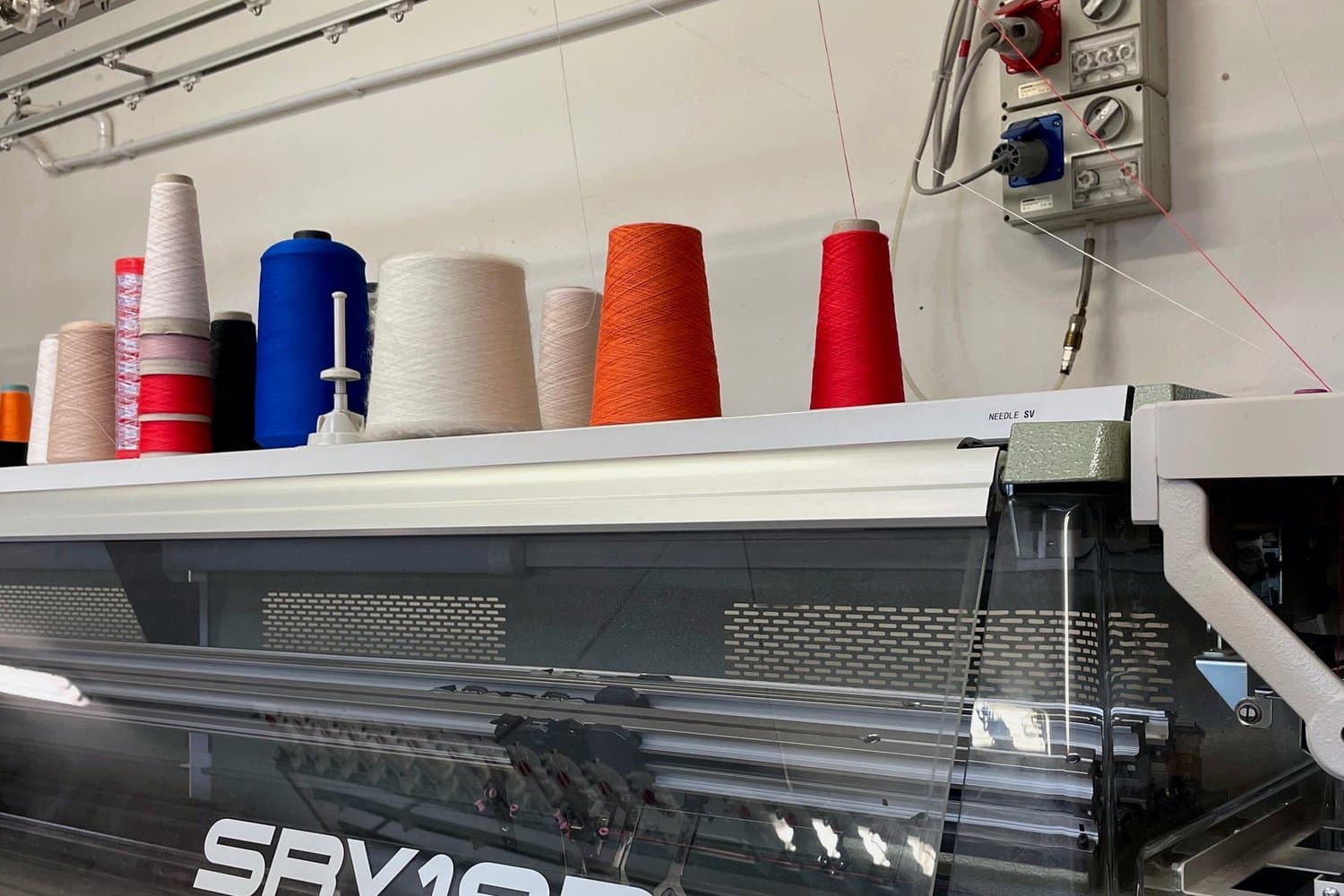
The second structural move came at month 11, before the AW dye block. Knitwear factories typically buy yarn from spinners against confirmed POs. For one-off brands that means yarn lead time stacks on top of production lead time and you take whatever lot is available.
For the engine SKUs, the brand committed — in writing, against a non-binding forecast — to roughly 65 percent of expected AW reorder volume. The factory used that forecast to pre-book the lambswool and the mohair at the spinner, who in turn could request a fiber lot from the mill before the broader AW Q3 dye block. The brand wasn't placing a yarn PO, exactly; it was sitting inside the factory's aggregated yarn buy, which is the only way small brands get access to fiber-level allocation.
This is the single highest-leverage move in the whole exercise. Yarn pricing and yarn availability are both more sensitive to timing than to volume at this scale. A 200-piece reorder placed inside the Q3 dye block costs and runs differently from the same 200 pieces placed in November against whatever the spinner has left.
The Numbers, Rounded
These are composite figures, rounded the way industry numbers should be reported.
Metric
Pilot (Year 1)
Month 18 Reorder
Change
Sample iteration time
~6 weeks
~11 days
-75%
Lead time PO to ex-factory
~42 days
~28 days
-33%
Per-piece FOB (lambswool crew)
baseline
~8% lower
-8%
Lab-dip rounds per color
2-3
0-1 (lot bridging)
n/a
Production slot lead
ad-hoc
pre-blocked
n/a
MOQ pressure
tight at 30/color
absorbed across calendar
n/a
The per-piece FOB drop deserves a note. Nobody renegotiated anything. The list FOB on the tech pack didn't change. The effective per-piece cost dropped because: sample charges were no longer being amortized into small runs, yarn was sitting in a more efficient lot, and shipping consolidation across the calendar improved. This is what "price coming down at scale" actually looks like in knitwear — not a number on a quote sheet but a slow tightening of the underlying cost stack.
Consolidating Commercial Terms
The third move, at month 14, was administrative. Every prior PO had been negotiated as a one-off — slightly different payment terms, slightly different Incoterms, different inspection arrangements. Reconciling them was a part-time job.
The brand and the factory agreed a single PO template covering the engine SKUs for the next 12 months: terms (30 percent deposit, 70 percent against shipping copy), Incoterm (FOB Shenzhen), inspection (AQL 2.5 on a defined defect list, third party from the brand's side), packaging spec frozen, hangtag artwork frozen. New POs against the template only need to specify SKU, color, size break, and quantity. They sign and run.
This sounds like paperwork. In operational terms it's the difference between a brand and a series of orders.
What Disqualifies an SKU From the Reorder Track
The single most expensive mistake we see at this stage is the founder quietly making changes that void the reorder discipline. The hard rule the brand adopted, after one painful relapse on the mohair:
Silhouette change — any pattern adjustment, body length, sleeve length, neckline opening. Voids the reorder; goes to development track as a v2.
Yarn change — different fiber, different ply, different mill, different spinner. Voids it. Even "the same yarn from a different mill" is a new program.
Gauge change — moving from 7GG to 5GG or any structural knit change. Voids it.
Fit grading revision — re-grading the size set. Voids it.
Color rotation — this is fine, within a pre-defined palette. The lab-dip cost is bounded.
Trim swap — usually fine if it's a like-for-like substitution. Care with branded trims that have their own lead time.
The rule of thumb: if the change requires a new sealed sample, it's not a reorder.
What the Reorder Calendar Looks Like
By month 18 the brand was running a four-PO yearly cadence on the engine SKUs. The development track ran independently.
PO 1 (January) — late SS top-up on the spring-summer engine items.
PO 2 (May) — AW main buy, placed inside the Q3 dye block with pre-booked yarn.
PO 3 (August) — AW top-up, slotted against actual sell-through data from August trade.
PO 4 (November) — early SS commitment plus any pre-holiday top-up.
The development track ran on its own clock: new program briefs in March, sampling May-July, sealed samples August, production-ready by the following March. The two tracks shared a factory but not a calendar or a tech-pack governance process.
What This Is Not
This pattern works for a brand with at least one or two genuine engine SKUs — pieces that have proven sell-through across a full season and are likely to sell again. It does not work for brands whose entire identity is constant product newness. It also does not work if the founder cannot resist tweaking. The discipline question is whether you can leave a working garment alone.
It is also not a magic cost lever. The eight percent FOB drop on the engine SKUs took 18 months to materialize and came from operational compounding, not negotiation. Brands that show up demanding lower prices on small repeat POs without changing how they place those POs generally get nowhere.
The shift from one-off model to reorder calendar is, structurally, a transition from being a customer to being a partner. The factory invests in the relationship — slot allocation, yarn pre-booking, lot bridging — because the forecast is real enough to plan against. That investment shows up as cost and lead-time efficiency that a one-off buyer literally cannot access. It is paid for in forecast discipline, not in dollars.
---
Talk to our team about this
If you're planning a real project around any of the points above, we'd be glad to take a quick look. Send a short brief and we'll come back within one business day with a practical direction, MOQ + lead time estimate, and a sample plan if it makes sense.
Practically, one strong full season plus the early read on a second season is enough to start. We have seen brands lock too early — calling something an engine SKU after a single launch month that benefited from press or a stockist push that won't repeat. The cleaner signal is sell-through at full margin across the natural season window (eight to twelve weeks for AW knitwear), plus reorder demand from at least two stockists. If both are present, freeze the tech pack. If you are still asking whether it's a hero, it isn't yet.
Direct FOB renegotiation on small-volume reorders rarely works and often damages the relationship. Factories quote against time-and-materials reality, and a 200-piece repeat doesn't change their reality. What does work is structural: pre-booking yarn against a forecast, consolidating POs into a calendar the factory can slot, freezing the tech pack so sampling cost disappears, and stabilizing commercial terms so admin cost falls. These compound. The eight percent we typically see in our composite cases comes from this stack, not from anyone redrawing the quote sheet.
For a small brand this generally means committing to roughly 60-70 percent of expected reorder volume on a specific SKU at a specific gauge in a specific yarn, ideally three to four months ahead of the relevant dye block. The commitment is rarely a binding PO — it's a forecast the factory uses to aggregate yarn buys across customers. The brand carries some risk if reorders underperform, but the upside is access to better lots and locked pricing. Without a forecast, the brand sits at the back of the line and buys whatever yarn the spinner has left.
Build a defined seasonal palette per engine SKU — typically four to six colorways the SKU is approved to run in, with sealed lab dips on file. Color rotation within that palette is reorder-track behavior: no new sampling, just confirm the lot against the existing reference. Adding a color outside the palette is a development-track event — it needs fresh lab dips and ideally a strike-off in the actual stitch structure. The discipline is to plan the palette annually rather than ad-hoc, so the factory's lab work is bounded and predictable.
Treat development as a deliberately separate workstream with its own brief cycle, its own sample budget, and its own production slot allocation. The most common failure is the founder reactively cramming new ideas into engine reorders to save time, which contaminates the discipline. A useful rule: development POs are scheduled at fixed points in the year (typically two new-program windows per year for a small brand) and engine reorders never get tweaked to accommodate them. If a new piece is ready in time for the window, it ships; if not, it waits.
We focus on men's sweaters, cardigans, knit jackets, jacquard knitwear and private label knitwear. We support B2B buyers with OEM/ODM development, sampling and bulk production planning.
MOQ, lead time, cost ranges, gauge selection and QC checkpoints across typical OEM/ODM knitwear programs in NA + EU. Enter your email — we'll send you the report link in 30 seconds.
No spam. Unsubscribe with one reply. We use your email only to send you the report and follow up if you want a sourcing conversation.
Brand names shown are previously serviced OEM/ODM partners. Logos are decorative and do not imply current endorsement.