Pilling Resistance: Yarn Selection and Process Controls That Matter
更新 2026/6/5约 12 分钟阅读Licheng Knitwear 团队
Pilling is the single most common consumer complaint a QC lead hears about knitwear, and most of the root causes are locked in long before bulk knitting starts. This guide breaks down what pilling actually is — short fibres migrating to the garment surface and tangling under friction — and walks through the levers that decide whether a sweater shrugs off abrasion or balls up after three wears. We cover fibre length and yarn twist at the spinning stage, mill processes such as combing and gas singeing, finishing options including anti-pill chemistry and brushing direction, and the practical Martindale and ICI pillbox tests buyers can specify at the sample stage. Written for QC leads tired of post-sale returns, it is a buying and approval guide, not a marketing pitch.
1. 概览
Pilling is the single most common consumer complaint a QC lead hears about knitwear, and most of the root causes are locked in long before bulk knitting starts. This guide breaks down what pilling actually is — short fibres migrating to the garment surface and tangling under friction — and walks through the levers that decide whether a sweater shrugs off abrasion or balls up after three wears. We cover fibre length and yarn twist at the spinning stage, mill processes such as combing and gas singeing, finishing options including anti-pill chemistry and brushing direction, and the practical Martindale and ICI pillbox tests buyers can specify at the sample stage. Written for QC leads tired of post-sale returns, it is a buying and approval guide, not a marketing pitch. 本指南介绍与 Licheng Knitwear 合作时的主要制造流程。
买家指南内容
Pilling sits at the top of almost every knitwear returns dashboard we have ever been shown. It is rarely a single defect — it is the predictable end-state of decisions that were made months earlier in spinning, knitting and finishing. By the time a customer is photographing fuzz balls on a sleeve and emailing the brand, the levers that mattered are no longer accessible.
This guide is written for the QC lead who has lived through that conversation more than once. Our position is straightforward: pilling resistance is bought at the yarn and process stage, verified at the sample stage with the right test method, and then protected by a finishing spec that survives bulk. Skip any of those three layers and you are gambling.
A pill is a small ball of tangled fibre anchored to the fabric surface by a few longer fibres acting as a tether. The mechanism has four stages and understanding all four matters, because different yarns and constructions fail at different stages.
Ready to Start Your Project?
Get a free catalog or submit an RFQ today. Our team will respond within 24 hours.
First, fuzz forms: short fibre ends work their way out of the yarn structure and stand up on the surface. Second, those loose fibres tangle with each other under abrasion — a backpack strap, a desk edge, a seatbelt. Third, the tangle densifies into a recognisable pill. Fourth — and this is the stage that decides whether the consumer sees a problem or not — the pill either falls off (because its tether fibres are weak or short) or stays attached (because its tether fibres are strong or long).
This is why pilling severity is not simply 'how much fuzz' — it is the ratio of pill formation to pill shedding. A cheap acrylic with very strong fibres can actually pill worse than a fragile lambswool, because the lambswool pills shed quickly while the acrylic pills cling. We have had buyers reject a 'soft' sample for pilling and approve a coarser sample that performs better in test — the second yarn was simply better at letting pills fall off. Understanding this ratio is what separates a useful pilling spec from a vague aspiration to 'not pill', and it is the framing we encourage buyers to bring into every sample review meeting.
How Yarn Selection Drives Pilling
How Yarn Selection Drives Pilling
The single biggest predictor of pilling resistance is fibre length. Short staple fibres have more loose ends per unit of yarn, so more starting material for fuzz. Long staple cotton, long-fibre wool grades and the longer cashmere grades all give you a head start. When you see a yarn spec that highlights 'long staple' or 'extra long staple' (ELS), that is the spinner telling you the raw material has fewer short ends to migrate. Where you can specify it, it is worth specifying, and it is worth asking the spinner for the staple length distribution rather than a single headline number.
The second lever is twist. A higher-twist yarn locks fibres into the structure and reduces migration. Low-twist or zero-twist yarns feel softer because the surface fibres are free to move — but free-to-move is exactly the property that produces fuzz. This is the trade-off buyers most often misjudge: the softest hand at sample stage is usually the worst-performing yarn at three months of wear. If you are sourcing a softness-led product, accept that you will need extra finishing work to compensate, and budget the cost of that finishing into the FOB rather than discovering it during costing negotiations.
The third lever is fibre blend. Mixing a low-pilling fibre with a high-pilling one does not give you the average — it often gives you the worse outcome, because the weaker fibre forms pills and the stronger fibre tethers them. Wool–acrylic and cotton–polyester blends are common offenders. Wool–nylon at small nylon percentages (used in sock-yarn style constructions) is the exception that tends to behave well because the nylon adds tensile strength without creating long-fibre tethers.
The fourth lever is yarn structure itself. Two-ply and three-ply yarns generally pill less than single-ply because the twist of plying locks surface fibres in. Compact-spun and Siro-spun yarns pill less than ring-spun of the same fibre because their geometry traps short ends. When a spec sheet quotes a spinning system, it is telling you something material — not a marketing detail.
Mill Process Controls That Reduce Pilling
Once fibre and blend are chosen, the mill still has two large levers.
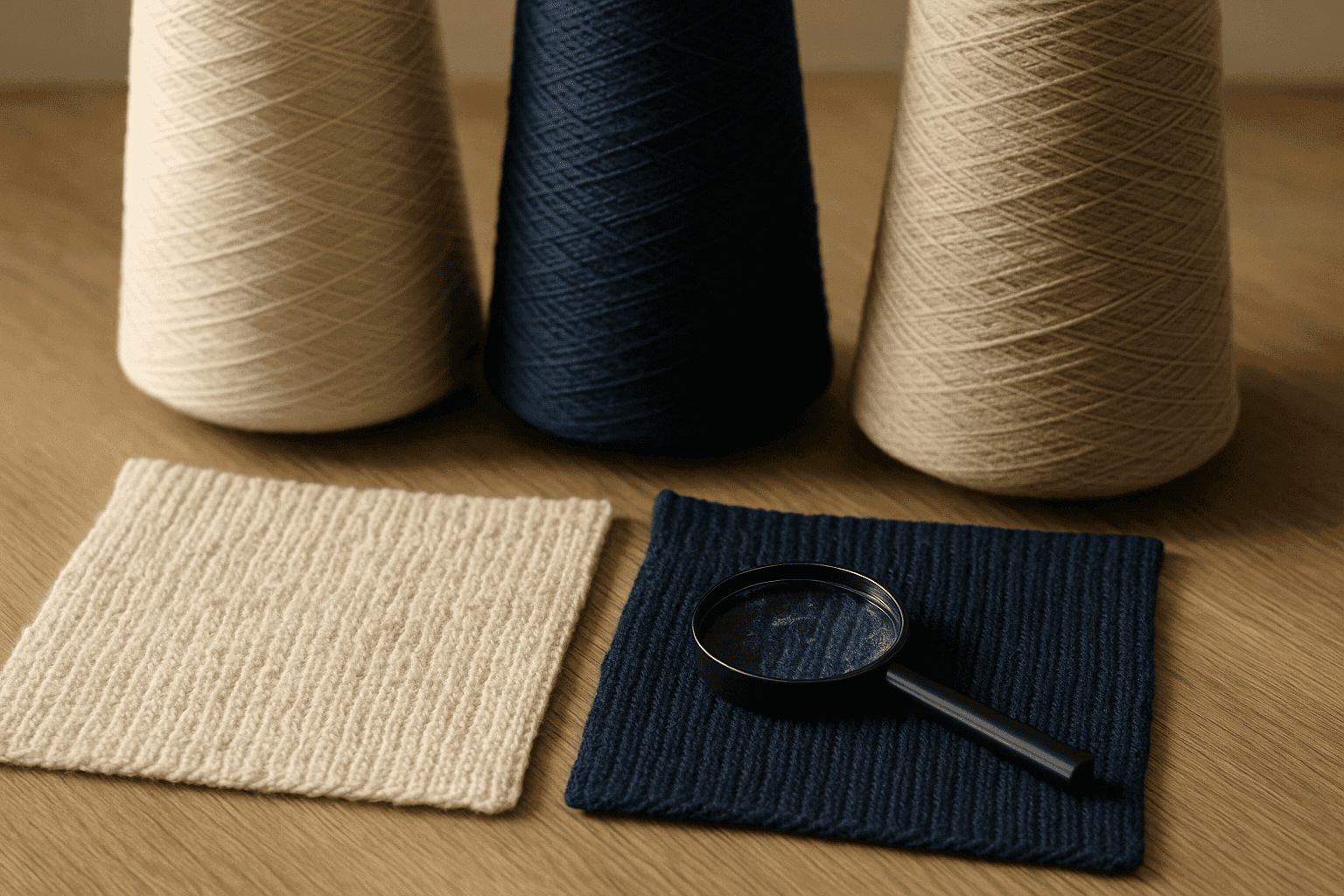
Combing removes the shortest fibres from the cotton or wool top before spinning, leaving a more uniform length distribution and dramatically fewer migration candidates. Combed cotton yarn pills less than carded cotton of the same staple, every time. The cost difference is real but small in the context of a finished sweater; for any product where pilling matters, combed is the default we recommend.
Gas singeing is the process that runs the spun yarn through a controlled flame, burning off protruding fibre ends. The effect is cosmetic and functional at once — the yarn looks cleaner and pills less because the starting fuzz population has been physically removed. Gas-singed yarn (sometimes labelled 'mercerised and gas-singed' on cotton) is standard for premium polo and fine-gauge programs. It adds cost per kilo and does not work on every fibre — heavily lofted wool yarns or brushed mohairs cannot be singed without destroying the hand. When the construction allows it, it is one of the cleanest interventions available.
A third mill-side control is yarn waxing and conditioning before knitting. Properly conditioned yarn knits at consistent tension, which produces a more uniform stitch and reduces the localised surface stress that promotes fuzz at high-friction zones such as cuffs and underarms. This is a quiet variable that buyers cannot easily inspect, but it is one we ask about when qualifying a new spinner, alongside questions about humidity control on the spinning floor and yarn storage conditions before delivery.
Factory Finishing: Anti-Pill Chemistry And Brushing
At the factory, two finishing levers matter.
Enzyme washing (commonly cellulase wash on cotton) chemically removes the protruding short fibres that survived spinning. The wash is the same family of treatment used to soften denim. It improves both hand and pilling at the same time, which is rare among interventions. Wool can be treated with comparable resin or polymer finishes branded as 'anti-pill' or 'easy-care' — these coat the fibre surface so loose ends cannot migrate as freely. Both treatments add cost and both have ceiling effects — anti-pill chemistry buys you a grade or so on a standard test, not a transformation.
Brushed and raised fabrics — mohair, brushed lambswool, fluffy melange — are a special case. Brushing deliberately lifts surface fibres for hand, which is the opposite of what you do to suppress pilling. The mitigation is direction control: brushing one way (with the knit direction) lifts fibres without breaking them, while brushing against the knit creates short, broken ends that immediately fuzz. A well-controlled brushed sweater can still pass commercial pilling tests; a poorly controlled one will not. If you are buying brushed, this is a question to ask explicitly.
Steam pressing and the final finishing setting also matter. Over-pressed garments can have a smooth, glossy surface that hides incipient fuzz at PP stage and then releases it after the first home wash. We have learned to wash-test finished samples before accepting them, not just inspect them.
Comparing Yarn Choices For Pilling Resistance
The table below summarises how common yarn directions tend to behave, the typical anti-pill treatment that applies, and where buyers can ask for an upgrade. These are directional ranges based on common spec sheets in our category and on test results we have seen across projects — not a guarantee for any specific lot, which is why sample-stage testing exists.
Yarn direction
Typical pilling tendency
Common anti-pill route
When to upgrade
Combed long-staple cotton
Low to moderate
Enzyme/cellulase wash
Default for premium cotton programs
Carded short-staple cotton
High
Limited — switch fibre
Avoid for visible-wear zones
Worsted wool (combed)
Low to moderate
Resin anti-pill finish
Tailored and fine-gauge product
Woollen wool (carded, lofted)
Moderate to high
Limited — accept and disclose
Heritage chunky knits
Merino, fine micron
Moderate
Resin/Hercosett type finishes
Next-to-skin programs
Cashmere
Moderate (sheds quickly)
Enzyme softening
Set buyer expectations
Acrylic, standard
High (pills cling)
Anti-pill acrylic variants
Specify anti-pill grade
Cotton–polyester blend
High
Limited
Reconsider blend
Wool–nylon (low nylon %)
Low
Inherent
Strong default for socks and hems
Brushed mohair
High by design
Direction-controlled brushing
Disclose to consumer
Test Methods Buyers Should Specify At Sample Stage
Test Methods Buyers Should Specify At Sample Stage
Do not approve bulk on visual inspection alone. The industry has two standard test methods and every sample for a pilling-sensitive program should run one of them.
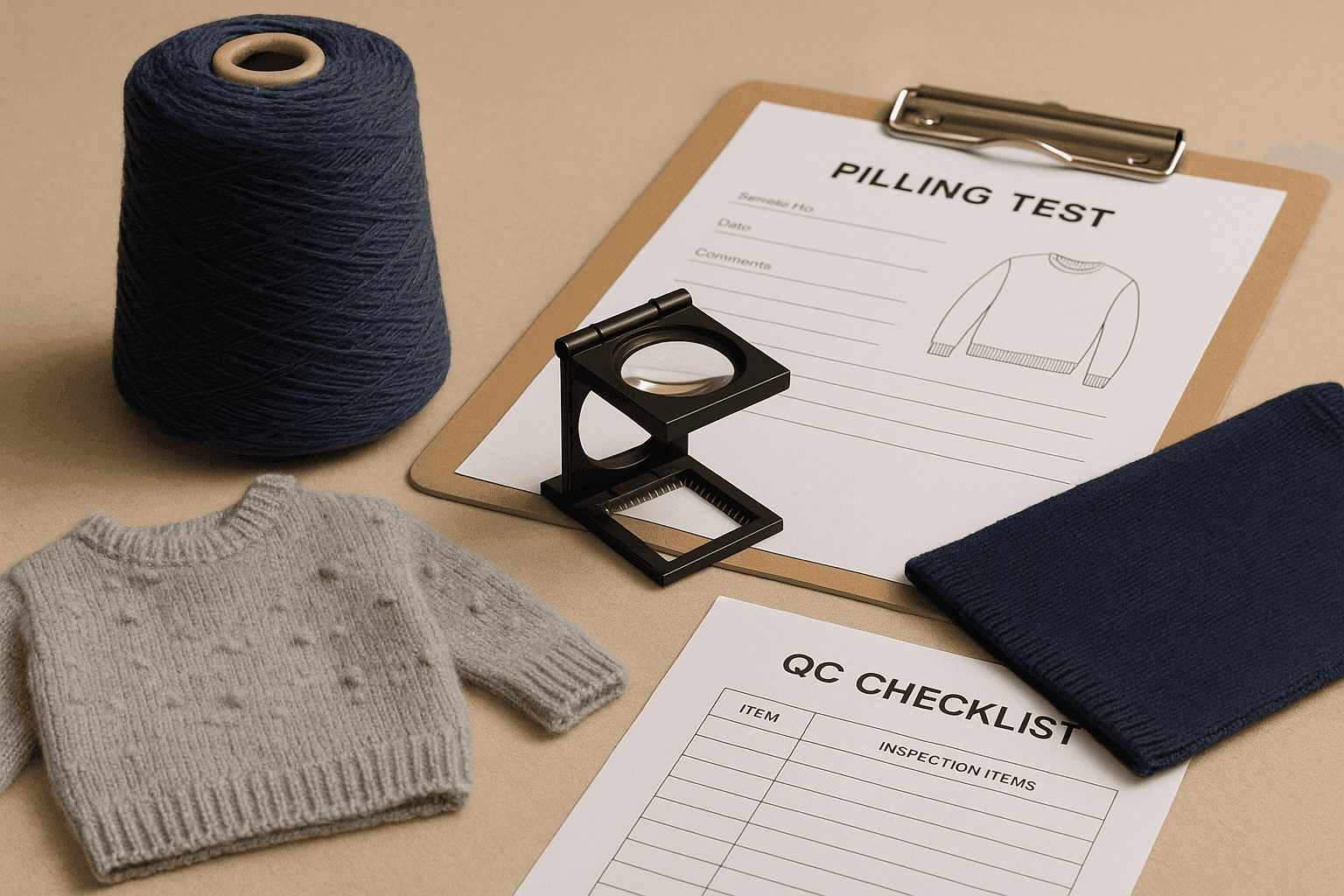
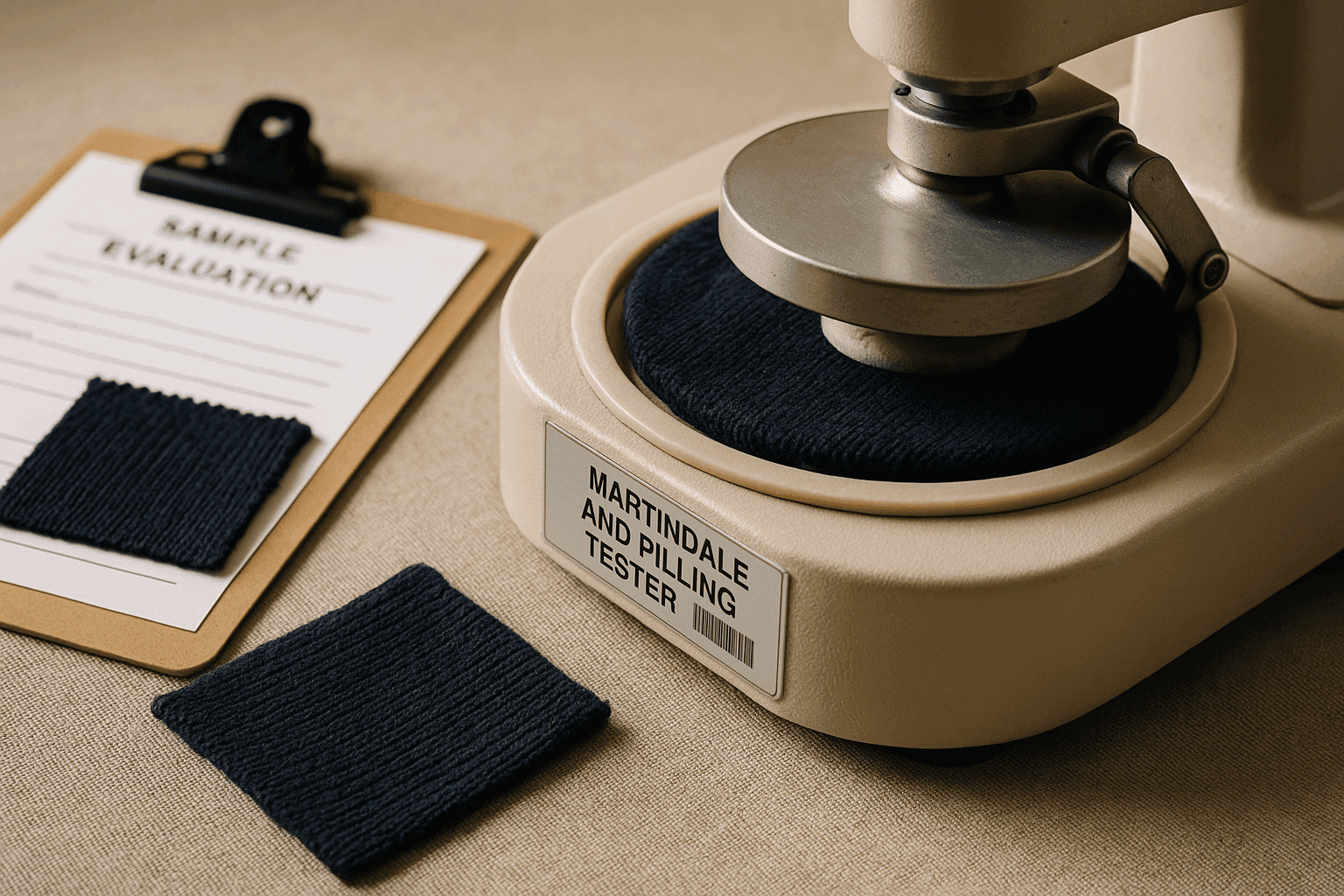
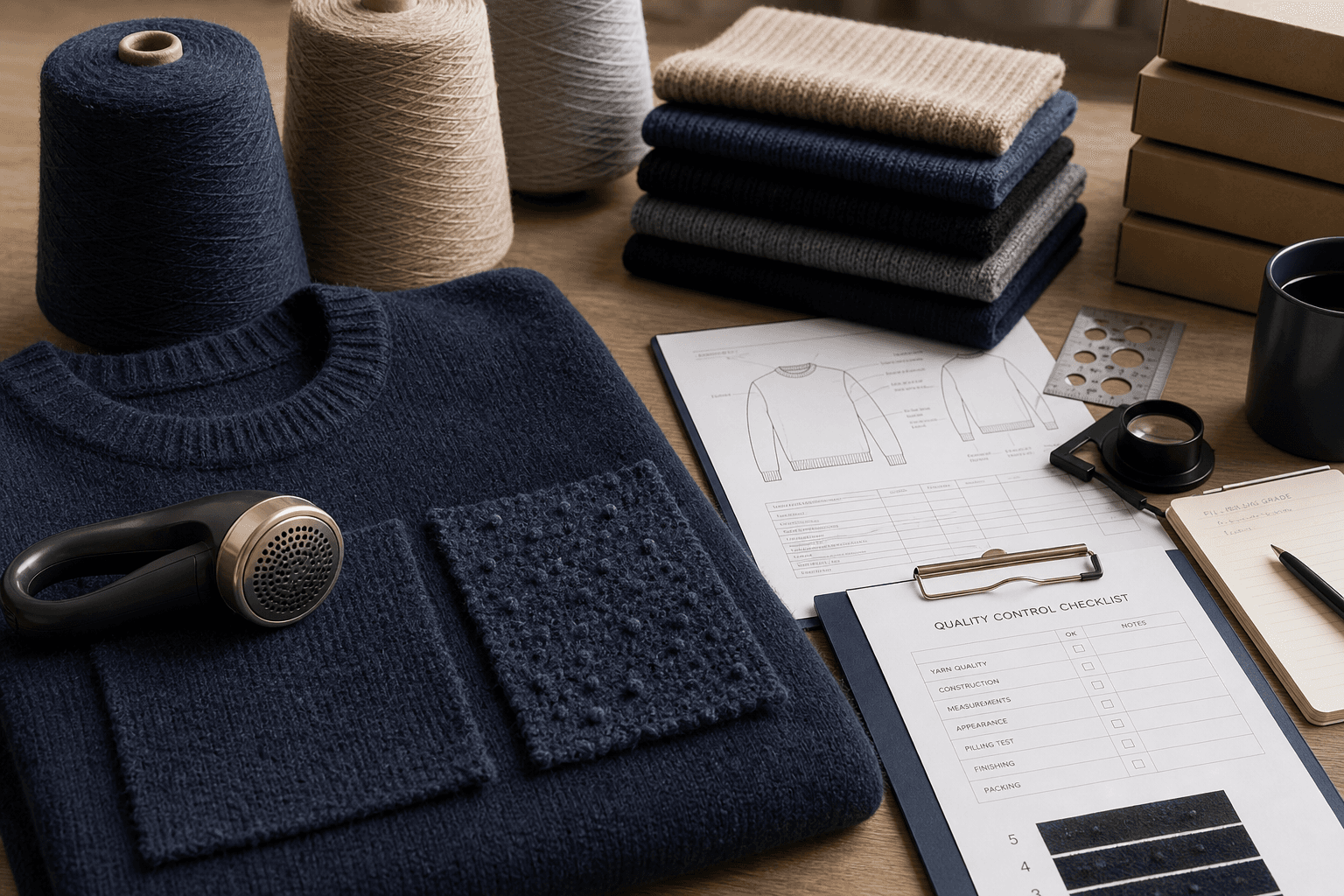
The Martindale pilling test (ISO 12945-2) abrades the fabric against a standard wool abradant in a figure-of-eight motion under a defined load. After a fixed number of cycles — commonly 2,000, 5,000 and 7,000 — the sample is rated visually on a 1 to 5 scale, where 5 is no pilling and 1 is severe. Martindale is well suited to flat-knit fabrics and woven-feeling knits and is the method most European testing houses default to.
The ICI pillbox test (ISO 12945-1, sometimes called the random tumble in its ASTM variant) tumbles fabric tubes inside a cork-lined box for a fixed time. It tends to produce realistic pilling on chunky and lofted knits where Martindale under-stresses the surface. North American buyers more often default to ASTM D3512 random tumble.
We recommend buyers specify which method and which rating they require — for example, 'minimum grade 3-4 on Martindale at 5,000 cycles per ISO 12945-2' — and then have the factory or a third-party lab perform the test on actual sample fabric, not on a generic yarn swatch. We forward the raw lab report on request. We do not publish or quote pilling grades for any specific yarn or product in this article because real results vary by lot, dye colour and finishing batch; a number with no test report behind it is marketing, not data.
A cheap supplementary check buyers can do in-house at the QC desk is a hand-rub test: rub the sample fabric against itself or against a standard denim swatch for a defined number of strokes and photograph the result. It is not a substitute for the standard test but it will quickly separate the obviously bad samples from the candidates that deserve a real lab test.
When To Specify Anti-Pill Yarn Versus Accept Default
Not every program needs an anti-pill spec. The right question is what failure looks like to the end customer.
For everyday workwear, polos, knit hoodies and any product worn under a jacket strap or backpack — specify. For fine-gauge office knitwear that sits under a coat all winter — specify. For heritage chunky cables sold on hand and texture, where the consumer expects some surface character — describe the expected behaviour in your care copy and accept a moderate pilling grade. For brushed mohair, fuzz is the product; pilling resistance ceases to be the right metric.
We work with buyers in both directions. We have programs where we source combed long-staple cotton, gas-singed, with an enzyme finish and a documented Martindale grade for every shipment. We also have programs where the buyer correctly chose a chunky woollen and we set written expectations with their customer service team about what 'normal' looks like at three months. Both are correct decisions when they are made deliberately, and both rely on the same upstream discipline: write the spec down, test against it, and refuse to let bulk drift away from the approved standard.
The wrong decision is to leave the pilling spec blank, accept the cheapest yarn the supply chain offers that month, and then process returns. The QC lead's job is to make the decision visible upstream — in the tech pack, in the RFQ and in the sample approval — so that the bulk that lands at the warehouse is the bulk that was specified.
---
Talk to our team about this
If you're planning a real project around any of the points above, we'd be glad to take a quick look. Send a short brief and we'll come back within one business day with a practical direction, MOQ + lead time estimate, and a sample plan if it makes sense.
→ [Request a free quote](/request-quote) · [WhatsApp us](https://wa.me/8615170244792) · info@lcgarment.cn
MOQ, lead time, cost ranges, gauge selection and QC checkpoints across typical OEM/ODM knitwear programs in NA + EU. Enter your email — we'll send you the report link in 30 seconds.
No spam. Unsubscribe with one reply. We use your email only to send you the report and follow up if you want a sourcing conversation.
Brand names shown are previously serviced OEM/ODM partners. Logos are decorative and do not imply current endorsement.