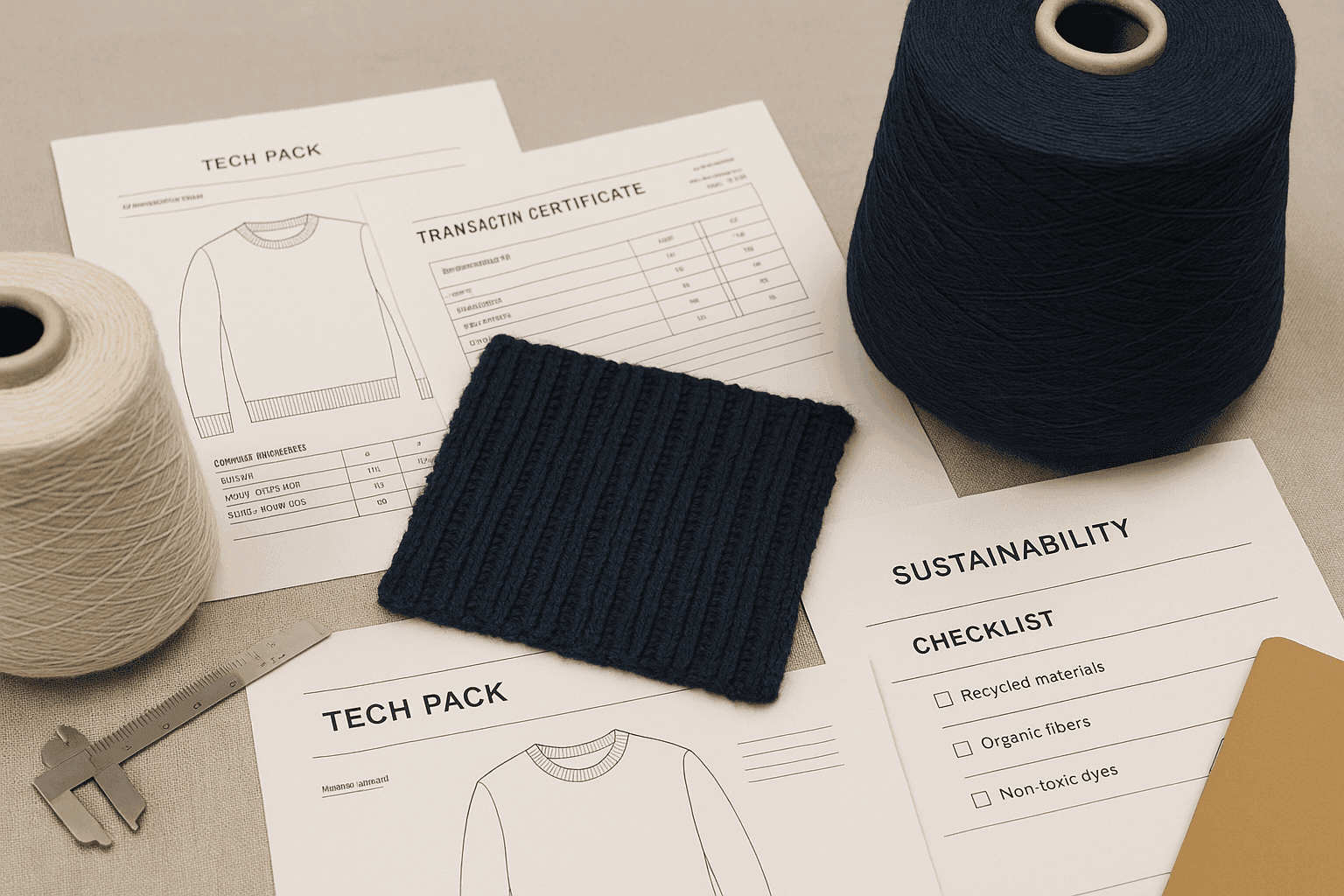
An organic cotton sweater is not made organic by the cotton alone. It is made organic — in the legal, hangtag-claim sense — by an unbroken paper trail. From the moment seed cotton leaves a certified farm to the moment a finished sweater is packed into a polybag, every transfer of material has to be documented on a transaction certificate (TC) issued by an accredited certification body. If even one link in that chain is missing, the entire claim collapses. A buyer can have receipts for certified yarn and a finished garment that genuinely contains that yarn, and still be unable to legally print "GOTS" or "100% Organic Cotton" on the label.
This is the part of organic sourcing that surprises most first-time buyers. The certification is not stamped on the fibre — it lives in the paperwork. And in custom knitwear, where the supply chain typically runs through six to eight independent operators, the paperwork is exactly where things go wrong. We have seen sourcing managers receive beautiful sample sweaters from a yarn the spinner swore was GOTS-certified, only to discover that the dyer who coloured it does not hold scope certification, breaking the chain. We have seen others arrive at production with a scope certificate from the spinner but no TC covering the actual shipment of yarn — meaning the yarn might be organic, but this particular lot is not certified to be.
This article walks through how the organic cotton chain of custody actually works in a knit garment, what documents exist at each step, the difference between scope certificates and transaction certificates, the most common places where programs break, and what a brand should request from each supplier — including the knit garment factory at the end of the chain — before placing a first organic-claimed order.
The Global Organic Textile Standard (GOTS) and the Organic Content Standard (OCS) are both managed against the same underlying logic — certified organic fibre traced through every processing step — but they cover different ground. GOTS is the stricter of the two: it certifies the organic fibre content and environmental and social criteria at every processing stage, including restricted dyes and chemicals, wastewater treatment, and worker conditions. OCS is content-only — it verifies the organic fibre is present and traceable in the right percentage, but it does not regulate the dyestuffs, the chemistry, or the labour conditions at the processing facilities.
This distinction matters for buyers because it changes who in your supply chain needs which certificate. A GOTS claim requires every processor — spinner, dyer, knitter, finisher, garment factory — to hold a GOTS scope certificate covering the products and processes they touch. An OCS claim only requires that the organic content be traceable through TCs; the processors handling the material do not need GOTS-grade chemistry or labour scope. For brands focused on a credible "organic cotton" content story without making broader environmental or social claims, OCS is often the practical entry point. For brands that want the strongest organic textile claim on the market — and the ability to print the GOTS logo — GOTS is the target.
Neither standard is automatic. Both require the brand making the consumer-facing claim to either be GOTS/OCS certified itself or to source from a certified supplier and document that the specific shipment was covered. For more on how compliance certifications fit into a broader knit programme, see our knitwear certifications guide and broader sustainable yarn options overview.
Scope Certificate Versus Transaction Certificate
The two documents that drive every organic textile claim are the scope certificate (SC) and the transaction certificate (TC). They are not interchangeable, and confusing them is the single most common reason an organic programme fails its first audit.
A scope certificate is issued to a facility (a spinner, a dyer, a knit factory). It says: this site is approved to process certified organic material within these categories — for example, "GOTS-certified ring spinning of organic cotton yarns 12s to 60s." It is valid for one year, lists the certified products, and proves the facility *can* handle certified material correctly. It does not prove that any specific lot it sold was actually organic.
A transaction certificate is issued per shipment. It says: this specific consignment, on this date, with this weight and lot number, is certified organic material covered by the seller's scope. The TC names the buyer, the seller, the quantity, the certification standard, and the previous TC reference (so the chain can be reconstructed backwards). The TC is the document that legally enables the next processor — or the brand — to make an organic claim about that material.
The practical rule for buyers: a scope certificate alone is never enough. If a supplier sends you only their SC and not the TC for your specific shipment, you cannot legally claim the resulting product is GOTS or OCS, no matter how genuine the underlying material is.
How Organic Cotton Flows Through A Knit Garment Supply Chain
How Organic Cotton Flows Through A Knit Garment Supply Chain
A typical organic cotton sweater touches seven independent operators between the field and the polybag. Each transfer is a moment where the TC chain must be issued and preserved.
Stage
Operator
Certification Needed
Document At This Transfer
1. Cultivation
Organic farm or grower group
Organic farm certification (e.g., USDA NOP, EU 2018/848, India NPOP)
Farm certificate; scope-equivalent
2. Ginning
Cotton ginner
GOTS or OCS scope certificate
TC for ginned lint to spinner
3. Spinning
Yarn mill
GOTS or OCS scope certificate
TC for yarn shipment to dyer or knitter
4. Dyeing
Yarn dyer
GOTS scope (GOTS only) or OCS pass-through
TC for dyed yarn to knitter
5. Knitting
Knit panel or fabric supplier
GOTS or OCS scope certificate
TC for knit panels/fabric to garment factory
6. Finishing
Washing / softening / pressing
GOTS scope (GOTS only)
In fully fashioned knitwear the lines blur slightly — the knitter, linker, finisher, and CMT operation may all sit inside one garment factory — but each functional step still has to fall within a scope certificate, and the final TC issued to the brand has to reference the preceding TC chain back to the spinner.
For context on how fully fashioned versus cut-and-sew construction affects which operators are involved, see our fully fashioned vs cut-and-sew guide.
Where Programs Quietly Break: The Three Most Common Gaps
In our experience working with buyers who arrive with an organic spec, three failure points come up again and again.
Gap 1: Missing TC at the spinner. The yarn mill holds a valid scope certificate but did not issue a TC for the specific yarn lot you bought. This usually happens when the brand or the trader did not request the TC at the time of yarn purchase, and by the time the yarn is on the boat or sitting in the knit factory, it is too late — TCs cannot be issued retroactively for an uncertified transaction. The yarn is real organic yarn; the lot is not certifiable. Lesson: a yarn PO for a GOTS or OCS programme must explicitly request the TC, name the brand as the eventual end-user on the document, and tie payment to TC delivery.
Gap 2: TC lost or never forwarded at the knitter. The spinner issued a TC, but it was sent only to the trader or the yarn agent, never travelling with the yarn to the knit factory. The knitter then processes the yarn correctly under their own scope, but cannot issue an outgoing TC to the next link because they have no incoming TC to reference. This breaks the chain even though every facility is legitimately certified. Lesson: TC handoff is a documentation responsibility, not a logistical one — confirm in writing with every supplier in the chain that the TC will travel with each shipment, and ask for a copy to be sent directly to your brand inbox.
Gap 3: End factory holding only the spinner TC. The garment factory has received the yarn TC from the spinner and assumes that is enough to cover the finished garment. It is not. Each processing step (dyeing, knitting, finishing, garment make-up) needs its own TC issued by a certified operator covering its own scope. A brand that receives only the spinner TC and a finished sweater cannot legally call the garment GOTS-certified, even if every facility in between holds an SC. Lesson: the final TC the brand needs is the one issued by the garment factory (or the last certified operator) referencing the full chain backwards — not the spinner's original document.
Where Licheng Sits In This Chain
A direct point of honesty up front: Licheng is not GOTS or OCS certified. We do not hold our own scope certificate, and we do not issue transaction certificates in our own name. We are a custom knitwear manufacturer in Dongguan, founded in 2018, working at gauges from 3GG to 18GG with a 30-piece-per-colour catalogue MOQ and 30 to 45 day bulk lead times.
Where we add value to an organic cotton programme is upstream coordination. For buyers structuring a GOTS- or OCS-claimed knit collection, we work with spinning and dyeing mills that hold their own valid scope certificates, and we coordinate the TC paper trail across those mills so that the documents reach you intact. When a buyer wants their final garment to be issued under a certified scope, we route production through a partner garment factory that holds the appropriate certification and we structure the PO accordingly — with the additional cost and lead time that licensing brings.
What this means in practice: an organic cotton claim through Licheng is not free, and it is not automatic. It requires the buyer to commit to the certified yarn source up front (organic certified cotton yarn typically prices at a meaningful premium over conventional cotton of the same construction), to accept the documentation lead time the TC process adds, and to be specific about what claim — GOTS or OCS — the finished product is meant to carry. For buyers who arrive saying "we want organic cotton sweaters" without specifying the certification framework, we ask the framework question first, because GOTS, OCS, and "in-conversion" organic each demand a different documentation path.
The Documentation Checklist Buyers Should Request
Before signing a PO for an organic-claimed knit programme, a brand sourcing manager should have the following in hand or contractually scheduled.
From the yarn mill (or trader sourcing the yarn):
Current GOTS or OCS scope certificate covering the specific yarn count and fibre.
Written commitment that a TC will be issued for your lot, naming your brand or the next processor.
The certification body's name and the SC reference number (so it can be cross-checked on the GOTS or Textile Exchange public database).
From the dyer (if separate from the knitter):
Scope certificate covering yarn dyeing under your standard.
Confirmation that the incoming yarn TC will be referenced in the outgoing dyed-yarn TC.
From the knit factory or knit-garment factory:
Scope certificate covering knit processing (and, if applicable, garment make-up) under your standard.
Written acknowledgement that they will issue the final TC to your brand, referencing every preceding TC in the chain.
A clear quote that distinguishes the certified-route price from the conventional price for the same garment construction (because the cost gap is the basis for your retail price planning).
For your own brand file:
A copy of every SC in the chain.
A copy of every TC for the specific production run.
A statement of identity for the claim you intend to make on the hangtag (e.g., "Made with 95% certified organic cotton, GOTS-certified by [CB]") — this language is regulated and should be approved before label artwork is finalised.
For a brand approaching a first GOTS- or OCS-claimed knit collection, the structural changes versus a conventional PO are smaller than they first appear, but they have to be in writing.
First, the PO must name the certification standard (GOTS 7.0, OCS 3.0, or whichever is current) and the claim language the brand intends to use on the consumer-facing hangtag. This binds the supplier to deliver documents that support that specific claim.
Second, the PO must condition the final payment milestone on receipt of the full TC chain, not just on delivery of the goods. Without this clause, the supplier has no commercial pressure to chase down a missing intermediate TC after shipment.
Third, the PO must build in additional lead time. In our experience the TC issuance and chain consolidation adds two to four weeks to a typical 30-to-45-day knit production timeline — partly because TCs are issued after shipment, and partly because any gap in the chain requires the certification body to investigate before signing off. A buyer who needs an organic-claimed bulk delivery in 35 days is asking for a corner to be cut somewhere.
Fourth, the PO should specify the labelling — yarn percentages, GOTS or OCS logo placement, license number — and require approval of label artwork before production. Mislabelling a certified product is one of the fastest ways to lose the right to the claim.
Finally, the PO should plan for a fibre test on the finished garment, especially for a first programme. Independent fibre composition testing on the bulk-delivered sweaters confirms that the organic cotton actually made it into the final product at the declared percentage — closing the loop between the paper trail and the physical garment.
A Practical Closing Note
Organic cotton knitwear is one of the most documented categories in the entire apparel supply chain, and that is its strength as a marketing claim. But the strength only holds if the buyer treats documentation as a core deliverable, not as a paperwork formality bolted on after production. The brands that succeed at organic cotton knit launches are the ones that structure the very first yarn enquiry around the TC requirement, not the ones that ask about certificates after the sample is approved.
For buyers preparing a first organic-claimed collection: pick the standard (GOTS or OCS) before you pick the yarn, commit to a yarn source with a verifiable SC, write the TC chain requirement into every PO in the chain, and budget realistically for the price premium and the documentation lead time. A custom knit manufacturer like Licheng can sit inside that structure and help the documentation reach you in good order — but the structure has to come from the brand.
---
Talk to our team about this
If you're planning a real project around any of the points above, we'd be glad to take a quick look. Send a short brief and we'll come back within one business day with a practical direction, MOQ + lead time estimate, and a sample plan if it makes sense.
→ [Request a free quote](/request-quote) · [WhatsApp us](https://wa.me/8615170244792) · info@lcgarment.cn
MOQ, lead time, cost ranges, gauge selection and QC checkpoints across typical OEM/ODM knitwear programs in NA + EU. Enter your email — we'll send you the report link in 30 seconds.
No spam. Unsubscribe with one reply. We use your email only to send you the report and follow up if you want a sourcing conversation.
Brand names shown are previously serviced OEM/ODM partners. Logos are decorative and do not imply current endorsement.