Merino wool costs 3.2× what cotton costs, for the same garment, at the same MOQ, from the same factory. Wool/cashmere blends cost 4.4× a cotton blend. Those multipliers are the single most useful thing a knitwear buyer can know before opening a costing sheet — and nobody publishes them, because every quote a buyer collects comes from a different supplier with a different cost base, so the yarn effect and the supplier effect are impossible to separate.
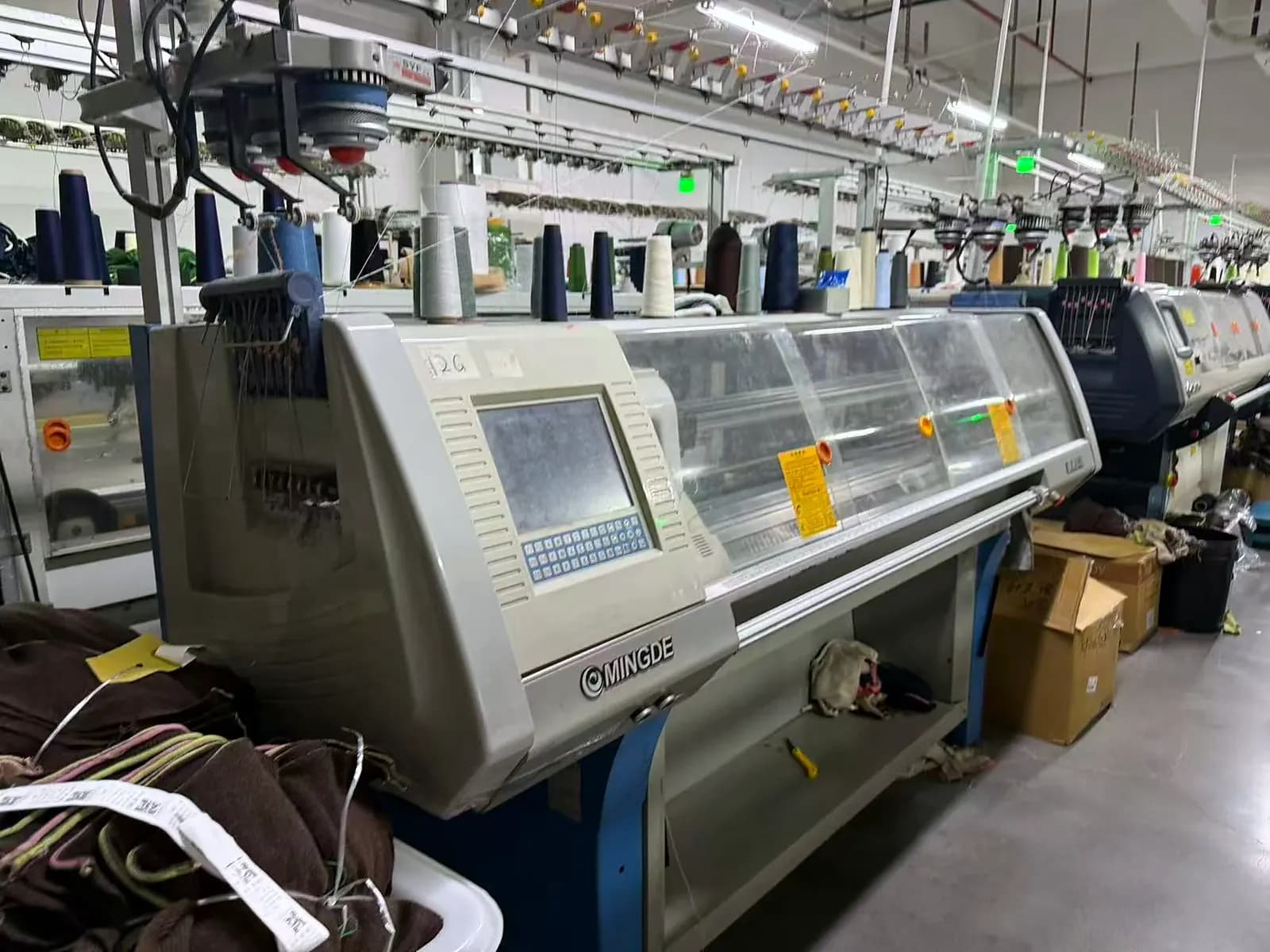
This index separates them. It is built from 112 knitwear styles priced by one factory — Licheng Knitwear, a direct OEM/ODM flat-knit manufacturer in Dongguan, China — all at the same MOQ tier (30 pieces per colour), all published openly on the company's own trading-platform storefront. Same factory, same overhead, same margin policy. The only thing that moves is the yarn and the garment.
2026 Q3 edition. Prices collected 30 July 2026 from the factory's own published storefront listings. Next edition: October 2026. Revision history and licence at the foot of this page.
Median of the published price bands, MOQ 30 pcs per colour. `n` = number of styles in that group.
What this means in practice. Moving a style from a cotton blend to 100% merino roughly triples the FOB. Adding 5% cashmere to a wool base costs far more than adding 5% cashmere to a cotton base — the base yarn, not the cashmere percentage, drives most of the difference. Buyers who ask "how much does cashmere add?" are usually asking the wrong question; the right one is "what is the base yarn?"
|
| Accessories (hat, glove, sock, scarf) | 7 | $1.68 – $3.99 | $2.83 |
| Sweater vest | 3 | $8.97 – $14.59 | $11.78 |
| Polo sweater | 9 | $15.97 – $23.88 | $19.48 |
| Cardigan | 11 | $14.99 – $24.46 | $19.73 |
| Knit jacket / outerwear | 14 | $17.97 – $25.96 | $21.61 |
| Knit dress / skirt | 4 | $17.47 – $25.99 | $21.73 |
| Sweater / pullover | 58 |
The counter-intuitive result: a knit jacket is *not* meaningfully more expensive than a pullover (1.0× on medians). Construction adds far less than yarn does. A cotton knit jacket lands below a merino crew-neck, every time. Accessories sit on their own scale entirely — the category median is USD 2.83, and what that figure does and does not mean is worth reading before it goes into a margin model. Buyers who assume outerwear is the expensive category are budgeting from the wrong variable.
The other outlier is knit bottoms and two-piece sets at $40.03 — nearly double a pullover — because a set is two garments, and knit trousers need more linking and more finishing than a body.
- Source: 112 unique styles with published price bands, collected 2026-07-30 from the manufacturer's public storefront listings. Duplicated listings of the same style were removed by product ID.
- Basis: FOB China, MOQ 30 pieces per colour. Price bands reflect quantity tiers; the "median" column is the midpoint of each band, then the median across styles in that group.
- Fibre and garment classification was derived from the published style descriptions. Where a listing did not state a composition it falls into "unspecified blend" (42 styles) and is excluded from the fibre table.
- Groups with fewer than 3 styles are not published — the sample is too thin to mean anything.
It is one factory's price structure, not a market average. A different manufacturer with different machinery, labour cost or margin policy will sit above or below these absolute numbers. What travels across suppliers is the shape — the ratios between fibres and between garment types — because those are driven by yarn markets and construction time, not by any one factory's overhead.
It is also not a quote. Real pricing moves with yarn lot, gauge, trims, quantity, and season. These are published list bands, which sit above what a committed order typically settles at.
1. Budget from the yarn, not the silhouette. Pick the fibre first; it decides most of the cost. Construction is a rounding error by comparison.
2. Sanity-check quotes you already hold. If a supplier quotes merino at cotton prices, ask what the actual composition and gauge are. If they quote a cotton pullover above $30 FOB at 30 pcs, ask what is driving it.
3. Use the ratios, not the absolutes, when comparing suppliers in other countries.
Related reading: 2026 Custom Knitwear Manufacturing Benchmarks covers MOQ, sampling and bulk lead times. China knitwear tariffs and landed cost covers what happens to these FOB numbers after duty and freight.
How this index is maintained
Edition 2026 Q3 · collected 30 July 2026 · next edition October 2026.
We re-pull the full style list once a quarter and republish as a new edition, rather than editing numbers in place. When a figure moves, the change is listed here with the reason. A price index that quietly rewrites its own history is not one anybody should cite.
Revision history
|
| 2026 Q3 | 30 July 2026 | First edition. 112 styles; 8 fibre groups, 8 garment groups; groups with fewer than 3 styles withheld. |
What would make us republish early: a yarn-market move large enough to shift any fibre median by more than 10%, or a change to our own MOQ tier. Either would be recorded in the table above rather than applied silently.
Licence. These figures are free to quote, reproduce and build on, including commercially, with attribution to Licheng Knitwear and a link to this page (CC BY 4.0). We would rather be cited than protected.
What this index is not. One factory's published price structure, not a market average — our overhead is our own, and a factory in Portugal or Türkiye will sit above or below these numbers. It is also not a quotation: real pricing moves with yarn lot, gauge, trims, quantity and season, and published list bands sit above what a committed order settles at. The ratios between fibres are the part that travels.
If you want this data cut a different way — by gauge, by target market, or against your own current costing — send us the parameters and we will run it. We reply within 4 business hours.
What is this yarn cost index, and what is it not?
It is our own published reference for what different fibres add to a knitted garment, stated so buyers can sanity-check a quotation. It is not a quotation, and it is not a market price feed - it is an index, and the article states its methodology plainly so you can judge how far to trust it.
How should a buyer use the index?
As a benchmark rather than a target. Take a quote you have received, find the fibre and product type, and see whether the number sits in a plausible band. It is most useful for spotting a quotation that is far outside the range in either direction.
Why publish cost figures at all?
Because almost every knitwear supplier hides them behind an inquiry form, which makes it very hard for a new brand to know whether it is being quoted fairly. Published figures are checkable, and a supplier willing to be checked is easier to work with.
Does the index replace a quotation?
No. Final price depends on yarn lot, gauge, colour count, structure, trims and quantity. The index tells you the neighbourhood; a quotation against your tech pack tells you the address.
How often is the index maintained?
The article states its maintenance basis directly. Fibre markets move, so treat any figure as current to the stated period rather than as a standing price.
💬 Sourcing this for an upcoming project? Request a free quote → · MOQ 30 pcs · Sample in 15–25 days · WhatsApp us