Approving knitwear samples well is a skill that separates smooth production from costly surprises. Many buyers know sampling takes time but few know how to evaluate a sample rigorously or give feedback that actually improves the next round. This guide covers the knitwear sample approval process from a buyer's perspective.
A sample is a question the factory is asking you: "Is this right?" The quality of your answer determines the quality of your bulk.
Handfeel and weight: does it feel like the product you intended?
After washing: wash the sample, twisting and shrinkage often appear only then
Give Feedback That Works
Vague feedback produces vague revisions. Make yours specific and structured:
Be precise: "shorten body by 2cm" not "a bit shorter"
Reference the spec: point to the tech pack measurement
Batch your comments into one structured response, not a trickle
Prioritize: separate must-fix from nice-to-have
Confirm in writing so there is a clear record
Approve the PP Sample as Your Benchmark
The pre-production sample is the most important: it becomes the standard bulk is measured against. Approve it only when it is genuinely right, because everything ships to match it. Keep the approved PP sample as your physical reference for any later quality dispute.
Common Sampling Mistakes
Approving on look alone without measuring
Not washing the sample before approval
Giving feedback in scattered messages
Rushing PP approval to save time, then paying in bulk defects
Not keeping the approved sample as a reference
A factory that communicates well during sampling, asking the right questions and flagging risks, is showing you how bulk production will go, see our vetting guide.
How Many Sample Rounds Should You Budget For?
Most knitwear programs reach approval in two to three rounds, but the number depends on how complete your starting brief is and how complex the construction is. Use this as a planning baseline:
The locked bulk standard, including wash and color
Final cycle before bulk
A clean tech pack with confirmed measurements, a yarn spec, and a physical color reference often collapses this to two rounds. Vague briefs, last-minute design changes, or color matched only from a screen are the usual reasons a program slips into a fourth or fifth round. Each extra cycle adds roughly a week before your 30–45 day bulk window can start, so the cheapest way to compress your timeline is a complete brief on day one, not a faster factory.
A Worked Example: Reading a PP Sample Against Spec
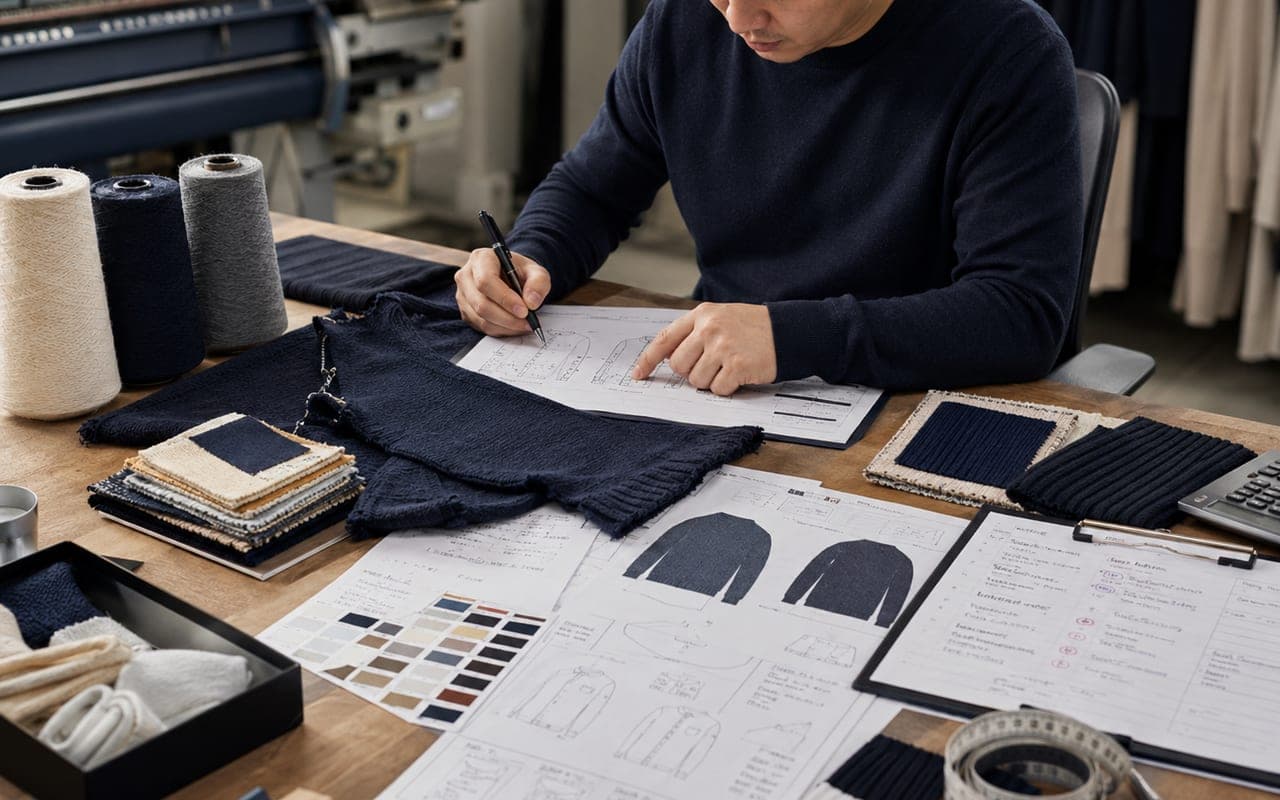
Suppose your tech pack calls for a 7GG merino crew, body length 68cm, chest 54cm (half measure), in a navy matched to a Pantone TCX chip. When the PP sample arrives, work the checklist in order rather than reacting to the first thing you notice:
1. Yarn and gauge — confirm it is merino at 7GG, not an acrylic blend substituted to hit a price. Burn-test or fiber-content paperwork settles disputes; for recycled-content claims, ask for the GRS documentation that backs the yarn.
2. Measure cold, then wash — record body and chest before washing, launder per your care instructions, then re-measure. A 68cm body that relaxes to 71cm after wash is a finishing problem to fix now, not in bulk.
3. Color in daylight — lay the sample next to the chip near a window. Approving navy under warm shop lighting is how "the wrong blue" arrives 30,000 units later.
4. Construction detail — check linking at the shoulders, neck-rib recovery, and that the crew does not gape.
5. Sign, photograph, retain — when it passes, mark it approved in writing, photograph it with a ruler in frame, and keep the physical garment. That sealed PP sample is the reference both sides point to if a quality dispute ever opens.
Licheng Knitwear runs a structured, communicative sampling process with clear PP approval for B2B buyers. Request a sample or request a quote.
Common Questions
How long does knitwear sampling take?
A single sample round typically takes 15–25 days from confirmed tech pack to delivered sample. Plan for two to three rounds before PP approval, then 30–45 days for bulk production.
Do I have to pay for samples?
Sampling is usually charged because it ties up yarn, machine time, and a skilled operator for a one-off make. Many suppliers credit the sample cost back against a confirmed bulk order, so ask how that works before the first round.
What is the difference between a proto and a PP sample?
A proto confirms the look, yarn, and stitch direction early on, while the pre-production (PP) sample is the final, locked standard your bulk is measured against. Bulk should match the approved PP sample exactly, so it gets the most rigorous sign-off.
---
Talk to our team about this
If you're planning a real project around any of the points above, we'd be glad to take a quick look. Send a short brief and we'll come back within one business day with a practical direction, MOQ + lead time estimate, and a sample plan if it makes sense.
Most programmes reach approval in two to three rounds. A clean tech pack with confirmed measurements, a yarn spec and a physical colour reference often gets there in two; vague briefs and late design changes push a programme into a fourth or fifth.
A fit or revised-proto round usually takes 7-10 days per cycle, after the first round inside the standard 15-25 day window. Each extra cycle delays the start of the 30-45 day bulk window by about a week.
Yes. Measure it first, launder it to your care instructions, then measure again. Twisting and shrinkage often appear only after washing, and a body that relaxes from 68 cm to 71 cm is a finishing problem to fix before bulk, not after.
In daylight, next to the physical Pantone TCX chip or swatch, for example beside a window. Approving a colour under warm shop lighting is how the wrong shade reaches bulk.
Precisely and in one structured batch: "shorten body by 2 cm" rather than "a bit shorter", referenced to the tech pack measurement, with must-fix items separated from nice-to-have, and confirmed in writing.
We focus on men's sweaters, cardigans, knit jackets, jacquard knitwear and private label knitwear. We support B2B buyers with OEM/ODM development, sampling and bulk production planning.
Ready to Start Your Project?
Get a free catalog or submit an RFQ today. Our team will respond within 24 hours.
MOQ, lead time, cost ranges, gauge selection and QC checkpoints across typical OEM/ODM knitwear programs in NA + EU. Enter your email — we'll send you the report link in 30 seconds.
No spam. Unsubscribe with one reply. We use your email only to send you the report and follow up if you want a sourcing conversation.
Brand names shown are previously serviced OEM/ODM partners. Logos are decorative and do not imply current endorsement.