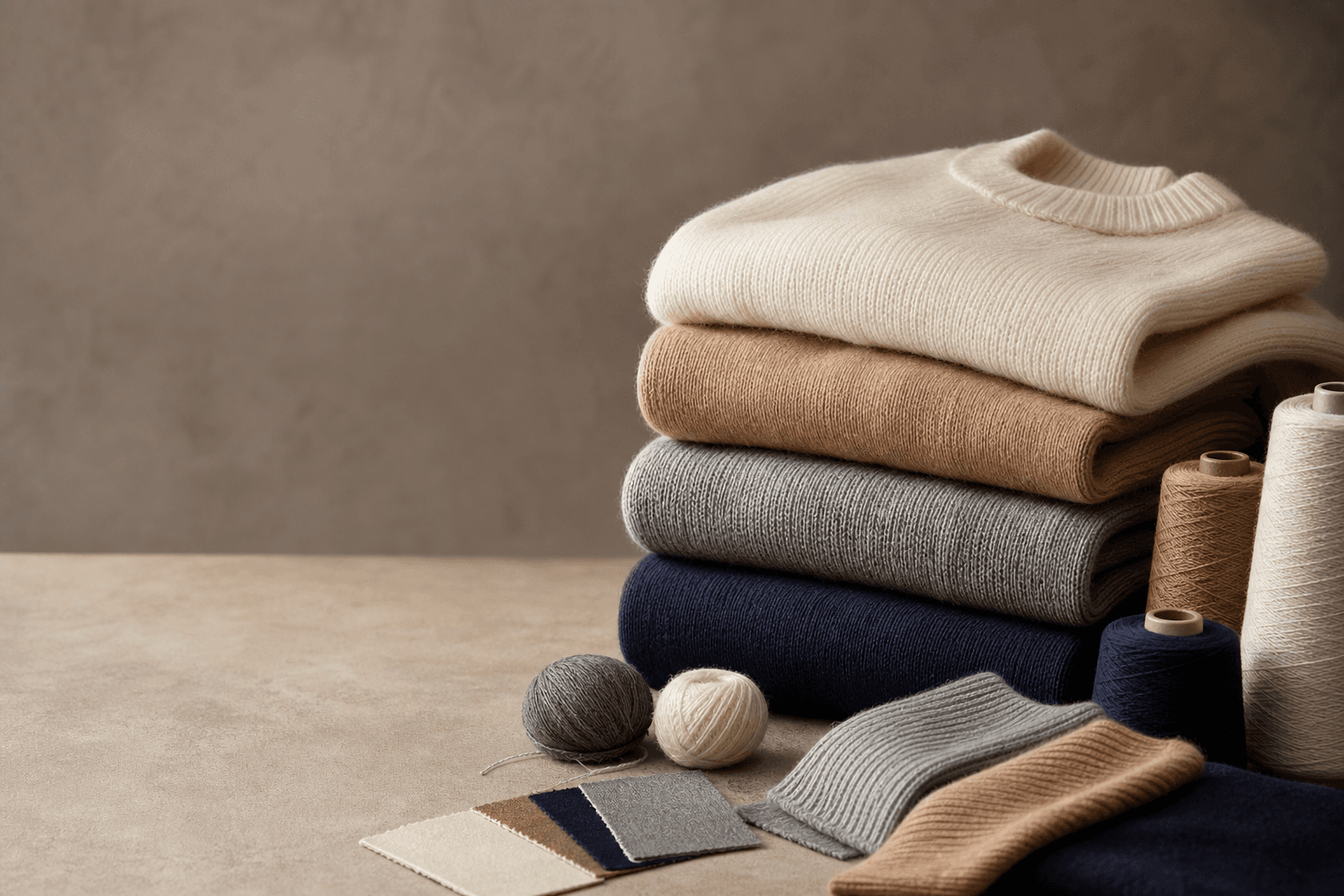
Two sweaters can use the same yarn, the same gauge and look almost identical on a hanger — yet feel completely different in the hand and last completely different on the customer. The variable is construction: how the panels are made and joined. This guide walks through the three methods buyers will be quoted on — full fashion, cup-seam and cut & sew — and explains where each one belongs in your range.
Construction is the silent quality lever. The same yarn becomes a heirloom piece or a one-season throwaway depending on how the panels were shaped and joined.
💬 Sourcing this for an upcoming project? Request a free quote → · MOQ 30 pcs/colour · Sample in 7–15 days · WhatsApp us
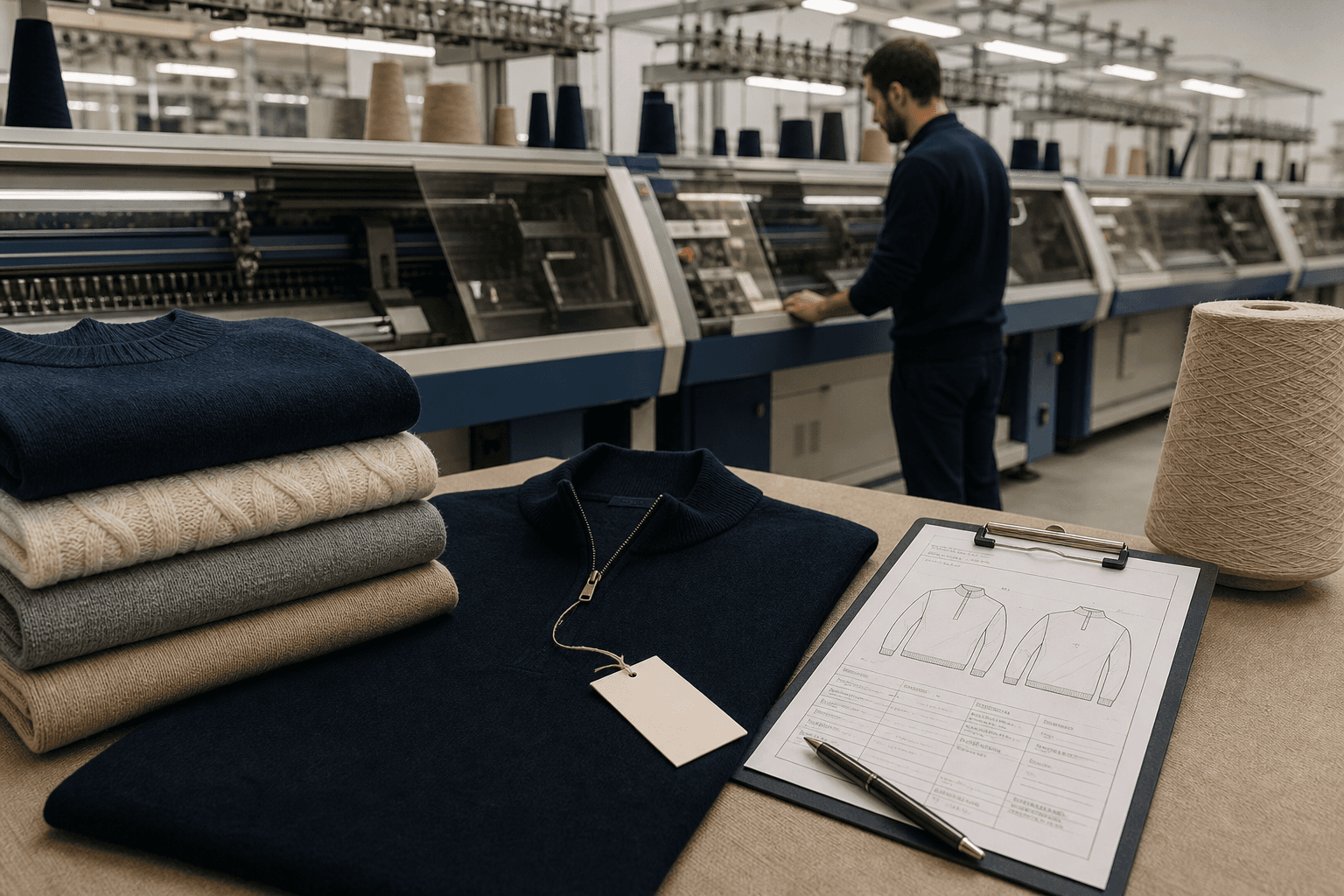
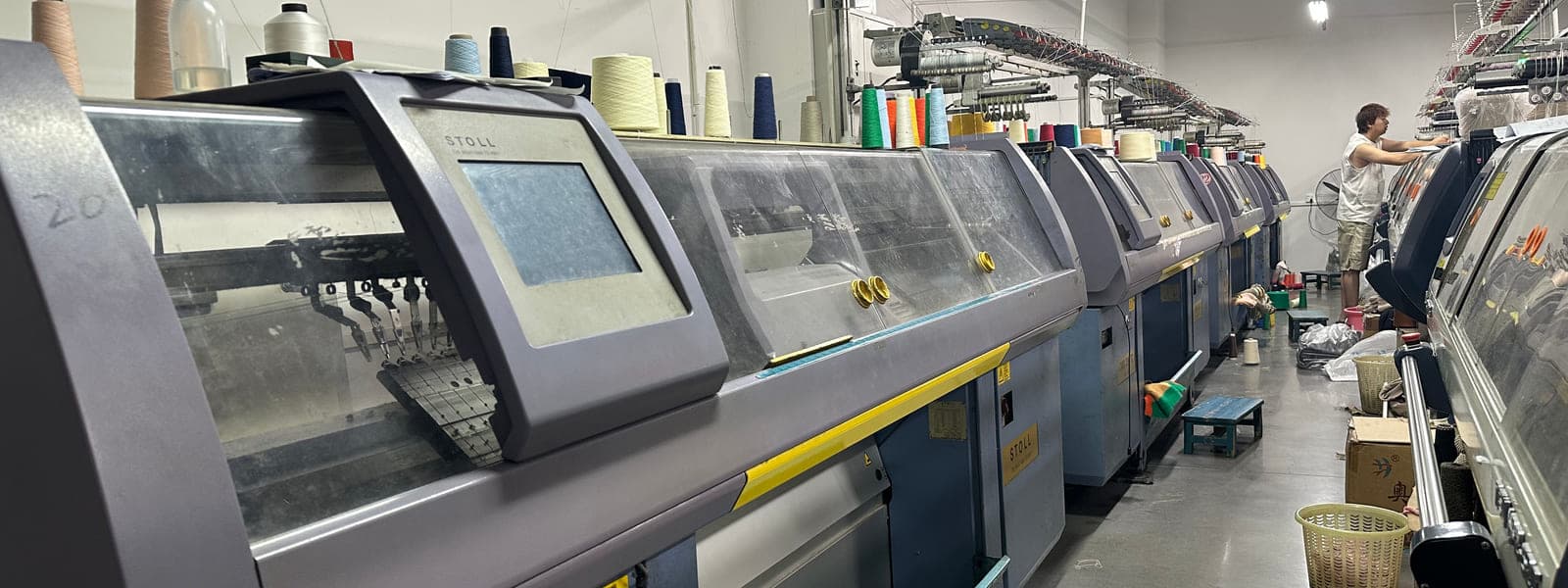
Panels are knit to shape on a flat knitting machine — the machine adds and drops stitches as it goes, so the front, back and sleeve are produced at their finished outline with no cutting. Panels are then joined by linking, a process that loops every stitch on the edge of one panel through every stitch of the next, producing an almost invisible seam that follows the knit structure.
A hybrid. Panels are still knit to shape (full-fashioned), but instead of true stitch-by-stitch linking, the seam is sewn on an overlock-style cup-seam machine. The seam is faster to produce, more elastic, and sits flatter than a cut-and-sew overlock — but it is not the same as full linking.
Large rolls or panels of knit fabric are produced first, then cut to pattern pieces and sewn together — much like wovens. The seam is a sewn overlock, not a linked one. This is how mass-market jersey knits, hoodies and many simple knit tops are made.
|
| Full fashion | Knit-to-shape | Linked, loop-by-loop | Minimal (~5%) | Premium sweater |
| Cup-seam | Knit-to-shape | Overlock-style chain | Minimal (~5%) | Mid-tier sweater |
| Cut & sew | Cut from fabric | Overlock sewn | Higher (~15–20%) | Jersey / sweatshirt |
The cost order is consistent: full fashion is the most expensive, cup-seam mid, cut & sew cheapest — but the gap varies by gauge and complexity.
|
| Full fashion (hand-linked) | High | 10–15 days | 35–45 days |
| Full fashion (machine-linked) | Medium-high | 7–12 days | 30–40 days |
| Cup-seam | Medium | 7–12 days | 30–40 days |
| Cut & sew (CMT knit) | Low | 7–10 days | 25–35 days |
Full fashion linking by hand is the slowest because each row of stitches is fed manually onto the linker's needle bed — a skilled but unhurried operation. Machine linking is faster but still requires a stable, well-shaped panel edge. Cut and sew is fastest because it runs on standard garment sewing lines. For more on the linking specifics, see our hand-linked vs machine-linked trade-offs article and the deeper full fashion vs cut-and-sew piece.
This is where the buyer choice matters most. Construction determines how the sweater behaves on body and over wash cycles.
- Seam visibility: almost invisible, follows the knit
- Drape: garment hangs like a single knit piece
- Durability: seams are as strong as the knit itself; no cut-edge fray points
- Repairability: a broken linked seam can be re-linked
- Best for: premium wool, cashmere, brand-defining core pieces
- Seam visibility: thin chain visible inside, neat outside
- Drape: very close to full fashion, slightly less fluid
- Durability: strong; better elasticity than full linking under stretch
- Best for: sportier silhouettes, mid-tier programs, fine gauges that need a little give
- Seam visibility: overlock visible inside; sometimes covered with binding
- Drape: stiffer at the seam; can pucker over time
- Durability: cut edges can fray or unravel if seam allowance is thin
- Best for: jersey, lounge, casual lightweight knits, prints on fabric that need cut precision
Four questions decide it for most programs:
1. What is the retail positioning? Premium price points (€80+ retail wool or any cashmere) almost always justify full fashion. Mid-tier private label often lands on cup-seam. Value lines and lightweight pieces sit at cut & sew.
2. How will it be worn? A heavy cable cardigan worn for 5 winters wants full fashion. A summer fine-gauge tee can run cut & sew without losing perceived quality.
3. What is the yarn cost? When yarn is your dominant cost (cashmere, fine merino), the labor uplift of full fashion is a small share of total FOB. When yarn is cheap (acrylic blends), construction labor is a bigger relative cost and cut & sew makes more sense.
4. What is the volume? Cut & sew amortizes fabric setup over larger runs. Full fashion has no fabric setup, so it scales down to low MOQ more gracefully — useful for low-MOQ programs.
Many brands run a hybrid: full fashion on the core wool / cashmere SKUs, cup-seam on mid-tier fine-gauge pieces, and cut & sew on summer cotton tees that share the brand. Treating construction as a per-style decision — not a brand-wide rule — usually produces the best margin.
A single sweater can also mix methods. A common pattern: hand-linked shoulder seam (where stretch and visibility matter most), cup-seam side seams and underarm (faster, still neat), full-fashioned ribbed cuffs and hem (no cut edges to fray). This per-seam approach lets you spend labor where the eye and the wear actually land.
Whatever method you spec, write it explicitly in the tech pack. "Hand-linked shoulder, cup-seam side seam, ribbed cuff" is unambiguous; "sewn" is not. The tech pack should also call out the linking gauge — see the section below — because a fine knit linked at the wrong gauge will pucker or pull in wear.
Linking gauge must match the knit gauge. A 12GG sweater requires a 12GG linker; a 7GG sweater requires a 7GG linker. Mixing them produces visible stitch distortion at the seam. This is one reason full-fashion programs at very fine gauges (14GG and above) carry a small price premium — fine-gauge linkers are slower and the operator skill required is higher. Conversely, very chunky 3GG knits link quickly but require precise tension to avoid bulky seam ridges. The knit gauge guide covers the gauge ranges this affects most.
- Which seams are linked vs cup-seam vs overlock on your style
- Linking gauge (must match knit gauge; a 12GG knit needs 12GG linking)
- Whether hand or machine linking is used, and where
- Seam allowance and stitch density for any cut & sew portions
- AQL inspection level (Licheng's standard is AQL 2.5 with seam strength tests)
Licheng Knitwear's linking and knit construction capability covers full-fashion hand linking, machine linking and cup-seam across 3GG to 18GG, with AQL 2.5 seam inspection on every order. For the related cost picture, our custom knitwear cost factors guide breaks down where construction sits in the full FOB stack.
Request a quote with your style sketches and we will recommend the construction route that fits your positioning and budget.
---
If you're planning a real project around any of the points above, we'd be glad to take a quick look. Send a short brief and we'll come back within one business day with a practical direction, MOQ + lead time estimate, and a sample plan if it makes sense.
→ [Request a free quote](/request-quote) · [WhatsApp us](https://wa.me/8615170244792) · info@lcgarment.cn