A buyer emailed us recently with a question we hear every season. Her sample of a fine-gauge merino crew came in at 12.50 dollars. The bulk quote at 500 pieces, same yarn, same construction, came back at 7.20 FOB. She wanted to know which number was lying.
Neither was, as it turns out. But the question is the right one to ask, because if you do not understand what is actually in that 12.50, you cannot negotiate, you cannot benchmark a second supplier honestly, and you cannot tell the difference between a fair quote and one that has been quietly inflated on the sample side to make the bulk look like a bargain. This briefing breaks down the math the way a costing engineer would, and then walks through where the negotiation room actually sits.
Why does a knitwear sample cost so much more per piece than bulk?
Because a sample carries the whole set-up on one garment. Programming the style, conditioning the yarn, running the machine for a single piece and linking it by hand cost roughly the same whether one piece follows or five hundred do. Bulk spreads that cost; the sample absorbs it.
What bulk-to-sample ratio is normal?
A meaningful gap is expected and is not a sign of anything wrong. What matters is whether the supplier can explain the gap line by line - set-up, yarn minimum, machine time, hand work. A gap that cannot be explained is the problem, not the gap itself.
When is a wide sample-to-bulk gap a red flag?
When it is wide and unexplained, or when the sample price appears designed to discourage sampling altogether. A factory that will not sample at a sensible fee is telling you it is not set up for the order size you are placing.
What does a narrow gap usually mean?
Often that the style is simple, the yarn was in stock, and little bespoke set-up was needed. Occasionally it means the bulk price has been quoted optimistically, which is worth testing before you plan a margin around it.
Is it worth negotiating the sample charge?
Yes, but negotiate the right thing. Asking for the fee to be refundable against the first production order is usually more productive than asking for it to be waived - it aligns both sides and it is a common arrangement. Ours is refundable against the first order.
💬 Sourcing this for an upcoming project? Request a free quote → · MOQ 30 pcs · Sample in 15–25 days · WhatsApp us
Knitwear is not cut-and-sew. A woven shirt sample is essentially a smaller version of the bulk process — same fabric roll, same pattern, same sewing machines, just one piece instead of a thousand. The unit economics scale gracefully.
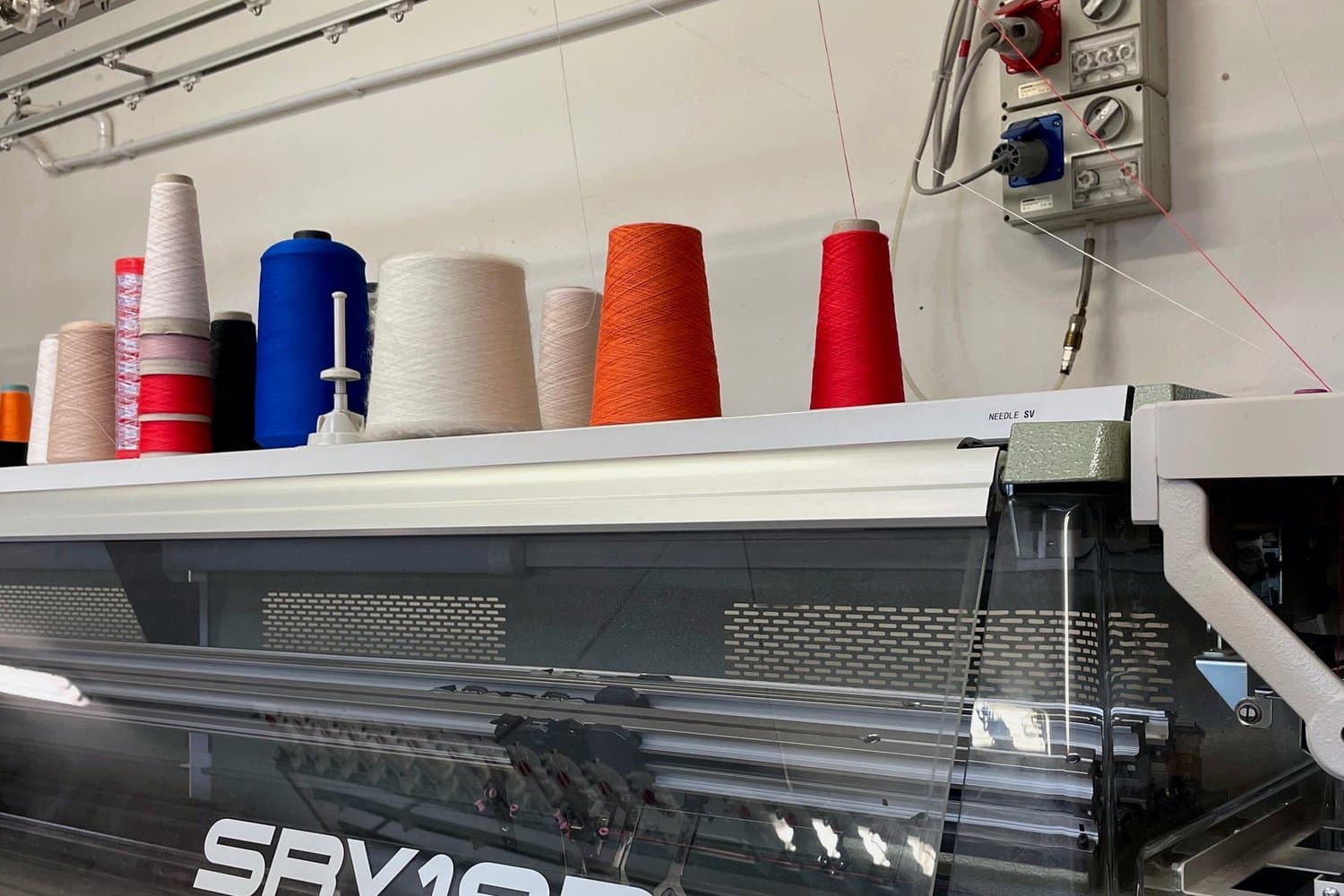
Knitwear does not work that way. A sweater starts as cones of yarn that have to be dyed to your colour, knitted on programmed machines, linked at the seams, washed, finished, and quality-checked. Many of those steps have a fixed cost floor that does not care whether you are making one piece or five hundred.
Think of it this way. If your factory dyes a 30 kg minimum lot of yarn to your custom Pantone, that dye charge is the same whether you knit one sweater out of it or fifty. If a programmer spends six hours setting up the knit pattern on a Shima Seiki machine, that six hours is the same for one piece or for the full PO. Spread across one sample, those costs land on the head of a single garment. Spread across 500, they nearly disappear into the unit cost.
That is the entire story in one paragraph. Everything that follows is just the line-by-line version.
Here is what is actually going into a roughly 12 dollar sample on a mid-weight wool-blend crew. Numbers are rounded and indicative — your supplier's structure will differ, but the shape will not.
|
| Yarn material | 3.20 | 3.20 | Truly variable. Same per piece. |
| Dye lot setup | 1.80 | 0.10 | 30-50 kg minimum amortized |
| Knit programming | 1.50 | 0.05 | 4-8 hours of programmer time |
| Machine setup and calibration | 1.20 | 0.08 | Loading yarn, tension, test panels |
| Knitting time | 0.90 | 0.85 | Roughly scales with piece count |
| Linking and trimming | 1.10 | 0.70 | Skilled labor, faster at scale |
| Washing and finishing setup | 0.80 | 0.05 | Line setup, steam, press blocks |
A few things to notice in that table.
The yarn material cost — the only cost that is truly proportional to pieces — is identical on both sides. So when you hear a sourcing manager say "the sweater only has 4 dollars of yarn in it, why is the sample 12," they are right about the yarn, but the yarn is not where the sample cost lives.
The setup costs — dye, programming, machine calibration, finishing line — collapse from roughly 5.30 per piece on a single sample to under 30 cents per piece in bulk. That is where almost the entire 5 dollar gap comes from. It is not margin games. It is arithmetic.
Notice also that factory margin is actually lower on the sample than on the bulk piece. This surprises people. Factories typically do not make money on samples — they often lose a little, or break even, treating sampling as the cost of winning the PO. Margin gets recovered in bulk.
For a same-SKU, same-yarn, same-construction comparison, a fair ratio sits roughly here:
- Bulk = 55-65% of sample price for typical fine-to-mid gauge knitwear at 300-1000 piece orders
- Bulk = 65-75% of sample price for chunkier 3-5GG pieces where setup is a smaller share of total cost
- Bulk = 45-55% of sample price when there is heavy custom dyeing, complex jacquard programming, or multi-yarn intarsia where setup costs are unusually high
If your bulk number lands inside those bands, you are in normal territory. The supplier is not doing anything strange. They are simply showing you the geometry of fixed-cost amortization.
Where it gets interesting is when the ratio falls outside those bands.
If your sample is 14 dollars and the bulk quote at 500 pieces comes back at 5.50 — a 39 percent ratio — something is being staged. The two most common patterns:
Inflated sample to make bulk look cheap. A supplier desperate to win the PO quotes a high sample fee, knowing the brand will mentally anchor on that number and feel relief when the bulk price drops. The bulk number itself may be technically achievable but only at corners-cut quality — lower yarn count, thinner finishing, faster linking. You will discover this at the first production sample.
Yarn or component switch between sample and bulk. The sample uses the yarn you spec'd. The bulk uses a downgraded equivalent. The gap reflects the spec change, not pure amortization. Always ask for a yarn certificate or shade card on the production sample and compare against the development sample physically.
Not every wide gap is a trap. Some are legitimate — for example, if the development sample required hand-finishing or special trims that bulk will not need. But you should be able to get a specific explanation, line by line, of where the extra money came from.
Sometimes a sample comes back unusually cheap — 8 dollars, say, for a piece you expected to pay 12 for. This is almost always one of three things, and all of them are fine:
- The factory reused an existing dye lot. If your color sits within a previously dyed lot's tolerance, the supplier may pull a kilo off the rack instead of running a new minimum. No setup charge.
- They used stock yarn from a regular yarn library. Standard merino, standard cotton, standard wool blends in core colors often sit on cones at the mill or factory. Stock yarn means no dye lot, no minimum, faster turnaround.
- The pattern was previously programmed. If you adapted an existing block — a crew neck the factory has run before, with only color and minor measurement tweaks — the programming time is already paid for.
A narrow gap can also mean a smaller bulk discount than you hoped. If the sample was 8 because the dye lot was free, the bulk piece might still be 6 — only a 25 percent gap because the savings were already partly baked into the sample.
When you receive a paired sample-and-bulk quote, ask for the costing in a few buckets even if the factory does not normally itemize. You are not asking for trade secrets. You are asking for enough granularity to know what is fixed and what is variable. A reasonable ask:
- Yarn cost per piece (variable)
- Dye and yarn preparation (fixed at lot level)
- Knit programming and machine setup (fixed at SKU level)
- Labor for knit, link, wash, finish, QC (semi-variable)
- Packaging and admin (mostly variable)
- Overhead and margin
A factory that is straight with you will share this in some form, even if rounded. A factory that refuses categorically is not necessarily hiding anything — many treat itemization as proprietary — but it does limit your negotiating leverage.
The single most effective lever is volume commitment. If you can sign a deposit or LOI tied to a bulk PO contingent on sample approval, most factories will discount or fully refund the sample fee at the point of bulk order. Cheaper still: ask for the sample fee to be credited against the bulk invoice if you proceed.
Other realistic levers, in rough order of how much they actually move the number:
- Commit to fewer sample rounds. Three full samples is the default ask in many briefs. Accept two — one fit sample, one pre-production — and pay for one. The factory's setup cost is the same, but their labor exposure drops.
- Provide your own yarn. If you have a yarn relationship already, sending cones direct to the factory removes the dye-lot setup from the sample entirely. Common with brands that have a house yarn.
- Share a dye lot with another color or another order. If you are running multiple SKUs in similar shades, ask the factory to dye one combined lot. Setup is paid once.
- Accept stock-color development. Start sampling in a stock color the factory already has. Switch to your custom Pantone only at the final pre-production sample. You pay one dye setup instead of three.
- Use an existing block. If the factory has knitted something similar before, ask them to adapt that program rather than write from scratch. Less programmer time, less calibration.
- Pay for two rounds, get the third free. A common factory concession when you commit to bulk volume north of their MOQ comfort zone.
What does not work, in our experience: arguing that the sample "only has 4 dollars of yarn in it." The factory knows this. They also know the yarn is not what you are paying for. That argument signals to a supplier that you do not understand the cost structure, which weakens you on every other line you negotiate later.
When you build a development budget for the season, treat sample costs and bulk costs as two separate line items, not as one number with a discount applied. A useful rule of thumb:
- Budget 10-15 dollars per development sample on mid-gauge wool/wool-blend pieces
- Budget 6-9 dollars per development sample on cotton or acrylic-blend basics
- Budget 15-25 dollars per development sample on cashmere, alpaca, or heavy chunky constructions
- Expect bulk FOB to land at 55-65 percent of that sample number for orders of 300-500 per colour
- Build in 2-3 development samples per SKU before pre-production, plus the PP sample itself
A brand launching 8 SKUs in a season will spend roughly 250-500 dollars on development sampling alone before any bulk PO is placed. That is not a leak — that is the cost of developing product. The leak is when brands try to skip rounds, ship a half-vetted PP sample into bulk, and pay the difference in returns six months later.
The sample-to-bulk gap is the single best diagnostic of whether your factory is being straight with you. A clean explanation, line-by-line costing on request, a ratio inside the 55-65 percent band, and a sample fee that gets credited against the bulk invoice — those are the markers of a supplier who plans to be doing business with you in three years. A factory that cannot explain the gap, refuses to itemize even at a high level, and shows a suspiciously wide ratio is telling you something. Listen to it before the first PO ships.
---
If you're planning a real project around any of the points above, we'd be glad to take a quick look. Send a short brief and we'll come back within one business day with a practical direction, MOQ + lead time estimate, and a sample plan if it makes sense.
→ Request a free quote · Download the men's knitwear catalog · WhatsApp us · info@lcgarment.cn
Browse the full men's sweaters range →