Children's Knitwear: What 18 Published Styles Show About Gauge, Fibre and Cost
更新 2026/11/19约 12 分钟阅读作者:Simon Liu · Licheng Knitwear
A children's knit programme is not a scaled-down adult one. Read from 18 published children's styles: the even split into six cardigans, six hoodies and six pullovers, why gauge runs at 7GG and coarser rather than the 12GG of adult spring/summer, where cotton, organic and recycled fibres actually sit, published index medians per fibre, and where the grading work really is across a Newborn-12y range.
The short answer. A children's knit programme is not a scaled-down adult one. Across the 18 children's styles published in our catalogue the gauge runs coarser than our adult spring/summer shelf, cotton appears in 11 of 18 with recycled and organic fibres on 8, and the range divides almost exactly into thirds — six cardigans, six hoodies, six pullovers. Costs are given per fibre below rather than as a single range, because the span from a cotton blend to 100% merino is nearly four times.
Safety compliance — EN 14682 cords and drawstrings, CPSIA, small parts, flammability — is the part that decides whether a children's knit can ship at all. That is covered properly in our children's knitwear manufacturing guide and is not repeated here. This article is the shelf reading: what we actually publish, at what gauge, in what fibre, and what it costs.
These are figures from our own published catalogue and yarn cost index, not quotations. Final cost moves with yarn lot, gauge, colour count and quantity.
The programme divides into thirds
Silhouette
Published styles
What sits in it
Cardigan
6
Button-down, shawl collar with toggles, colour-block, patterned, one sleeveless knit vest
7GG and coarser. Nine of our 18 published children's styles are 7GG, with 3GG and 5GG for chunky and patterned pieces. Children's knits are judged on warmth and durability through repeated washing, and a fine-gauge children's sweater disappoints after ten washes.
Cotton appears in 11 of our 18 published children's styles and wool in 6. Five use organic cotton and three recycled fibre, a higher share than our adult shelf, with alpaca, cashmere and merino on one style each.
Published index medians at MOQ 50 per colour run from USD 13.98 for 100% cotton and USD 14.98 for a cotton blend to USD 22.73 for sweaters and USD 44.27 for 100% merino - nearly four times from low to high, so choose the fibre first.
Per style, and in a first programme across two or three age bands rather than the full Newborn-12 years. Neck opening, sleeve-to-body proportion and ease all change between a newborn and a 10-year block, and not in a straight line.
A cardigan, a hoodie and a pullover cover the wardrobe - our 18 published children's styles split evenly, six of each. Adding a fourth silhouette usually adds tooling and grading work before it adds sales.
We focus on men's sweaters, cardigans, knit jackets, jacquard knitwear and private label knitwear. We support B2B buyers with OEM/ODM development, sampling and bulk production planning.
Ready to Start Your Project?
Get a free catalog or submit an RFQ today. Our team will respond within 24 hours.
That even split is worth noticing when you are planning a first children's drop. A cardigan, a hoodie and a pullover cover the wardrobe; adding a fourth silhouette usually adds tooling and grading work before it adds sales.
Gauge runs coarser than adult knitwear
Gauge
Styles
Why it sits there
7GG
9
The working middle for children's knits — warm enough, not stiff, holds pattern
3GG
3
Chunky cable and textured play sweaters
5GG
2
Nordic patterns and structured hoods
12GG
1
Fine embroidery base
Confirmed per design (3GG–18GG)
3
Open specification
Half our adult spring/summer shelf sits at 12GG fine. Children's knitwear sits at 7GG and coarser, because a child's garment is judged on warmth and durability through repeated washing rather than on drape. A fine-gauge children's sweater looks refined on a sample and disappoints after ten washes.
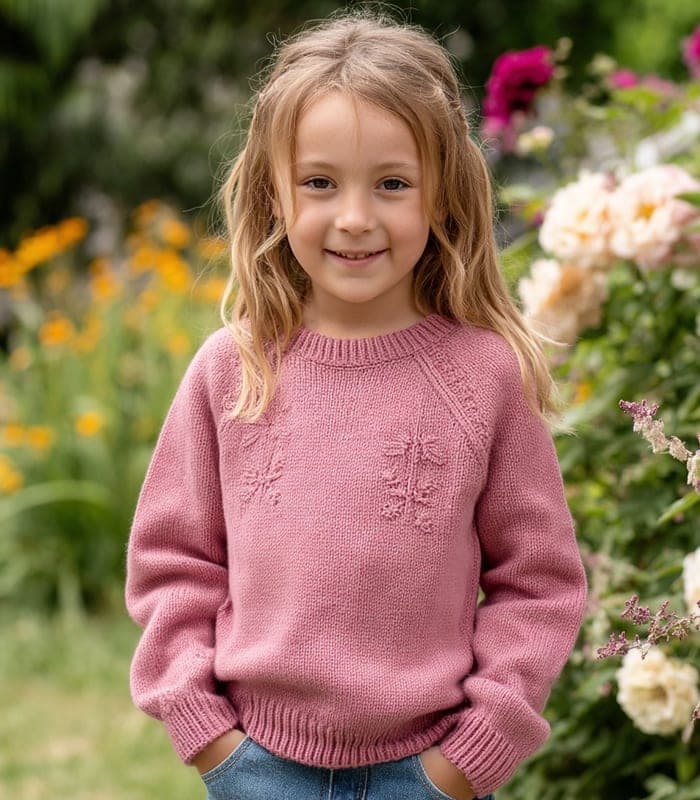
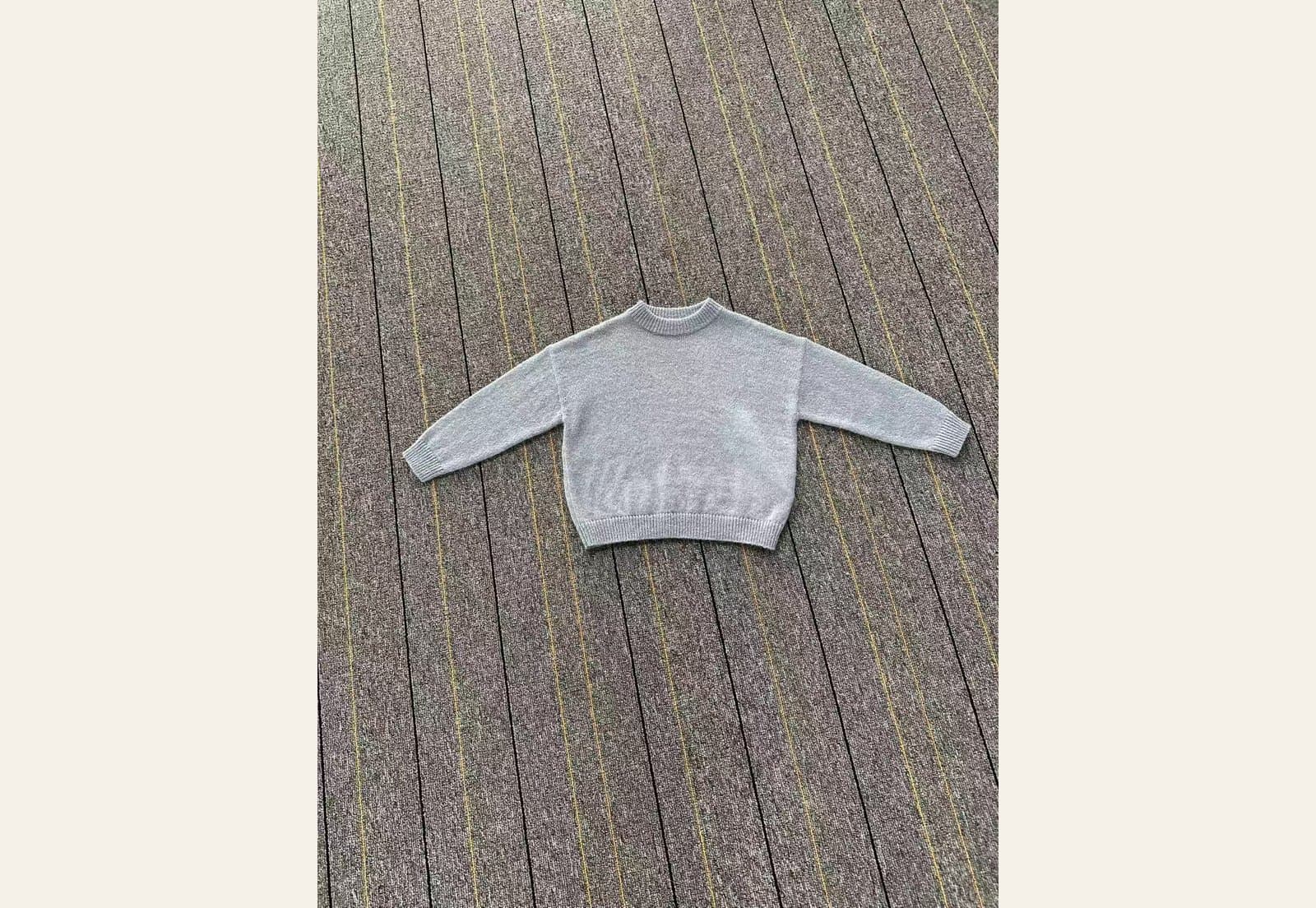
A plain children's crewneck with rib neck, cuffs and hem. In-house development piece, photographed in our Dongguan factory, November 2026.
Fibre: cotton first, recycled and organic well represented
Cotton appears in 11 of the 18 styles and wool in 6. Beyond that, five styles are published on organic cotton and three on recycled fibre — a higher proportion than our adult shelf carries, which reflects where children's buyers actually push. Alpaca, cashmere and merino appear on one style each as the premium end.
Skin contact is the reason this matters more here than elsewhere. Our OEKO-TEX Standard 100 certification is the document most children's buyers ask for first.
What a children's knit costs
Published index medians at MOQ 50 per colour, on the styles that carry each:
Basis
Published index median
Styles
100% cotton
USD 13.98
3
Cotton blend
USD 14.98
8
Wool blend
USD 17.36
4
Cardigans
USD 19.73
5
Knit jackets
USD 21.61
6
Sweaters / pullovers
USD 22.73
6
Mohair / alpaca
USD 26.48
1
Cashmere blend
USD 31.48
1
100% merino
USD 44.27
1
Deliberately not expressed as one range. The high is nearly four times the low, so a single figure would be useless for planning. Choose the fibre first; the number follows.
MOQ is 50 pieces per colour, sizes may be mixed within that 30, samples run about 15–25 days from a confirmed tech pack and yarn, and bulk 30–45 days. All 18 styles publish a size range of Newborn–12y.
Where the grading work actually is
All eighteen publish one range: Newborn to 12 years. That is a thirteen-year span in a single published line, and it is honest only because the grading is done per style rather than once for the category. A newborn body block and a 10-year block are different garments that happen to share a name — neck opening ratios, sleeve-to-body proportion and ease all move, and none of them move linearly.
In practice a first programme is graded across two or three age bands, not thirteen years. Deciding which bands you are actually selling into, before the tech pack, removes most of the sampling rounds.
What our shelf does not cover
Fifteen of eighteen are regular fit, three relaxed. Children's buyers increasingly ask for roomier, layer-friendly volumes and our published shelf does not show much of that.
Fifteen of eighteen are published as all-season, only three as autumn/winter. For a category where warmth is a primary purchase driver, that is thinner winter representation than the shelf should carry.
*Figures in this article are read from the 18 children's styles published in our own catalogue as of 11 September 2026, and from our published yarn cost index. They are reference figures, not quotations.*