The Three-Year Knitwear Supplier Relationship: Total Cost of Ownership Beyond Per-Piece FOB
Updated 10/9/202612 min readBy Simon Liu · Licheng Knitwear
Most sourcing scorecards still treat per-piece FOB as the headline KPI, and most brand directors quietly know it lies. In knitwear specifically — where every program runs through yarn development, lab dips, knit-down approval, wash trials, and a sampling room that has to learn your house fit — the cost of a garment is paid across eighteen months of friction, not in a single price line on a quotation. This article lays out a three-year total cost of ownership (TCO) model for knitwear supplier relationships aimed at brand directors and VPs of sourcing who keep getting pressured to chase a 40-cent FOB delta to a new factory. We walk through how sample cost actually declines as a supplier internalizes your spec (year 1 = 100, year 2 ≈ 70, year 3 ≈ 50), why reorders compress from week 7 to week 3 once a tech pack is genuinely owned by the other side, how yarn library carry-over kills new color development charges each season, and how production calendar priority — the unwritten advantage — only accrues to brands that stay. We also do the part most of these articles skip: the honest exit triggers. Communication breakdown, repeated first-bulk quality failure, no capability growth after eighteen months — these are real reasons to leave, and we name them. The argument is not loyalty for its own sake. It is that switching suppliers each season in knitwear almost always pays a 15-25% premium the FOB line does not show.
Sourcing leaders in apparel are paid to defend margin, so the per-piece FOB number ends up on the dashboard that goes to the CFO. Fair enough. But in knitwear — a category where every program walks through yarn dyeing, lab dips, knit-downs, hand-feel approvals, and a sampling room that has to learn your fit block — the FOB on quotation week is the smallest part of what you actually pay. The hidden costs sit in the eighteen months around it. This piece is for the brand director or VP-sourcing who keeps getting asked, by a younger merchant or a private-equity sponsor, why you don't just chase the new factory that quoted you 40 cents under your incumbent. Here is the honest answer, with the math.
Why Per-Piece FOB Is The Wrong Headline KPI
Common Questions
Why is per-piece FOB the wrong number to choose a supplier on?
Because it ignores everything that recurs. Over three seasons a relationship accumulates sample costs, colour development, reorder lead time and the friction of re-explaining your fits. A slightly higher FOB with a shorter reorder cycle and a carried-over yarn library often costs less in total.
Ready to Start Your Project?
Get a free catalog or submit an RFQ today. Our team will respond within 24 hours.
What actually falls over a multi-year supplier relationship?
Sample rounds, mostly. The first season pays for pattern development and fit correction; later seasons reuse blocks, yarn selections and approved colours. That curve is where the real saving sits, and it resets to zero when you switch.
What does a reorder track unlock that a first order does not?
Shorter lead times, because the pattern, the yarn and the colour are already approved and sometimes already booked. A reorder from a settled style is a fundamentally different calendar from a new development.
When is switching supplier the right call?
When quality or communication has failed repeatedly, when the supplier cannot serve a capability you now need, or when volume has grown past what they can run. Switching for a small per-piece saving usually costs more than it returns once the redevelopment is counted.
How should a buyer make the total cost visible?
Track sample spend, number of sample rounds, reorder lead time and colour development cost per season alongside FOB. Those four make the difference between suppliers visible in a way that a unit price never does.
A per-piece FOB number assumes the garment is a finished, repeatable commodity priced against a stable spec. In knitwear it almost never is on first pass. The first time a factory makes your crewneck, they are guessing at how much your buyer cares about a 2mm difference in neck rib depth, whether "slightly brushed" means a single pass or two, and which Pantone reference you will actually approve at lab-dip stage versus reject and re-submit. That guessing is paid for somewhere — usually in extra sampling rounds, a slower production calendar slot because they bumped your bulk to re-run shoulder shaping, or a defensive FOB that already prices in two more revisions than the incumbent would have needed.
If you compare two FOBs side by side without normalizing for relationship maturity, you are comparing year-three cost on one side against year-one cost on the other. The new factory's quote looks competitive because it is being priced against a fantasy of cooperation that has not been tested yet. Six months in, when you have paid for four extra lab dips, a re-knit on bulk, and a 10-day air-freight rescue to hit a drop date, the savings have already evaporated.
This is not an argument against ever switching. It is an argument for naming the full cost stack before you do.
The Three-Year Sample Cost Curve
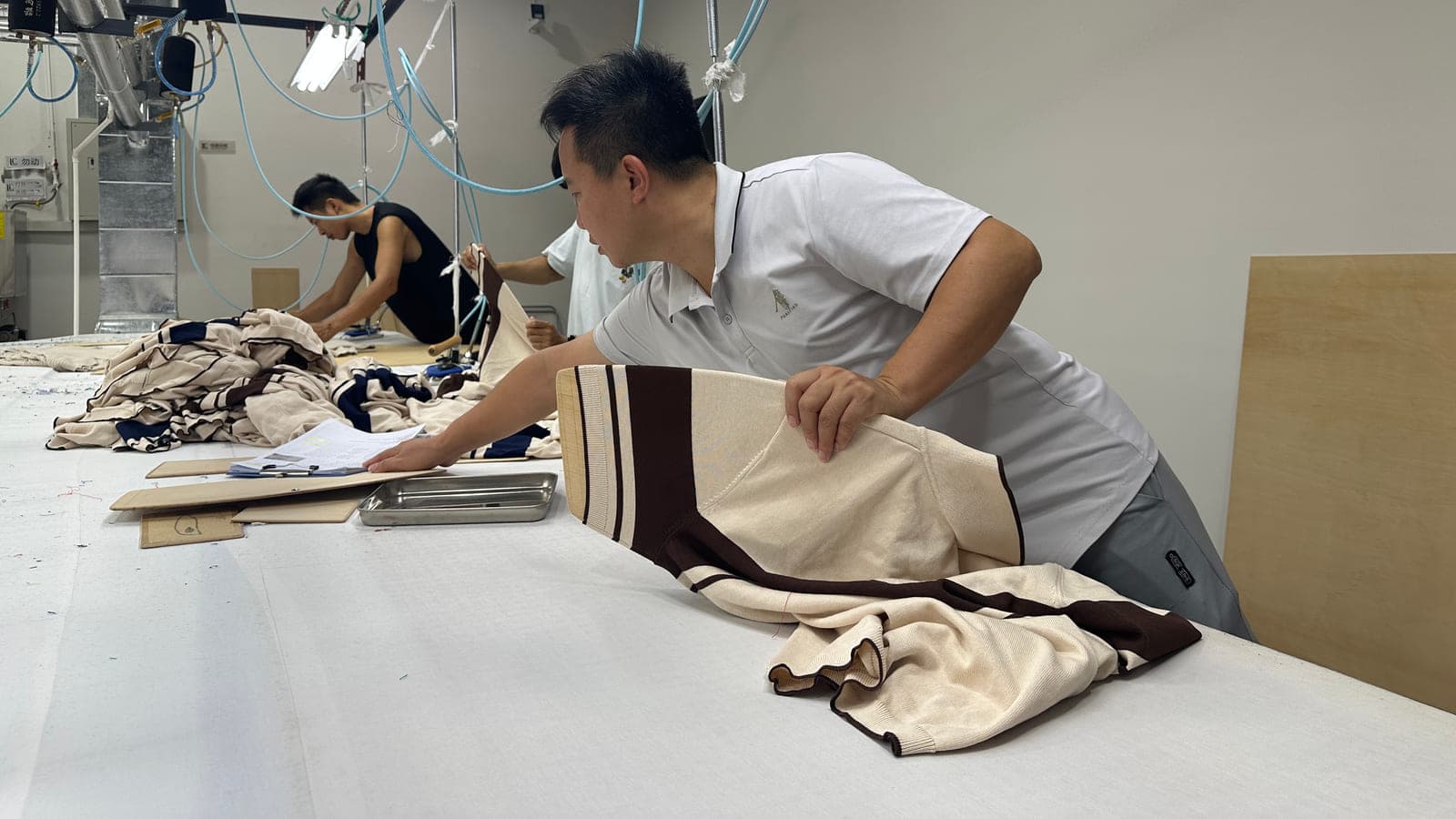
The single most underweighted line item in knitwear TCO is sampling spend across seasons. A supplier who has never made your product needs three to five rounds of proto and fit samples before bulk approval — sometimes more on a complex jacquard or a fully fashioned cardigan with intarsia panels. By year two with the same factory, that compresses to two rounds for similar constructions because the patternmaker already has your block and the sampling knitter knows your tension. By year three it is often a single proto plus a size set, because they are predicting your buyer's reaction before sending the sample.
If we index year-one all-in sampling cost (samples, lab dips, knit-downs, freight on rejected rounds, internal review time) at 100, a typical curve in knitwear looks like this:
Year
Sampling Index
Avg Sample Rounds
Lab Dips per Color
Knit-Downs per Stitch
Year 1 (new supplier)
100
3-5
2-3
2-3
Year 2
65-75
2-3
1-2
1-2
Year 3
45-55
1-2
1
1
The drop is not magic. It is the supplier doing on their side the boring work of building a fit library, archiving knit-downs, and standardizing finishing notes for your account. That work only happens if they believe you will be there next season. A factory that thinks you are auditioning them will defensively over-sample and bill it.
Reorder Lead Time: The Calendar You Don't See
Reorders are where mature relationships pay the largest hidden dividend, and they almost never show up in supplier scorecards because most brands score on first-bulk metrics. With a new supplier, a reorder of a proven style still typically needs a re-confirmation sample, a re-issued PP (pre-production) sample, and queue time behind whoever's program was already in their planning slot. Realistically that is seven to eight weeks from PO release to PP approval before bulk knitting even starts.
With a year-three supplier on a carried-over style, PP can be waived on identical color repeats and shortened to a confirmation knit-down on color updates. Total compression from PO to bulk start can be three to four weeks. In a category like knitwear where buyers re-issue best-sellers mid-season — a strong sell-through on a cable crewneck or a brushed mohair piece — that month of calendar is the difference between catching the second sell window and shipping into markdown.
Nobody puts "calendar priority" on an RFQ template, but it is real, and it is mostly distributed by trust.
Yarn Library Carry-Over And Color Development
In knitwear, yarn and color development is its own quiet cost center. A new supplier relationship begins with a yarn-source-and-approve cycle for every quality you want: gauge, fiber blend, twist, ply, hand. That is two to three weeks of back-and-forth before you have a usable yarn card, and it is paid for in calendar more than in cash. Each new Pantone or custom shade then needs lab dips, which themselves cost 2-3 rounds in year one and 1 round once the dyehouse knows your tolerance.
A supplier you have run multiple seasons with carries a yarn library for your account: the qualities you have approved, the dyehouses you have signed off on, the colors that are already in archived submission. Carrying over even six colors from last season into a new collection can save four weeks of development calendar and a low-four-figure spend in lab-dip and yarn submission costs. Over three years across two seasons a year, this stacks meaningfully.
This is also the reason a brand with stable color stories — heritage neutrals, repeated seasonal palettes — gets more out of long-term supplier relationships than a brand that resets its color card every season. If you are the former, the carry-over benefit is even larger than the table below suggests.
Commercial Terms And Pre-Negotiated Friction
A mature supplier relationship in knitwear typically produces a small set of pre-negotiated norms that never go into a written contract but quietly remove friction every season:
A standing MOQ floor (often anchored around 30 pieces per color) that both sides treat as the working baseline
Agreed sample lead time bands (typically 15-25 days) without a per-season re-negotiation
Bulk lead time bands (typically 30-45 days post-PP approval) that the planner can hold against without weekly re-confirmation
Default size-set logic (XS-3XL or whatever the brand's standard run is) without re-quoting grading
An understanding on payment milestones that doesn't require legal review each PO
None of this is on a quote sheet. All of it is real money in avoided coordination time, faster PO turn, and fewer surprises at booking. A new supplier costs you the re-negotiation of every one of these lines, often during the first two or three POs while your merchandiser is also trying to run a season.
The Hidden Premium Of Switching Each Season
If we stack the buckets honestly across a three-year horizon for a brand running two seasons a year at a moderate program size — say a few hundred to a few thousand pieces per style across a 10-15 SKU collection — switching every season versus staying with a competent incumbent typically looks like this:
Cost Bucket
Stay (Year 3)
Switch Every Season
Delta
Sampling all-in
50
100
+100% on switcher
Lab dip / color development
40
100
+150% on switcher
Reorder lead time risk (markdown exposure)
Low
High
Material
Calendar priority in peak
Strong
Weak
Material
Coordination overhead (internal merchant hours)
1.0x
1.6-1.8x
+60-80%
First-bulk failure / rework risk
Low
Elevated
Material
If you fold this into a per-piece equivalent on a typical knitwear program quoted around 11-14 dollars FOB, the effective premium on a season-rotation strategy runs 15-25% over a stayer strategy, even when the headline FOBs look identical. That is not a number you'll find on the CFO dashboard, but it is the number you are actually paying.
When Switching Is The Right Call
None of this is an argument for loyalty as a virtue. There are real reasons to leave a supplier, and pretending otherwise is how brands end up captive to factories that have stopped growing with them. The honest exit triggers, in our experience working with mills across China and increasingly in Vietnam and Bangladesh on selected lots:
Repeated first-bulk quality failure. One bad bulk is a problem to fix. Two in a row on different styles is a system issue. Three is a signal to leave.
Communication breakdown. If you cannot get a straight answer on a question that should take a day, and that pattern is consistent across multiple touchpoints in the factory, the relationship has stopped functioning regardless of how good the FOB looks.
No capability growth after 18 months. A supplier you have been with for six seasons should be able to take on slightly harder constructions, a finer gauge, or a new yarn category. If every new ask gets a flat "no" or a panicked over-quote, you have plateaued.
Compliance regression. If a supplier you previously trusted on social or chemical compliance starts ducking documentation requests on lots where you reasonably expect Oeko-Tex Standard 100 or equivalent paperwork, that is a red flag worth acting on.
Ownership change without continuity. Factory sales, merger of sampling teams into a different building, or loss of the merchandiser who actually ran your account — any of these can quietly reset your year-three benefits back to year one.
These are not soft signals. If two or more are firing at once, switching is the right call and the TCO math actually flips. The point of the framework is not to defend incumbents indefinitely. It is to make sure you are switching for the right reasons and not because someone in a Monday meeting waved a 40-cent FOB delta.
What This Means For How You Score Suppliers
If you are revising your supplier scorecard for next year, a few specific edits help align it with how knitwear actually costs out across a multi-year horizon:
Add a sampling efficiency line (rounds-to-approval) and track it season over season per supplier, not just per program.
Track reorder lead time separately from first-bulk lead time. They are different KPIs and a supplier can be strong at one and weak at the other.
Track carried-over yarn qualities and colors as an explicit metric, not a footnote.
Add a "calendar priority" qualitative line — does this supplier hold your slot in peak, yes/no, and what evidence.
Replace flat per-piece FOB with a three-year rolling TCO estimate that includes sampling, color development, and coordination overhead.
None of this is exotic. It is just a more honest accounting of where the money actually goes in knitwear sourcing, and it tends to make the long-relationship case argue itself.
---
Talk to our team about this
If you're planning a real project around any of the points above, we'd be glad to take a quick look. Send a short brief and we'll come back within one business day with a practical direction, MOQ + lead time estimate, and a sample plan if it makes sense.
Bring two numbers, not one. Keep the per-piece FOB on the dashboard because that conversation isn't going away, but add a second line: three-year rolling all-in cost per piece, including amortized sampling, lab-dip and color development, internal coordination hours, and markdown exposure from missed reorder windows. Stated that way, even a CFO who has never seen a knit-down will recognize that comparing year-one cost on a new supplier to year-three cost on an incumbent is apples to oranges. Frame the switch decision as a capital allocation question, not a procurement question, and you usually get a more honest hearing.
Calendar time and program volume both matter. A brand running two seasons a year with 10-15 styles per drop typically reaches the efficiency curve we describe around month 18-24, assuming reasonable continuity in construction types and yarn qualities. Brands that reset their construction story every season — moving from cardigans one year to fully fashioned polos the next to mohair the year after — never really get there, because the supplier is effectively in year one on each new technique. If you want the TCO benefits, give the supplier overlap between seasons, not a new category each time.
It holds more strongly for low-MOQ programs, not less. At MOQs around 30 pieces per color (plain and striped styles in the same yarn and color can be combined), sampling and color development are a much higher percentage of total program cost than they are at thousand-piece runs, so the year-on-year compression of those costs has a bigger relative impact. The reorder lead time benefit is also disproportionately important at small scale, because small brands often re-issue best-sellers mid-season to bridge to the next drop. If anything, season-rotation is more punishing for small brands than for large ones, because they have less negotiating leverage to absorb the friction.
Dual-sourcing is sensible for risk, but split it by category rather than by style. Put one supplier on your fully fashioned and complex constructions where the year-three benefits compound most, and the other on a clearly defined adjacent category — say, basic flat-knit crewnecks or zip cardigans. Don't run the same style at both suppliers across alternating seasons; you will pay year-one costs at both factories permanently. The goal is two long-term relationships in parallel lanes, not one relationship being constantly auditioned against another.
Run the test on additive program, not replacement program. Give the new supplier a clearly bounded trial — usually two to three styles in a category your incumbent doesn't run well, or a small capsule that wouldn't fit your incumbent's calendar — and evaluate them over at least two full seasons before drawing conclusions. Be transparent with the incumbent that you're trialling, framed as capacity expansion rather than competitive review. Most mature suppliers understand that brands need backup options, and reacting honestly tends to deepen the primary relationship rather than damage it. What burns relationships is hidden parallel testing that the incumbent finds out about later.
We focus on men's sweaters, cardigans, knit jackets, jacquard knitwear and private label knitwear. We support B2B buyers with OEM/ODM development, sampling and bulk production planning.
MOQ, lead time, cost ranges, gauge selection and QC checkpoints across typical OEM/ODM knitwear programs in NA + EU. Enter your email — we'll send you the report link in 30 seconds.
No spam. Unsubscribe with one reply. We use your email only to send you the report and follow up if you want a sourcing conversation.