Best Low-MOQ Knitwear Manufacturers for Small Brands (2026): 9 Things the Good Ones Get Right
Updated 6/15/202612 min readBy Licheng Knitwear Team
A criteria guide (not a paid ranking) to choosing a low-MOQ knitwear manufacturer: the 9 traits that separate the good partners from the risky ones, each with its red flag, plus a shortlist scorecard.
1. Overview
A criteria guide (not a paid ranking) to choosing a low-MOQ knitwear manufacturer: the 9 traits that separate the good partners from the risky ones, each with its red flag, plus a shortlist scorecard. This guide walks you through the manufacturing journey with Licheng Knitwear.
Buyer Guide Content
Quick answer — how to find the best low-MOQ knitwear manufacturer for a small brand: ignore the "Top 10" lists that rank suppliers by who paid to be on them, and judge a factory against what actually protects a small order: a genuinely low MOQ stated per colour (30–100 pcs, not a headline number that balloons at quote stage), honest sampling lead times, a real factory (not a trading desk), clear FOB pricing with the cost drivers explained, the compliance paperwork your market needs, and communication you can build a calendar on. Below are the nine traits that separate the good low-MOQ partners from the risky ones — written as a checklist you can run a shortlist through, with the honest red flags for each. This is a criteria guide, not a paid ranking.
1. A real low MOQ — stated per colour, and it holds at quote stage
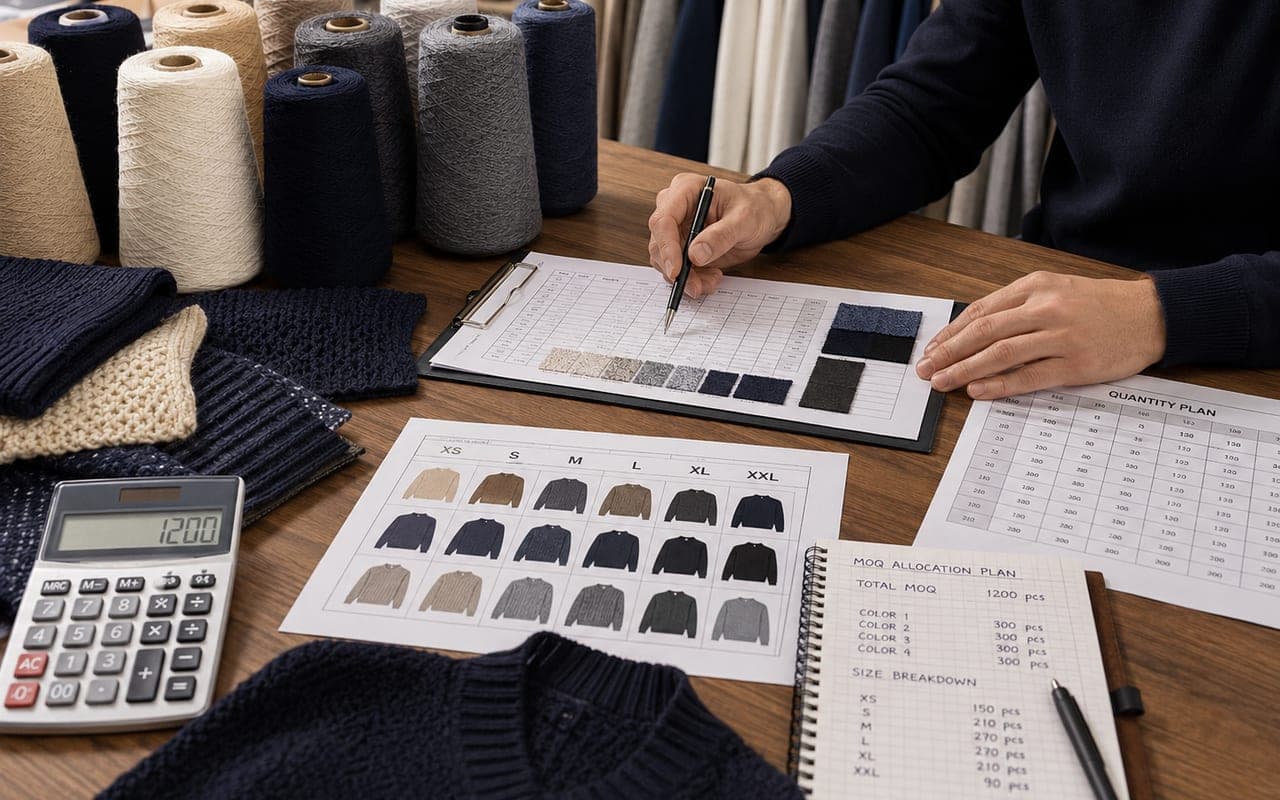
The headline "low MOQ" means little until you see it per . A factory that says "MOQ 30" but quotes a 300-pc minimum once you pick three colours wasn't low-MOQ; it was marketing. Ask for the MOQ *per colour* and confirm it survives the actual quote. a number that changes the moment you give real details.
Ready to Start Your Project?
Get a free catalog or submit an RFQ today. Our team will respond within 24 hours.
Good low-MOQ partners quote sampling in a believable window — for knitwear, roughly 15–25 days for an averagely complex style, longer for fine gauges or dyed-to-order yarn. Red flag: "3-day samples" on a custom yarn and gauge — either it's a stock style dressed up as custom, or the date won't hold.
3. An actual factory, not a trading company
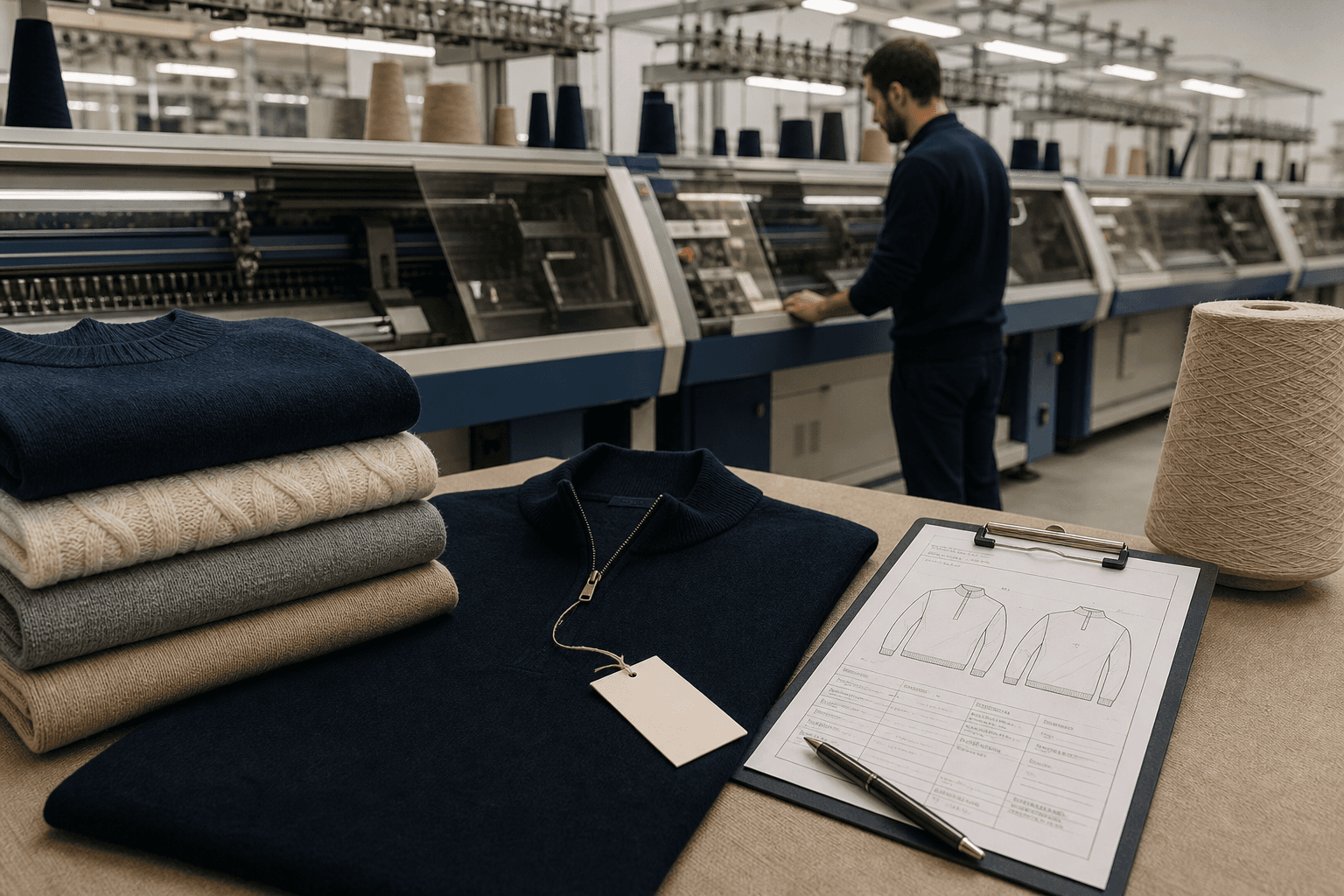
Trading desks can be fine, but for a small brand they add a margin and a layer of telephone between you and the floor. Ask to see the knitting floor — machines, gauges, linking, washing — on a recent video or call. Red flag: vague answers about "our partner factories" and no current floor footage. (We show our production floor on the Trust Center.)
4. Gauge and yarn range that fits your product
The best partner for *your* brand is the one whose machine range and yarn relationships match what you're making — fine 12–14GG for refined polos, 5–7GG for chunky AW knits, the right wool/cotton/cashmere/recycled sources. A factory strong in one band may be weak in another. Red flag: "we do everything" with no specifics.
5. Clear FOB pricing with the cost drivers explained
A trustworthy quote explains *why* it costs what it costs — yarn count and fibre, gauge and knit time, colour count, trims, MOQ split — not just a single number. That transparency is also how you negotiate intelligently. Red flag: a flat price with no breakdown and no willingness to explain it.
6. The compliance paperwork your market actually needs
This is where small brands get caught after the order. If you sell into the EU, you need an EU Responsible Person under the GPSR, packaging EPR registration, OEKO-TEX/REACH on the materials, and correct fibre/care labelling — and most factories cannot support the EU Responsible-Person part. Confirm the supplier can produce the documents *your* retailer or marketplace will ask for. Red flag: "no problem" with no actual certificate or registration number to show. (See our EU market compliance guide.)
7. Private-label and packaging support
A real OEM/ODM partner handles woven labels, care labels, hangtags, polybags, size stickers and export cartons to your spec — so your low-MOQ run still ships brand-ready. Red flag: "we only do the garment; labels are your problem."
8. Communication you can plan a calendar around
For a small team, a supplier who replies clearly within a business day and flags problems early is worth more than one a dollar cheaper who goes quiet. Time-zone overlap, a named contact, and proactive updates matter. Red flag: slow, copy-paste replies that don't answer the question.
9. Willingness to start small and grow with you
The best low-MOQ partners treat a first 30–100 pc order as the start of a relationship, not a nuisance — and have a sensible reorder path as you scale. Red flag: obvious disinterest until you can place a four-figure quantity.
Quick-reference: the shortlist scorecard
Trait
Green flag
Red flag
MOQ
Low, stated per colour, holds at quote
Balloons once you give details
Sampling
Believable (≈15–25 days knitwear)
Implausibly fast on custom
Who you're dealing with
Real factory, shows the floor
Vague "partner factories"
Gauge/yarn fit
Specific to your product
"We do everything"
Pricing
FOB with cost drivers explained
Flat number, no breakdown
Compliance
Has the docs your market needs (EU: GPSR/EPR)
"No problem", nothing to show
Private label
Full label/packaging support
Garment only
Communication
Clear, < 1 business day, proactive
Slow, copy-paste
Scaling
Happy to start small
Only interested at high volume
Where Licheng fits (transparently)
We're a Dongguan knitwear manufacturer founded in 2018, OEM/ODM and private label, MOQ 30 pcs per colour, sampling 15–25 days, gauge 3GG–18GG. We're EU-market-ready (EU Authorized Representative under the GPSR, German packaging EPR registration, OEKO-TEX/GRS/ISO processes — verifiable on our Trust Center). We're not claiming to be "the best for everyone" — run us through the scorecard above against your product and see. If we fit, send a tech pack and we'll come back within a business day. Request a quote →
Common Questions
What is a realistic low MOQ for custom knitwear?
For genuine custom (your yarn, gauge and design), 30–100 pieces per colour is realistic from a small-brand-friendly factory. Much lower than that on truly custom production is rare; much higher isn't really "low MOQ".
Are "Top 10 knitwear manufacturer" lists reliable?
Treat them with caution — many are pay-to-list or self-promotional. They're a starting point for names at best. Judge any candidate against objective criteria (MOQ per colour, lead times, real factory, pricing transparency, compliance, communication) rather than its ranking on a list.
How do I check a factory is real and not a trading company?
Ask for a recent video or live call of the knitting floor, the machine gauges they run, and their own business registration. A real manufacturer can show the floor; a trading desk deflects to "partner factories".
What compliance should a low-MOQ supplier support for the EU?
An EU Responsible Person under the GPSR, packaging EPR registration, OEKO-TEX/REACH on materials, and correct fibre/care labelling. Many factories can't cover the EU Responsible Person — confirm it before you order.
---
Talk to our team about this
Building a shortlist? Send your product direction, target MOQ and destination markets, and we'll reply within one business day with a straight answer on fit, MOQ, lead time and a sample plan.
MOQ, lead time, cost ranges, gauge selection and QC checkpoints across typical OEM/ODM knitwear programs in NA + EU. Enter your email — we'll send you the report link in 30 seconds.
No spam. Unsubscribe with one reply. We use your email only to send you the report and follow up if you want a sourcing conversation.
Brand names shown are previously serviced OEM/ODM partners. Logos are decorative and do not imply current endorsement.