Pantone-Farbabstimmung für maßgefertigte Strickwaren: Ein Leitfaden für Einkäufer
Aktualisiert 24.8.202612 min readVon Simon Liu · Licheng Knitwear
Wie Pantone-Farbabstimmung bei maßgefertigten Strickwaren wirklich funktioniert: Lab-Dip-Runden, Solid-Coated-Codes, Delta-E-Toleranzen, Lichtkabinen und Serienfreigabe.
Die Farbe ist der Teil eines Strickprogramms, bei dem Einkäufer am emotionalsten sind — und zugleich der Teil, bei dem die Fabrik den geringsten Spielraum für Fehler hat. Ein Pullover, der eine Nuance von Ihrer Referenz abweicht, kann die gesamte Serienproduktion unverkäuflich machen. Dieser Leitfaden erklärt, wie die Pantone-Farbabstimmung bei maßgefertigten Strickwaren tatsächlich funktioniert, welche Toleranzen realistisch sind und wie Sie einen Freigabeprozess aufsetzen, der genau die Farbe liefert, die Sie sich vorgestellt haben.
Farbe ist in der Produktion nicht subjektiv. Sie wird gemessen, freigegeben und dokumentiert — und Einkäufer, die sie so behandeln, erzielen reproduzierbare Ergebnisse.
Warum die Farbabstimmung bei Strickwaren schwieriger ist als bei Webwaren
Ein flaches gewebtes Stoffmuster und ein gestricktes Muster, die im selben Färbebad gefärbt wurden, wirken auf das Auge unterschiedlich. Der Grund ist die Struktur: Strickmaschen streuen und absorbieren Licht anders als das flache Kett-und-Schuss-Gefüge eines Gewebes, sodass sich die wahrgenommene Farbe verschiebt. Die Oberflächentextur verändert dies zusätzlich — ein gebürsteter Mohair wirkt weicher und heller als ein glatter Feinstrick-Merino, der in identischer Partie gefärbt wurde.
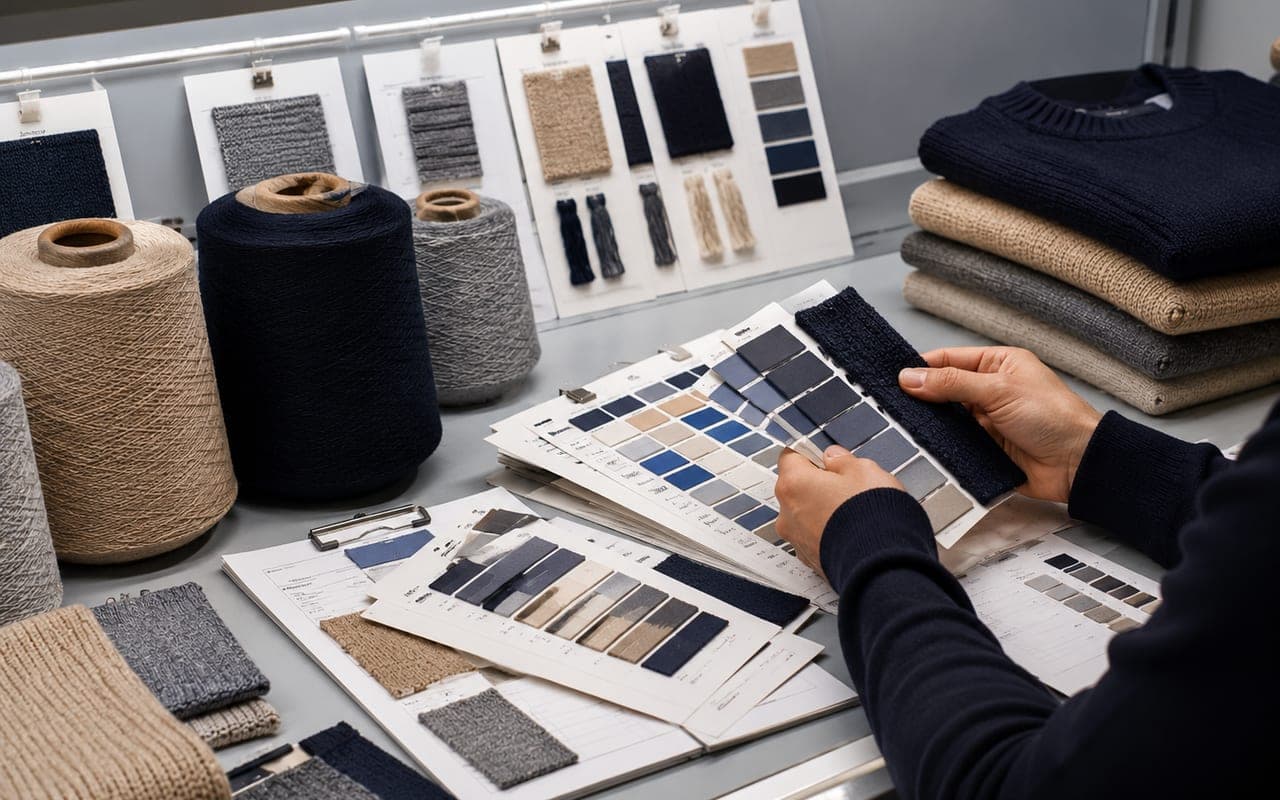
Deshalb erfolgt die Pantone-Abstimmung bei Strickwaren immer Faser auf Faser: Der Lab Dip muss auf genau dem Garn erstellt werden, das in der Serienproduktion verwendet wird — gestrickt in derselben Feinheit und Maschenstruktur, mit derselben Ausrüstung.
Variable
Wirkung auf die wahrgenommene Farbe
Was der Einkäufer angeben sollte
Faser
Baumwolle, Wolle, Acryl nehmen Farbstoff unterschiedlich auf
Endgültige Garnzusammensetzung
Feinheit (Gauge)
Maschengröße verändert die Lichtreflexion
Endgültige GG (z. B. 7GG vs. 12GG)
Maschenstruktur
Zöpfe und Rippen werfen Schatten
Referenz-Maschenbild
Ausrüstung
Bürsten, Waschen, Anti-Pilling verändern den Farbton
Ausrüstungsweg
Lichtquelle
Farbe verschiebt sich unter D65, TL84, A
Unter allen 3 freigeben
Das Pantone-System: TPX, TCX und Solid Coated
Nicht jeder Pantone-Fächer ist für Strickwaren geeignet. Die drei, denen Sie begegnen werden:
Pantone Solid Coated (PMS-C) — der Standard im Grafikdesign. Als Ausgangsreferenz nützlich, aber auf Papier gedruckt und repräsentiert daher kein Textil.
Pantone TPX (Textile Paper eXtended) — Pigmente auf Papier gedruckt, für textile Briefings konzipiert. In Tech Packs verbreitet.
Pantone TCX (Textile Cotton eXtended) — dieselben Farben auf Baumwollgewebe gefärbt. Die genaueste Referenz für textile Arbeiten.
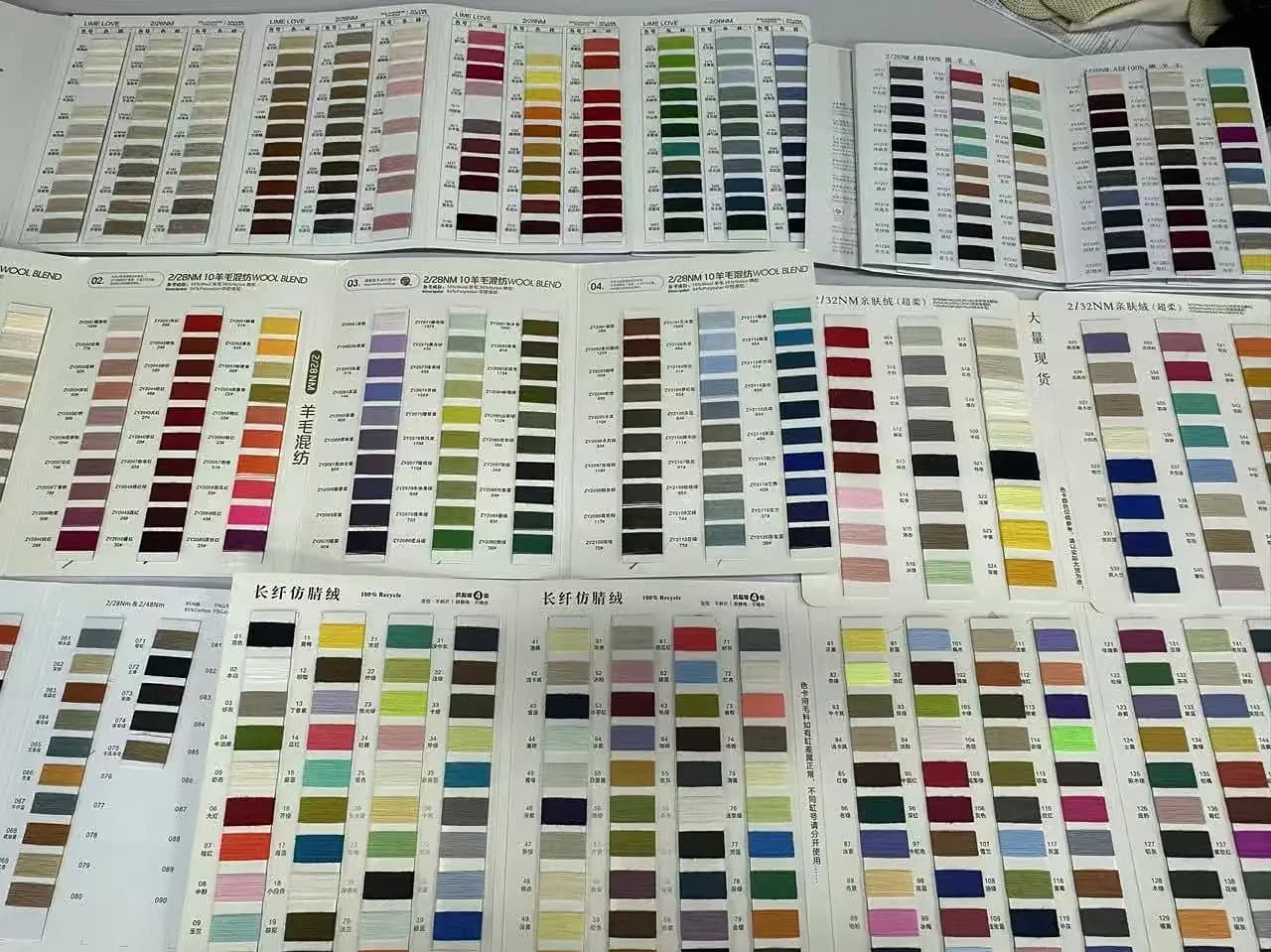
Wo immer möglich, briefen Sie in TCX. Ein Code wie `19-1664 TCX True Red` gibt der Färberei ein echtes textiles Ziel statt einer gedruckten Annäherung. Wenn Sie nur eine Solid-Coated-Referenz haben, senden Sie sie, weisen Sie aber darauf hin, dass die Abstimmung auf Garn interpretiert werden muss.
Lab Dips: Die erste Farbrunde
Ein Lab Dip ist ein kleiner, testgefärbter Garnstrang, der vor der Serienfärbung erstellt wird. Die Färberei mischt eine Rezeptur, färbt einen Strang und sendet zwei oder drei Optionen — üblicherweise einen Ton leicht über, auf und leicht unter dem Ziel. Der Einkäufer wählt die nächstliegende Option, kommentiert die Richtung („wärmer", „weniger gelb", „5 % dunkler"), und eine zweite Runde wird auf Basis dieses Feedbacks gefärbt.
Ein typischer Lab-Dip-Zyklus:
Runde
Typische Dauer
Was Sie erhalten
Was Sie tun
Runde 1
7–10 Tage
2–3 Optionen gegen Ihre Pantone-Referenz
Richtung kommentieren
Runde 2
5–7 Tage
1–2 verfeinerte Optionen
Freigeben oder feinjustieren
Runde 3 (falls nötig)
5–7 Tage
Finaler korrigierter Lab Dip
Freigabe für die Serienproduktion
Die meisten Farben sind in 2 Runden erreicht. Schwierige Farbtöne — gesättigte Rottöne, tiefe Marineblautöne, leuchtende Petroltöne, fluoreszierende Töne — können 3 oder mehr Runden benötigen. Planen Sie das in Ihren Kalender ein; gehen Sie nicht davon aus, dass eine Runde genügt. Für den größeren zeitlichen Kontext siehe unseren Leitfaden zu Lieferzeiten bei der Pullover-Bemusterung.
Delta-E: Die numerische Toleranz
Eine professionelle Farbfreigabe arbeitet mit einer gemessenen Toleranz, nicht nur mit einer Sichtprüfung. Delta-E (ΔE) ist der berechnete Abstand zwischen zwei Farben in einem gleichabständigen Farbraum (CIELAB). Je niedriger der ΔE-Wert, desto genauer die Übereinstimmung.
ΔE ≤ 1.0 — praktisch kein wahrnehmbarer Unterschied, Premium-Standard
ΔE ≤ 1.5 — die Arbeitstoleranz von Licheng für Serienware gegenüber dem freigegebenen Lab Dip
ΔE ≤ 2.0 — akzeptabel für Casual- / Promotion-Sortimente
ΔE > 2.5 — sichtbarer Unterschied, in der Regel abgelehnt
Seriöse Fabriken verwenden ein Spektralphotometer (etwa Datacolor oder X-Rite), um das Seriengarn gegen den freigegebenen Standard zu messen. Fragen Sie, ob Ihre Fabrik die Farbe misst oder nur visuell beurteilt — die Messung ist es, die Farbe über Nachbestellungen hinweg reproduzierbar macht.
Die Lichtkabine: D65, TL84 und A
Zwei Farben, die unter einer Lichtquelle übereinstimmen, können unter einer anderen voneinander abweichen. Dieses Phänomen heißt Metamerie und ist die Quelle der meisten Farbstreitigkeiten zwischen Einkäufer und Fabrik.
Jede ernsthafte Farbfreigabe erfolgt in einer standardisierten Lichtkabine unter drei Lichtarten:
D65 — durchschnittliches Tageslicht; der primäre Standard für Bekleidung
TL84 — europäisches Einzelhandels-Leuchtstofflicht; so wirkt der Pullover im Laden
Lichtart A — Glühlampenlicht / warmes Wohnlicht
Geben Sie Ihre Farbe unter allen drei frei. Stimmt sie unter D65 überein, verschiebt sich aber unter TL84 deutlich, muss die Färberezeptur vor der Serienproduktion angepasst werden. Das ist auch der Grund, warum die Freigabe eines Lab Dips anhand eines Handyfotos niemals ausreicht — fordern Sie den physischen Garnstrang an.
Der Schritt der Serienfreigabe
Die Lab-Dip-Freigabe ist nicht das Ende. Vor der Massenproduktion färbt die Fabrik die tatsächliche Seriengarn-Partie und sendet eine Bulk-Garnvorlage (manchmal BYS oder Bulk Lab Dip genannt) gegen den freigegebenen Lab-Dip-Standard. Erst wenn die Serienpartie innerhalb der vereinbarten ΔE-Toleranz liegt, beginnt das Stricken.
Bei mehrfarbigen Programmen klären Sie außerdem, ob die Farben über die Styles einer Kollektion hinweg übereinstimmen müssen — ein Marineblau auf einem Polo sollte genauso wirken wie das Marineblau auf einem Rundhalspullover. Das erfordert gemeinsame Färbepartien oder eine strenge Partie-zu-Partie-Toleranz und sollte im Tech Pack vermerkt werden.
Häufige Fehler bei der Farbfreigabe
Freigabe anhand eines JPEGs. Bildschirme lügen. Geben Sie immer den physischen Garnstrang unter Kabinenlicht frei.
Auslassen der Bulk-Garnvorlage. Ein hervorragender Lab Dip garantiert keine hervorragende Serienpartie.
Briefing mit einem getragenen Kleidungsstück als Referenz. Waschen, Sonne und Zeit verschieben die Originalfarbe; sie ist kein verlässliches Ziel.
Unterschätzen gesättigter und dunkler Farbtöne. Rottöne, Royalblau und tiefes Schwarz benötigen regelmäßig eine zusätzliche Dip-Runde.
Wechsel der Faserzusammensetzung mitten im Programm. Wenn Sie nach der Lab-Dip-Freigabe von 100 % Baumwolle auf eine Baumwoll-/Acrylmischung wechseln, verschiebt sich die Farbe.
Praktische Checkliste für Einkäufer
Vor dem ersten Lab Dip:
[ ] Pantone-Code(s) festgelegt, idealerweise TCX, mit `Solid Coated` nur als Ausweichlösung
[ ] Endgültige Faser, Feinheit und Maschenstruktur bestätigt
Fordern Sie ein Angebot an mit Ihren Pantone-Referenzen, und wir führen das Lab-Dip-Programm gegen Ihre Toleranz durch — auf genau dem Garn, das Sie in der Serienproduktion verwenden werden.
---
Sprechen Sie mit unserem Team darüber
Wenn Sie zu einem der oben genannten Punkte ein konkretes Projekt planen, schauen wir uns das gerne kurz an. Senden Sie uns ein kurzes Briefing, und wir melden uns innerhalb eines Werktags mit einer praxisnahen Einschätzung, einer MOQ- und Lieferzeit-Schätzung sowie — falls sinnvoll — einem Bemusterungsplan zurück.
You supply a Pantone (TCX/TPX) reference; the mill dyes a lab dip, we send it for approval, then dye the bulk yarn to the approved standard. Stock colours skip the dyeing step.
A lab dip is a small dyed yarn sample for colour sign-off before bulk. It prevents costly colour mismatches on the full order.
Not the MOQ - a custom-dyed colour still starts at 30 pieces per colour, with a small-lot dyeing surcharge below the mill's 100-300-piece dye lot, and the lab dip adds 7-15 days. Designing around in-stock colours keeps cost and lead time lowest.
Wir konzentrieren uns auf Herrenpullover, Cardigans, Strickjacken, Jacquard-Strickwaren und Private-Label-Strickwaren. Wir unterstützen B2B-Käufer bei OEM/ODM-Entwicklung, Mustererstellung und Serienproduktionsplanung.
Verfügbare Musterstile und ausgewählte kundenspezifische Programme ermöglichen risikoärmere Testläufe vor größeren Saisonaufträgen.
Ja. Marken, auch neue Labels vor ihrer ersten Kollektion, können ein Muster bezahlen und es ansehen, bevor sie einen Produktionsauftrag erteilen. Zwei Wege: ein Ready-Sample eines veröffentlichten Modells für USD 60 pro Stück in etwa 7 Tagen, oder ein Entwicklungsmuster nach Ihrem Tech-Pack für USD 150 pro Modell – inklusive Garnbeschaffung, Strickprogrammierung, einem Prototyp und einer Korrekturrunde – in 15-25 Tagen. Kaschmir- und Mohair-Modelle werden einzeln kalkuliert, der Versand wird zum Selbstkostenpreis berechnet. Die Produktion startet erst nach Freigabe des physischen Musters, ab 30 Stück pro Farbe, Größen innerhalb der 30 mischbar. Ein Muster verpflichtet Sie nicht zur Produktion; Kleidung für den privaten Gebrauch fertigen wir nicht.
Bereit, Ihr Projekt zu starten?
Fordern Sie einen Katalog an oder senden Sie heute eine Anfrage. Unser Team antwortet innerhalb von 24 Stunden.