There is a specific moment in every sourcing manager's first year when they realize the freight quote they accepted wasn't actually the freight quote. The wire from origin looked clean. Then a destination invoice shows up with CFS charges, ISF filing, chassis split, demurrage, and a deconsolidation fee that together cost more than the ocean leg itself. For knitwear in particular this hurts, because sweaters take up a lot of cubic meters for very little money per piece, and the wrong mode choice can erase 4-6% of your landed margin before the goods leave the port.
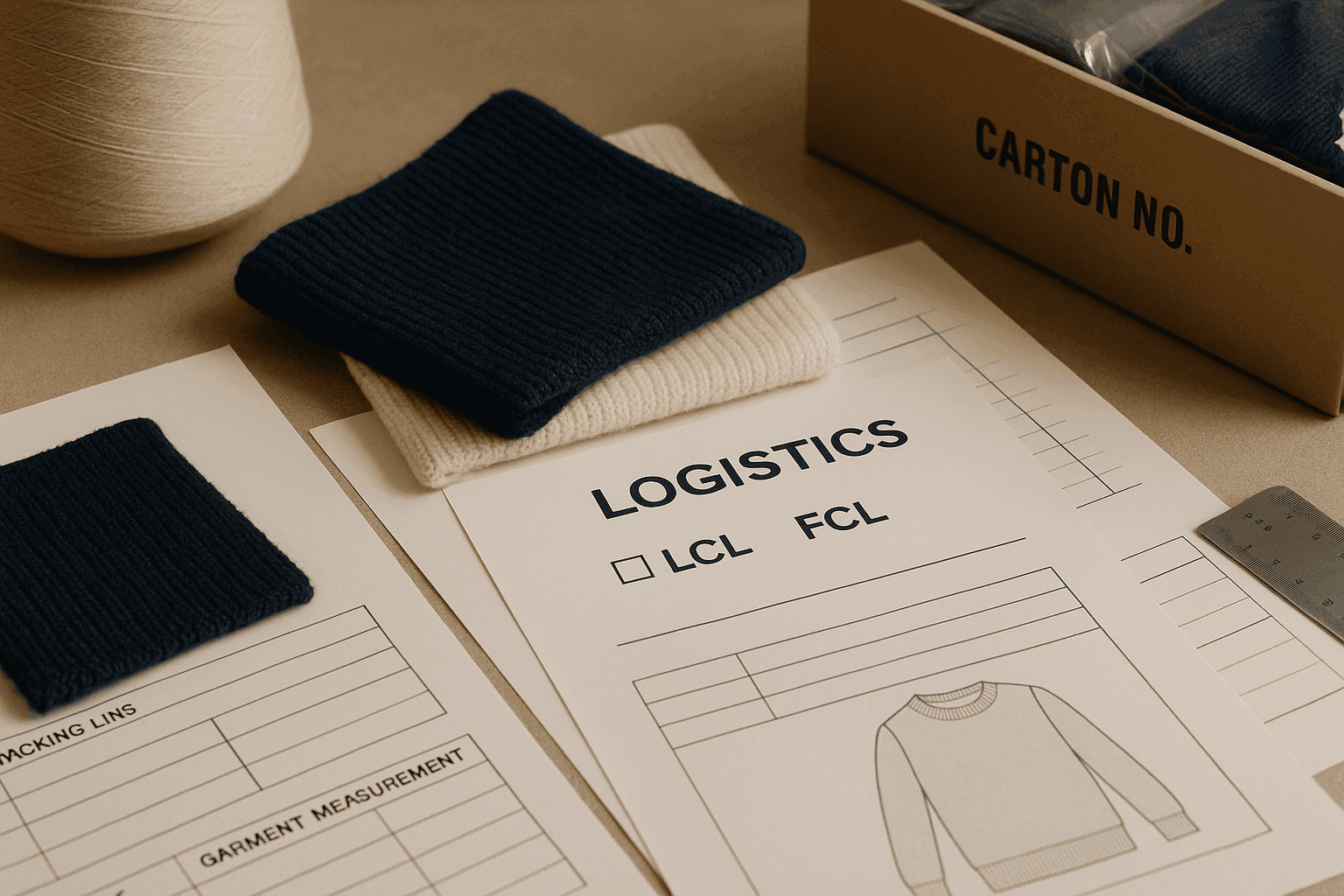
This is a practical guide to deciding LCL versus FCL for a knitwear PO of 200-2000 pieces moving from a South China port to the US East Coast or Northern Europe. The math isn't complicated. The trap is the line items nobody mentions at quote time.
Before you can argue about modes you need to know what your PO looks like in cubic meters. Knitwear is a low-density cargo: a finished sweater in a retail-folded poly bag with a hangtag and a size sticker is mostly air. A 7GG cotton crewneck weighs around 450-550 grams. A chunky 3GG wool cardigan can hit 900 grams. Neither pushes the weight limit of an ocean container; you will run out of space long before you run out of payload.
The rule of thumb we use on quotes leaving Dongguan:
Mid-gauge crewneck or polo in poly bag, retail-folded: about 100-120 pieces per CBM
Heavy chunky cardigan or jacket-style knit: about 70-90 pieces per CBM
Fine-gauge spring polo or light cotton knit: about 130-160 pieces per CBM
Solid-pack export carton (no individual poly): about 180-220 pieces per CBM
Most retail-ready buyers land near 100 pieces per CBM as a planning number. Run a quick translation against your PO sizes:
PO size
Mid-gauge CBM
Heavy knit CBM
Mode call
200 pcs
~2 CBM
~2.5 CBM
LCL, no question
500 pcs
~5 CBM
~6.5 CBM
LCL
800 pcs
~8 CBM
~10 CBM
LCL, but check FCL
1200 pcs
~12 CBM
~15 CBM
Break-even zone
2000 pcs
~20 CBM
~25 CBM
20ft FCL, easy
3000 pcs
~30 CBM
~37 CBM
40ft FCL or 20ft + LCL split
A 20ft standard container has roughly 33 CBM of nominal capacity but only about 26-28 CBM of usable space once cartons are stacked properly. A 40ft has about 58-60 CBM usable. For knitwear you almost always cube out before you weigh out, so payload limits are irrelevant to the decision.
The Break-Even Point
The Break-Even Point
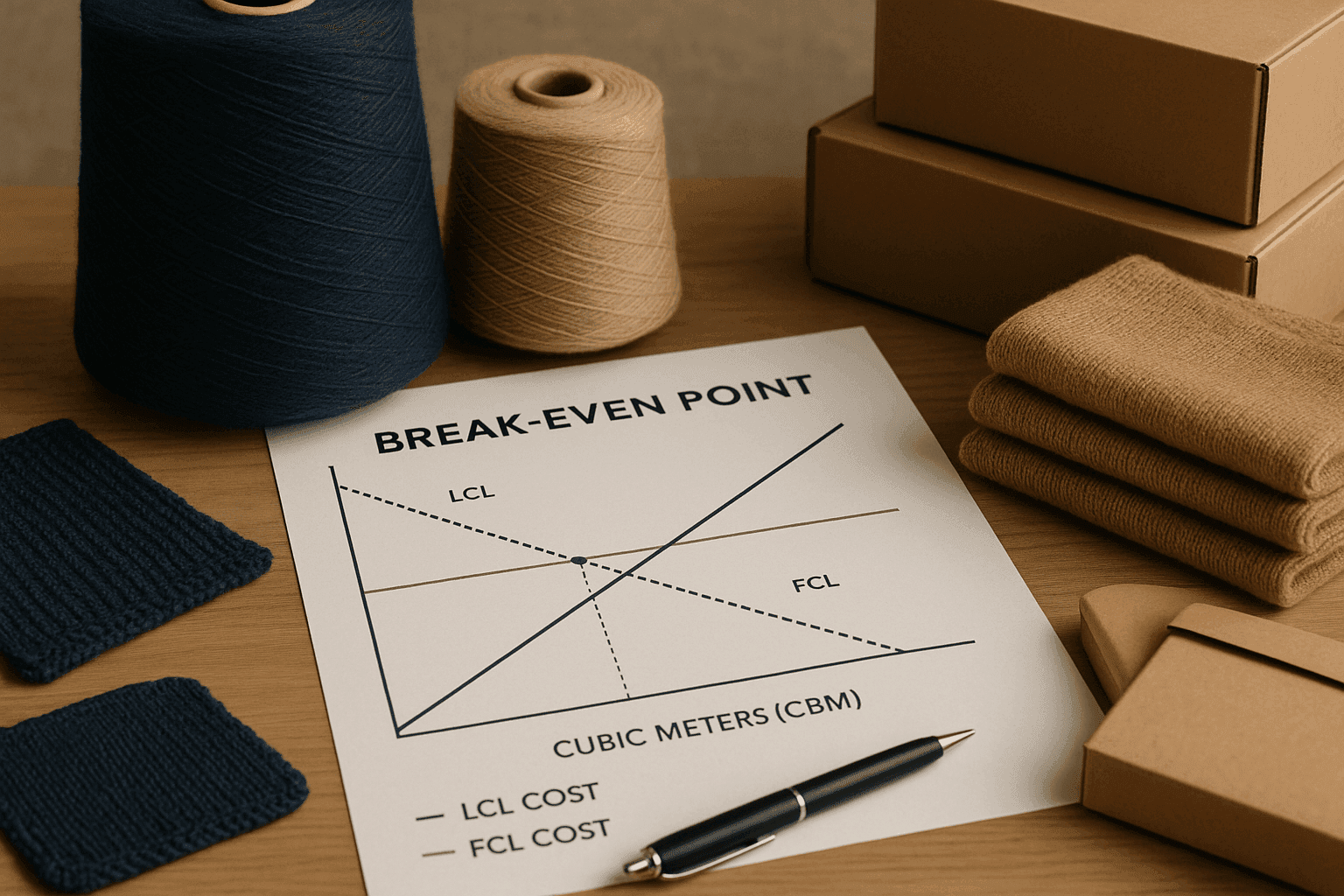
For knitwear out of South China the break-even between LCL and a 20ft FCL sits around 12-15 CBM once destination fees are honestly loaded in. Below that LCL is cheaper on a per-CBM basis. Above that FCL is cheaper, faster, and cleaner through customs.
The exact line moves with three things: the spot ocean rate (which has been volatile), how aggressive your forwarder's CFS partner is at destination, and whether your destination port charges chassis fees by the day. As of mid-2026, on the Shenzhen to New York lane:
LCL all-in lands around 90-130 dollars per CBM origin to destination port, plus 150-300 dollars in fixed destination charges per shipment
A 20ft FCL all-in lands around 1800-2800 dollars all-in on the same lane
Divide and you see why 12-15 CBM is the inflection. At 8 CBM LCL costs about 1100 dollars total versus 2300 for FCL. At 18 CBM LCL costs about 2100 versus the same 2300 FCL, with FCL now winning on speed and cleanliness. By 22 CBM the LCL bill exceeds the FCL bill outright.
Roughly the same picture holds for Northern Europe (Rotterdam, Hamburg) with the absolute numbers a few hundred dollars lower per box but the inflection point in the same 12-15 CBM range.
A Real Math Example
Take a 1200-piece PO: 800 mid-gauge crewnecks at 100 pcs/CBM and 400 heavier shawl-collar cardigans at 80 pcs/CBM. That's 8 + 5 = 13 CBM. Right on the break-even.
LCL total landed = about 2915 USD, or 2.43 USD per piece
20ft FCL quote, same lane:
Ocean freight all-in to port = 2300 USD
Terminal handling at destination = 250 USD
Chassis + dray to warehouse = 550 USD
Customs entry = 175 USD
ISF = 35 USD
FCL total landed = about 3310 USD, or 2.76 USD per piece
LCL wins by about 33 cents a piece. But you also pay 7-10 extra transit days, you absorb 2-3 extra touches in the CFS process, and you carry a higher demurrage risk if customs flags the load (because demurrage on a deconsolidated LCL shipment can run faster than on your own box). For most buyers the 33-cent savings on a 13 CBM load is real but not life-changing; if your on-shelf date is tight, FCL becomes the right call even though it costs more on paper.
Now run the same exercise at 18 CBM. LCL climbs to about 3700 USD. FCL stays near 3300. You are now paying more and waiting longer. This is the bracket where buyers most often miscall.
Lead Time: The 5-10 Day LCL Tax
FCL is door-to-door faster than LCL on virtually every lane because the container does not sit at a CFS waiting to fill up at origin or sit at a CFS waiting to be deconsolidated at destination. Typical penalty:
Origin CFS wait for sailing-week consolidation: 2-4 days
Slower transit (LCL services often skip transshipments FCL takes direct): 1-3 days
Destination CFS deconsolidation, sort, and release: 3-5 days
Total LCL penalty: usually 5-10 calendar days versus FCL on the same lane. On a Holiday delivery window where every day matters this is the variable that should drive the decision more than the per-piece freight number.
The Hidden Costs Most Buyers Miss
The origin ocean rate is the part everyone compares. The destination invoice is where the money quietly disappears. By mode:
LCL hidden costs:
CFS handling at origin (usually 8-15 USD/CBM)
CFS handling at destination (usually 25-65 USD/CBM with a 200-300 USD minimum)
Deconsolidation fee, sometimes broken out separately
Manifest/documentation fees
Cargo storage if you don't pick up in 5 working days at destination CFS
Higher damage rate from extra touches (we see roughly 0.3-0.8% of cartons arriving crushed or wet-marked on LCL versus near zero on a clean FCL)
ISF mismatch risk when the master BL is filed by the consolidator and your house BL details don't perfectly tie
FCL hidden costs:
Terminal handling charges at both ends
Chassis fees in US ports (can run 25-45 USD per day)
Pre-pull and per-diem if your warehouse can't unload same-day
Customs broker minimums (usually 150-250 USD per entry whether you have one carton or a thousand)
Dray to inland warehouses (often the single biggest line if you are not near a port)
The pattern: LCL is cheaper at the ocean line but more expensive per CBM at destination. FCL is cheaper at destination on a per-CBM basis but carries a fixed-cost floor of 1500-2000 USD that doesn't shrink for a half-full box.
When to Split: Hybrid Strategies
When to Split: Hybrid Strategies
If you have a 3500-piece PO that cubes to 35 CBM, you have three legitimate options:
1. One 40ft FCL with a lot of slack (you pay for air)
2. One 20ft FCL plus an LCL leg for the spillover (often cheapest)
3. Two 20ft FCLs if your factory can stagger production windows
Most buyers default to option 1 because it's the easiest to book and reconcile. Option 2 saves real money but requires your factory to physically split the shipment into two outbound loadings, which means coordinating two cartons schedules and tracking two BLs. Option 3 only makes sense if you have a downstream reason to split the inventory (two DCs, two seasons, etc.).
The practical takeaway for sourcing managers placing 200-1000 piece knitwear orders:
Under 8 CBM (roughly under 800 pieces of mid-gauge knit): LCL is correct, don't even quote FCL
8-12 CBM: LCL still cheaper, but get an FCL quote and compare against your on-shelf deadline
12-18 CBM: This is the bracket. Quote both. If freight rates are spiking, FCL often wins on per-CBM. If they are soft, LCL can hold the edge
Over 18 CBM: 20ft FCL, almost always
Over 40 CBM: 40ft FCL, and look at whether you can pull the next season's PO forward to fill the remaining space
The other lever buyers under-use is timing. If your factory can ship the first 60% of a large PO via FCL and the topup quality/colour from the second loading via LCL three weeks later, you get the FCL economics on the bulk and the smaller drop arrives without holding up the main box. That requires a factory that can stage production cleanly. Our seasonal production planning piece walks through the calendar mechanics.
The last thing worth saying: knitwear has been one of the more freight-sensitive categories in apparel for two years now because the FOB unit price is moderate but the cube is high. A swing in spot ocean rates can move landed cost by 60-90 cents a sweater either way. Build that volatility into your quotes — and put it on the row above your margin line, not buried in a footnote.
---
Talk to our team about this
If you're planning a real project around any of the points above, we'd be glad to take a quick look. Send a short brief and we'll come back within one business day with a practical direction, MOQ + lead time estimate, and a sample plan if it makes sense.
→ [Request a free quote](/request-quote) · [WhatsApp us](https://wa.me/8615170244792) · info@lcgarment.cn
MOQ, lead time, cost ranges, gauge selection and QC checkpoints across typical OEM/ODM knitwear programs in NA + EU. Enter your email — we'll send you the report link in 30 seconds.
No spam. Unsubscribe with one reply. We use your email only to send you the report and follow up if you want a sourcing conversation.
Brand names shown are previously serviced OEM/ODM partners. Logos are decorative and do not imply current endorsement.