Cashmere Quality Grades: Fiber Length, Ply Count, and the A/B/C Decoder
更新 2026/8/24约 12 分钟阅读作者:Simon Liu · Licheng Knitwear
Cashmere is the most mislabeled premium fiber in knitwear. Two sweaters both stamped '100% cashmere' on the care label can differ in raw-material cost by 3-4x, and the difference is invisible to most buyers until the customer complaint emails start arriving in week six. This guide breaks down the A/B/C grading framework used across Inner Mongolian and Chinese cashmere supply, explains how fiber length and micron drive both hand-feel and pilling behavior, and decodes single-ply vs 2-ply vs cabled 4-ply yarn construction so you know what you're actually buying. It also covers the legal-but-misleading practices that let sub-grade or shorts-blended cashmere reach finished garments under a clean label, and the specific questions you should write into your tech pack and PO to lock the quality you priced for.
If you have been buying cashmere for more than two seasons you already know the secret: the words "100% cashmere" on a care label tell you almost nothing about what is in the garment. They tell you the fiber category. They do not tell you the length of those fibers, the micron count, whether they are first-cut combings or floor sweepings recovered from a spinning mill, or whether the yarn was twisted to last twenty wears or two. The price you pay reflects all of those invisible variables, which is exactly why your CFO keeps asking why one supplier's quote came in at $42 and another at $128 for what looks like the same crew.
This is the buyer's decoder for cashmere quality. We will walk through the A/B/C grading framework that Chinese and Mongolian spinners actually use, what fiber length and fineness mean for hand-feel and pilling, how ply construction changes both cost and durability, and the specific clauses to put into your tech pack and PO so the goods you take delivery on match the goods you costed.
Where Cashmere Actually Comes From
Common Questions
What do cashmere A, B and C grades actually mean?
They describe the raw fibre rather than the finished garment, principally on fineness and length. Longer, finer fibre resists pilling and holds its hand; shorter or coarser fibre is cheaper and pills sooner. Because grading is not a legal standard, the grade letter is only as good as the supplier who states it - which is why the specification matters more than the letter.
How can a garment be 100% cashmere and still be poor quality?
Because fibre content and fibre quality are different claims. A garment can be entirely cashmere and still be built from short, coarse fibre, spun loosely and knitted light. The label is accurate and the garment still pills within a season.
What does ply count tell a buyer?
Ply describes how many strands are twisted together. More plies generally means a rounder, more durable yarn and a heavier garment; a 1-ply piece is lighter and more fragile. Ply interacts with gauge and weight, so it should be specified alongside them rather than on its own.
It is a useful cross-check rather than a proof. For a given style and gauge, a substantially lighter garment usually means less yarn, and less yarn is where cost is most often removed. Weight is easy for a buyer to verify, which is precisely why it is worth writing into the tech pack.
Ready to Start Your Project?
Get a free catalog or submit an RFQ today. Our team will respond within 24 hours.
Is garment weight a reliable proxy for cashmere quality?
What should a cashmere tech pack actually specify?
Fibre composition, ply, yarn count, gauge, target finished weight for the size you will measure, and the pilling test you expect it to pass. That combination is checkable at sample stage; a grade letter alone is not.
Global cashmere supply is concentrated in a narrow geography. Inner Mongolia (Chinese side) and Mongolia together account for the majority of world raw fiber output, with smaller volumes from Iran, Afghanistan and parts of Central Asia. Inner Mongolian fiber is considered the benchmark for fineness because the cold continental climate produces a finer undercoat on the Capra hircus goats raised there. The best raw material is hand-combed from the goat's undercoat in spring, then dehaired to remove the coarse guard hairs that would otherwise feel prickly against skin.
The dehairing process is where grading really starts. After the guard hair is removed, the remaining down is sorted by length and color. Whites command a premium because they take pastel and bright dyes cleanly. Browns and grays are cheaper and are often piece-dyed dark. Fibers are then graded into broad quality tiers before they ever reach a spinner.
The A/B/C Framework Decoded
There is no single global standard for cashmere grading, but the A/B/C convention used across Chinese mills is consistent enough to be useful as a shorthand. Here is what each tier actually means in practice.
Grade
Fiber Length
Fineness
Typical Use
Indicative Raw Yarn Price
A
36mm and above
14.5-15.5 microns
Fine-gauge knitwear, premium 2-ply
High end of market
B
28-35mm
15.5-16 microns
Mid-tier knitwear, chunky gauges, blends
Mid-market
C
Under 28mm
16+ microns
Wovens, blended yarns, fill
Lower end
Grade A is what most premium brands believe they are buying when they spec "100% cashmere." Long staple length means fewer fiber ends sticking out of the yarn surface, which translates directly into less pilling and a smoother hand. Fineness under 15.5 microns is what gives cashmere its signature soft-against-the-neck feel; above 16 microns you start to detect a slight prickle, especially on next-to-skin styles.
Grade B is the workhorse of the industry. Most contemporary commercial cashmere programs at department-store price points run on B-grade fiber, often blended with a small percentage of A-grade fiber to lift the hand. There is nothing wrong with B-grade if it is priced and disclosed accurately. The problem is when B is sold as A.
Grade C and the even shorter "cashmere shorts" recovered from spinning waste are where things get murky. These fibers are too short to spin a strong worsted yarn on their own, so they are used in wovens, blended into woolen-spun yarns, or — and this is where the gray market lives — quietly added to a yarn marketed as 100% cashmere because the legal definition of cashmere is about fiber identity, not fiber length.
How "100% Cashmere" Becomes Sub-Grade
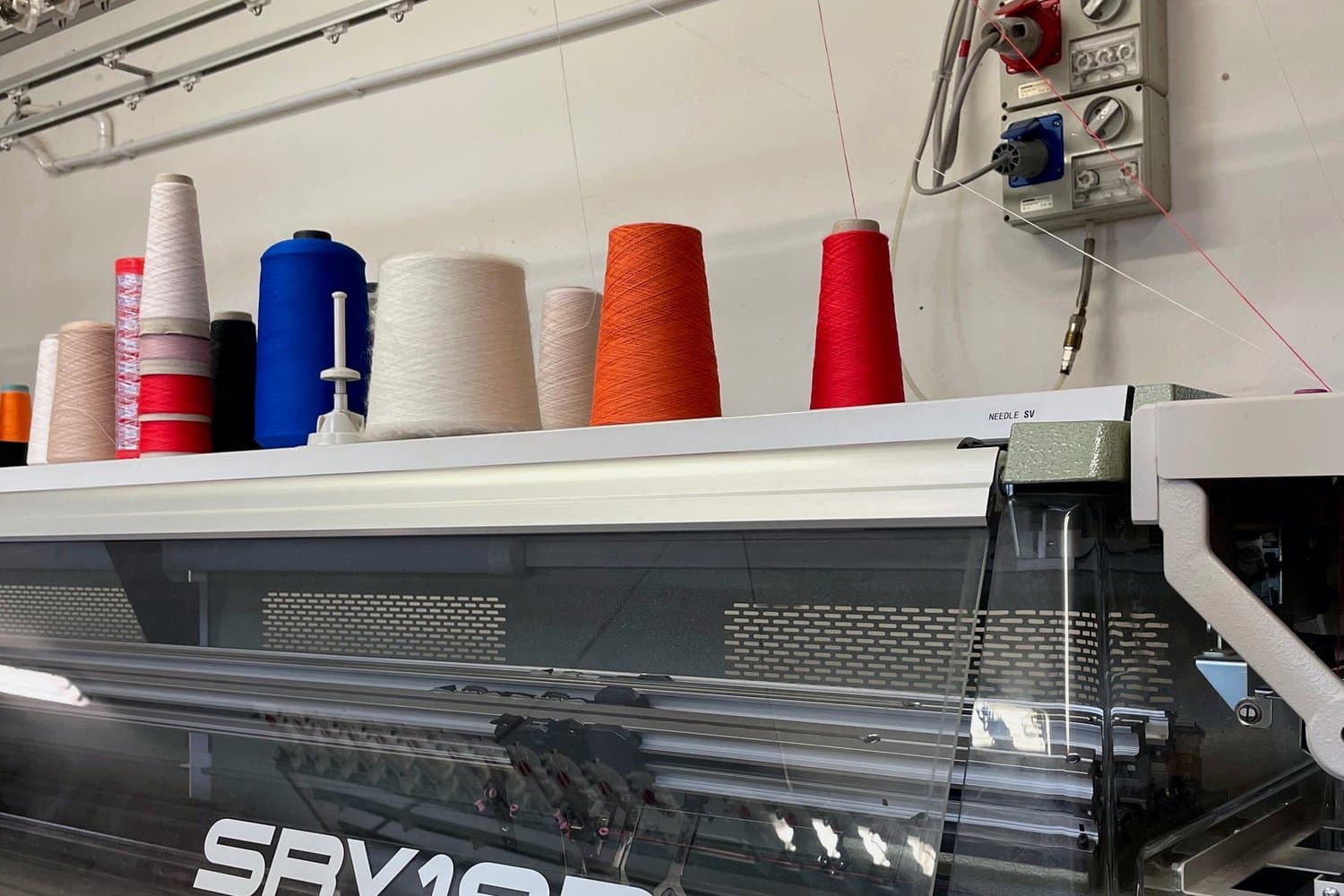
Incoming yarn check — where a cashmere blend either matches the spec sheet or does not.
The label "100% cashmere" is a fiber-content claim. It is regulated under FTC textile rules in the US and analogous regulations in the EU, and it is enforceable through fiber analysis. But fiber analysis tells you the fiber is cashmere. It does not tell you whether it is 38mm Grade A combings or 22mm shorts pulled out of a spinner's waste bin. Both are technically cashmere.
This is how a few common practices stay legal but produce vastly different finished goods:
Shorts blending. A spinner takes 70% B-grade longs and blends in 30% shorts from previous runs. The fiber content is still 100% cashmere. The yarn is weaker and the garment pills heavily after a few wears.
Recycled or regenerated cashmere. Post-industrial cashmere waste is mechanically pulled back into fiber and re-spun. Lower cost, shorter staple, often blended with virgin to make the yarn spinnable. Legitimate for sustainability storytelling — but disclose it.
Yak or wool blending undeclared. Less common at reputable mills, but cashmere with a few percent yak down or fine merino slipped in is hard to detect without lab testing and can drop raw-material cost meaningfully.
Geographic substitution. Cheaper Afghan or Iranian fiber sold as Inner Mongolian. Hand feel differs; the label may not.
The defensive move is not paranoia. It is third-party fiber testing per shipment from a recognized lab (Intertek, SGS, Bureau Veritas), tested for both fiber content and average fiber diameter, with results referenced on the PO.
Ply Count: Why 1-Ply, 2-Ply and Cabled 4-Ply Behave Differently
The "ply" of a cashmere yarn refers to how many individual single-end yarns are twisted together to make the finished yarn used at the knitting machine. This is one of the most misunderstood specs in cashmere buying.
Single-ply (1/26Nm, 1/28Nm). One twisted strand. Lightest weight, drapes beautifully, used for ultra-fine 14gg-16gg crews and lightweight summer cashmere. Lower twist multiplier means it feels soft straight off the machine, but it has the least dimensional stability and pills faster because there is nothing to lock the fibers in place.
2-ply (2/26Nm, 2/28Nm). Two singles twisted together. The volume standard for fine and mid-gauge cashmere knitwear (12gg-14gg). Better stitch definition, better pilling resistance, holds its shape on the body. If you are repping a "premium" 12gg cashmere crew at department-store price, this is what should be running.
Cabled 4-ply (2/2 construction). Two 2-ply yarns plied together. Used for chunkier 5gg-7gg constructions, heavy cardigans, and any garment where shape retention matters more than next-to-skin softness. More expensive per kilogram because more twisting steps and more yarn mass per garment.
A common cost trap: the buyer specs "12gg 2-ply 100% cashmere crew" and the supplier quotes against 1/13Nm single-ply doubled at the machine. The end product is technically two yarns at the feeder, but it is not a true 2-ply yarn. It will pill earlier and the surface will look fuzzier within a season. Write "2-ply twisted yarn (2/26Nm or 2/28Nm)" in the spec, not just "2-ply at knit."
Weight as a Quality Proxy
Finished garment weight is the most underused quality signal in cashmere buying. Yarn count, ply and gauge together drive how much fiber actually ends up in the garment, and fiber is where the money is.
For a men's size M cashmere crew, rough industry benchmarks:
Construction
Typical Weight (size M)
Reads As
14gg single-ply lightweight
180-220g
Travel-weight, summer-shoulder
12gg 2-ply standard crew
280-320g
Year-round premium
7gg cabled 4-ply chunky
500-650g
Heavy winter, statement piece
If a vendor offers you a 12gg "premium 100% cashmere crew" at 200g in a size M, ask why. The likely answers are thinner yarn count than specified, single-ply where 2-ply was specified, or shorts/blended content stretching the fiber. None of those are deal-breakers if priced honestly and labeled clearly. All of them are problems if you priced for 300g of long-staple 2-ply.
Weight is also the easiest spec to verify on incoming QC. Pull five garments randomly per size, weigh them, and reject the lot if the average falls more than 5% under spec.
The Standards And Certifications To Name In A Cashmere Spec
The section above tells you to test — here are the actual standards to reference on the PO so "tested" means something enforceable rather than a promise:
Fibre identification & content:ISO 17751-1 / ISO 17751-2 (quantitative analysis of cashmere, wool and other specialty animal fibres by SEM / light microscopy) — the test that separates true cashmere from undeclared yak or wool. Pair it with ISO 137 (fibre diameter) to back up the micron claim.
Labelling law: in the US, cashmere content is regulated under the FTC Wool Products Labeling Act (cashmere is a "wool" under the Act) plus the Textile rules; in the EU, Regulation (EU) No 1007/2011 on textile fibre names. A false "100% cashmere" claim is an enforceable violation under both.
Pilling & durability: spec Martindale (ISO 12945-2) or the random-tumble method (ASTM D3512) with a minimum grade — for example grade 3–4 after 2,000 cycles — instead of the word "anti-pill".
Sustainability claims: the two recognised herder-level programs are the Good Cashmere Standard (GCS) (Aid by Trade Foundation) and the Sustainable Fibre Alliance (SFA) Cashmere Standard; GRS (Global Recycled Standard) covers recycled-cashmere content. Name the one you need — each changes sourcing and adds certificate lead time.
📌 Put the number in the PO, not the adjective: "Grade A, ≥36 mm staple, ≤15.5 micron, 2/26Nm 2-ply, size-M finished weight 300 g ±15 g, ISO 17751 fibre test per shipment" is enforceable. "Premium 100% cashmere" is not.
What to Actually Write in the Tech Pack
The single biggest reason buyers get burned on cashmere is vague tech packs. "100% cashmere, 12gg, navy" leaves every quality lever in the supplier's hands. Here is what a defensible cashmere tech pack should include.
Fiber content with grade reference: "100% cashmere, Grade A Inner Mongolian, minimum 36mm average fiber length, maximum 15.5 micron average fineness."
Yarn construction: "2/26Nm 2-ply worsted-spun cashmere, S-twist over Z-twist, twist multiplier per mill standard for 12gg fine knit."
Gauge and stitch: "12gg, plain jersey body, 1x1 rib neck/cuff/hem."
Finished garment weight: "Size M target 300g +/- 15g."
Testing: "Third-party fiber content and fiber diameter test per shipment, Martindale pilling minimum grade 3-4 after 2000 cycles, dimensional stability +/- 3% after one hand wash per care label."
Country of fiber origin and country of spin disclosed on lot card.
This level of detail is not unreasonable to demand. Any spinner running real Grade A 2-ply cashmere will produce mill specs that map cleanly onto these requirements. A supplier that pushes back hard on documentation is telling you something about what is in the bag.
Pricing Sanity Checks
Cashmere yarn pricing moves with the spring combing season and currency. You will not get a stable number that works for a year. But you can build a sanity check using rough industry indicators.
At the time of writing, raw white dehaired Grade A Inner Mongolian cashmere fiber tends to trade in a range that puts finished 2-ply yarn somewhere in the upper double digits to low triple digits per kilogram USD at the spinner. B-grade equivalents run materially lower, and shorts-blended or recycled yarn lower again. A 12gg 2-ply crew that uses 350-400g of yarn for size M (including knitting waste) will carry meaningful raw-material cost before a single labor minute is added.
If a vendor quotes you a 100% cashmere crew at FOB pricing that does not leave room for that raw-material cost plus knitting, linking, finishing, trims, packaging and their margin, the answer is not that they have a magical supplier. The answer is somewhere in the fiber spec, and you should find it before the goods land.
Cashmere Blends as a Legitimate Strategy
Not every program needs to be 100% cashmere. Cashmere blends — typically with merino, silk, cotton or recycled cashmere — let brands hit a softer price point while delivering most of the hand-feel signal that customers associate with cashmere. A 70/30 merino-cashmere crew at 12gg gives you cashmere on the surface, wool's resilience underneath, and a landed cost the contemporary market can absorb. A 50/50 cashmere-silk blend gives you drape and luster for transitional pieces.
The rules are the same: spec the cashmere grade within the blend, spec the ply, spec the finished weight. Disclose the blend honestly on the care label. Customers who understand cashmere also understand blends, and a well-made 70/30 will out-perform a poorly-made 100% on the wear test every time.
Licheng works with cashmere and cashmere-blend yarns on a per-project basis, sourced through Inner Mongolian and Hebei spinners with documentation provided per shipment. We do not run an in-house cashmere spinning operation, and we will not pretend that 100% premium long-staple cashmere is a low-MOQ casual buy. For brands developing a real cashmere program, we are happy to walk through grade options, ply choices and weight targets against your price point before any sampling commits.
---
Talk to our team about this
If you're planning a real project around any of the points above, we'd be glad to take a quick look. Send a short brief and we'll come back within one business day with a practical direction, MOQ + lead time estimate, and a sample plan if it makes sense.
Require two documents on every shipment: a mill spec sheet from the spinner stating fiber origin, average fiber length, and average fiber diameter; and an independent third-party test report from Intertek, SGS, Bureau Veritas or equivalent covering fiber content and average fiber diameter (micron). Tests should reference your PO number. Pull retention samples at incoming QC and weigh them against tech-pack target weight. For ongoing programs, occasionally send a retention sample to a different lab than the supplier uses. The cost of testing per shipment is small compared to the cost of a returns wave from sub-grade goods reaching customers.
It can be, if disclosed and priced accordingly. Recycled cashmere has a real sustainability story and the better mills now produce yarn with acceptable hand. The catch is fiber length: mechanically recovered fiber is almost always shorter than virgin, which means more pilling and shorter garment life unless blended with virgin longs. If you go this route, spec the percentage of recycled content, require traceability to the recycler, and adjust pilling-test acceptance criteria realistically. Do not market it as "the same as virgin Grade A." Customers who care about sustainability also tend to be informed buyers; the honest framing performs better than the marketing-spin version.
For a custom 100% cashmere program with a specific yarn count, ply and color, you should expect minimums driven by the spinner more than the knitter. Dyed cashmere yarn typically requires a minimum dye lot in the range of 30-50kg per color from the spinner. That translates to roughly 80-150 finished garments per color depending on style weight. If you work in stock colors from the spinner's standing range, MOQs can drop. Licheng's standard knitwear MOQ of 30 pieces per color (plain and striped styles in the same yarn and color can be combined) applies to most yarns, but cashmere-specific dye-lot economics often push the realistic floor higher unless you accept a stock yarn color.
All cashmere pills initially. This is a function of the fiber, not a defect. Short loose fibers on the yarn surface ball up with friction and shed off in the first three to five wears. What separates good cashmere from bad is what happens after that. Grade A 2-ply, properly finished, settles into a smooth surface after the initial shedding period and pills only lightly under heavy wear. Sub-grade or shorts-blended yarn keeps pilling indefinitely because there is always another short fiber working its way to the surface. Spec Martindale pilling test grade 3-4 minimum after 2000 cycles as your acceptance bar.
Inner Mongolian and Mongolian fiber carries the highest market price because of fineness, length and brand recognition built up over decades of supply to European luxury houses. Afghan and Iranian fiber can be excellent quality in absolute terms but trades at a discount due to lower buyer familiarity and less consistent supply infrastructure. Chinese-spun yarn dominates the world supply chain even when the raw fiber is sourced from elsewhere, because the dehairing and spinning expertise is concentrated in Inner Mongolia and Hebei. For sourcing decisions, focus on fiber length, micron and mill reputation rather than country alone — a well-graded Mongolian fiber spun in Inner Mongolia is often a better buy than a marketing-driven Inner Mongolian claim with weak documentation.
We focus on men's sweaters, cardigans, knit jackets, jacquard knitwear and private label knitwear. We support B2B buyers with OEM/ODM development, sampling and bulk production planning.