First calls with a new knit factory burn out the same way: forty minutes of capability slides, ten minutes of price talk, and a closing line about "flexibility on MOQ." You hang up knowing roughly nothing you can defend to your category director. The checklist below is designed to replace that pattern. It assumes one video call of about forty-five minutes plus fifteen minutes of document review either side, and it produces a written scorecard at the end. We at Licheng Knitwear run the other side of this conversation almost weekly — the questions here are the ones serious buyers actually ask us, and the evasions are the ones we hear from competitors when buyers compare notes afterwards.
💬 Sourcing this for an upcoming project? Request a free quote → · MOQ 30 pcs · Sample in 7–15 days · WhatsApp us
Long audits feel rigorous but rarely are. A two-hour call drifts into rapport-building, and rapport is exactly what a weak supplier wants to substitute for evidence. A timeboxed sixty minutes forces the conversation onto a small number of high-signal questions, and it forces you to write down answers in real time rather than relying on memory. It also respects the supplier's time, which matters more than buyers usually credit — the factories worth working with are busy, and a tight, well-prepared first call is itself a signal that you are a serious buyer.
The other reason for the timebox is honesty. Evasive answers take longer than honest ones, because they have to be constructed. If a question that should take ninety seconds takes five minutes of reframing and qualification, that is data. Watch the clock.
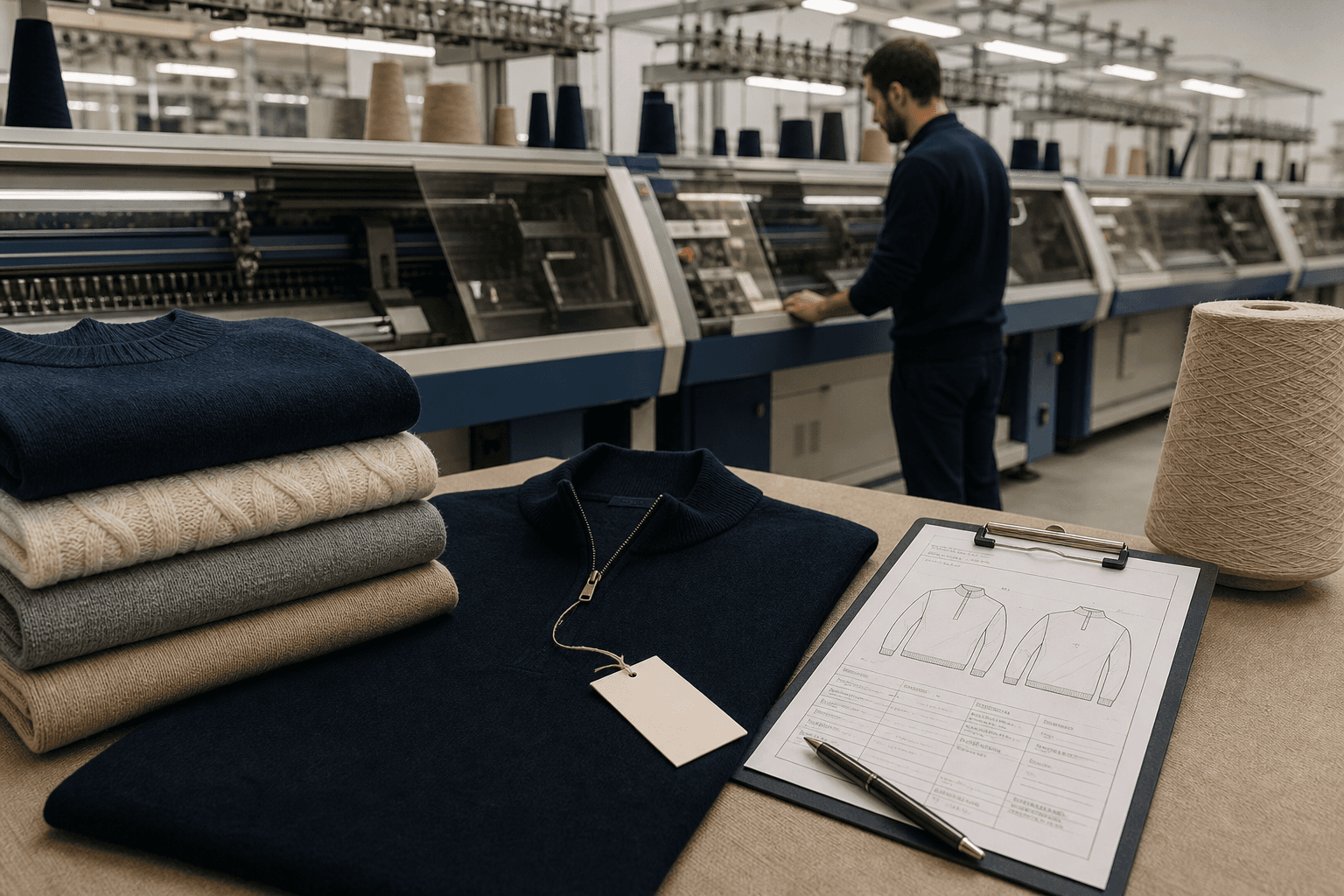
Forty-eight hours before the call, send a short email asking for four documents: a copy of the business license, a recent third-party inspection report (any AQL report from the last six months will do, names redacted is fine), a sample tech pack the factory has executed for another brand (again, redacted), and a price quote on a reference style you describe in two paragraphs. If you get all four back within twenty-four hours, you have already learned something. If you get a glossy capability deck instead, you have learned something else.
The reference style should be specific enough to price honestly: gauge, yarn composition, body weight in grams, target FOB, target MOQ per color. A factory that quotes without asking clarifying questions is either guessing or padding.
Open the business license they sent. Check the registered company name, the unified social credit code, the registered capital, and the date of establishment. Cross-reference the name and code against the National Enterprise Credit Information Publicity System (gsxt.gov.cn) — it is free, in Chinese, and authoritative. Ask which entity will appear on the proforma invoice and which on the bill of lading. A mismatch between the calling entity and the invoicing entity is not automatically disqualifying, but it must be explained. Trading-company-in-front-of-factory is a common, legitimate structure; trading-company-pretending-to-be-factory is not.
For reference, Licheng Knitwear was founded in 2018 and is based in Dongguan, Guangdong — those two facts and the license number should match everywhere they appear, including the website footer, Alibaba storefront, and email signature.
NAP is name, address, phone. Pull up the supplier's website, their Alibaba page, their LinkedIn, and the business license, side by side. The registered legal name on the license should match the website footer. The address should match within reason (a sales office in a different district is fine if disclosed; a completely different city is a flag). The phone numbers should overlap. If the website lists a Hong Kong address, the license is mainland, and the WeChat number is yet a third entity, ask why.
This takes five minutes and catches a surprising fraction of dropshippers and brokers presenting themselves as factories.
Ask for sample lead time on the reference style you sent. The honest range for a knit sample on a non-trivial style is seven to twenty-five days depending on yarn availability and complexity — we quote 7-25 days at Licheng and so do most serious knit houses. If someone promises three days, they are either using existing yarn on a stocked program or they are lying. If someone quotes forty days for a standard 7GG crew, they are overloaded or hedging.
The useful follow-up: "What drives the variation inside that range?" A real answer mentions yarn dyeing lead time, linking pattern complexity, and current sample-room queue. A weak answer is "it depends."
Then ask bulk lead time. Industry-standard for knitwear is roughly 30-45 days after sample approval and deposit, assuming yarn is available. Anyone quoting fifteen days for bulk on a new style is selling a fantasy.
Ask what AQL level they inspect to as standard, and at what stage. The expected answer is AQL 2.5 for major defects, 4.0 for minor, with inline checks during linking and final inspection before packing. Ask what they do with rejected pieces — repair, replace, or discount — and who pays. Ask whether they accept third-party inspection (SGS, Intertek, QIMA, or buyer-nominated) and at what stage they prefer it scheduled.
Then ask about metal contamination control. Knitwear with metal trims or needle-break risk should pass a needle detector before packing. "We do needle detection on every piece" is the right answer; "we can arrange that if you require" is the answer of a factory that does not currently do it.
Ask for standard payment terms on a first order. The honest industry answer for a new buyer relationship is 30% deposit on order confirmation, 70% balance against copy of bill of lading or before shipment. Anything more aggressive (50/50, or 100% before production) is negotiable but tells you about their cash position and risk appetite. Anything looser (open account, net 30) on a first order is either a very large factory chasing a very large brand, or a broker who will collect from you and then squeeze the actual factory.
Ask whether they accept TT, LC, or trade assurance. Ask which bank, in which country, and whose name the account is registered in. If the payee name does not match the invoicing entity, stop the call.
Ask whether they will sign your NDA, or whether they have a mutual NDA template they prefer. Both are reasonable. Ask specifically about tech pack confidentiality, sample exclusivity (will they show your sample to other buyers as a capability example), and pattern ownership after the order. The honest answer is that patterns developed for your styles are yours; the honest caveat is that general construction knowledge is not transferable IP.
Ask how they handle brand label and hangtag security. The good answer involves locked storage and reconciliation against order quantity. The bad answer is a shrug.
You are already on the call, so you have a sample. Ask who will be your day-to-day contact and whether they are on this call. Ask their working hours and response time SLA. Ask what happens when they are on annual leave. Ask whether technical conversations with the sample room go through the salesperson or directly. The right structure for a mid-sized brand is a dedicated English-speaking merchandiser who can pull the pattern maker into a call when needed.
We maintain content and customer support in English, German, and Spanish at Licheng. Ask which languages your candidate supports beyond English; for European buyers it matters more than it sounds.
Ask for two references: one current buyer of similar size to you, one buyer they have lost or wound down. The second request is the unusual one and the most informative. A factory willing to put you in touch with a former buyer is a factory confident in why the relationship ended. A factory that says "we have never lost a buyer" is either three months old or lying.
If they cannot share named references for confidentiality reasons, that is legitimate — ask instead for two anonymized case studies with order size, lead time achieved versus quoted, and defect rate at final inspection. The numbers should be specific. "Around 1% defect rate" is fine; "very low" is not.
Write the scorecard during the call, not after. Score each of the eight sections as Green, Amber, or Red. Any Red is a stop. Three or more Ambers means a second call before any sample order. All Green plus a credible quote means proceed to paid sample.
|
| Company verification | License matches calling entity, gsxt record clean | Trading company in front of factory, disclosed | Entity mismatch, no license, or refusal to share |
| NAP consistency | Name/address/phone align across license, web, Alibaba | One minor mismatch with plausible explanation | Three different addresses or names |
| Sample lead time | Quotes 7-25 days with reasoned variation | Quotes single number with no qualifiers | Promises under 5 days or over 40 days |
| AQL protocol | AQL 2.5/4.0, needle detection standard | Will arrange on request | Cannot describe inspection stages |
| Payment terms | 30/70 TT, payee matches invoice entity | 50/50 or LC only | Payee name differs, or 100% upfront |
It is worth saying that most established Chinese OEMs handle the production work competently. The reason this audit exists is not that factories are uniformly bad — they are not — but that the gap between competent and evasive looks identical in a sales deck. The checklist is designed to surface the gap in sixty minutes rather than three sample rounds. A good generic OEM will pass it. A weak one will produce eight Ambers and a polite goodbye.
For catalog reference, our own minimum is 30 pieces per color on standard styles, gauges 3GG through 14GG with the mid-gauges being the workhorses, sizes XS-3XL, and FOB pricing in USD ex-Dongguan. Those are the kinds of specifics that should be in your notes after sixty minutes with any factory you would actually order from.
Within two hours, write a one-page memo: scorecard, three quotes verbatim that stood out (good or bad), and a recommendation. Send it to yourself by email so it is timestamped. If you proceed to a paid sample, attach this memo to the sample order folder. Six months later, when the relationship is either thriving or unraveling, that memo is the most useful artifact in your sourcing file — it tells you whether what went wrong was something you could have known on day one, or something you genuinely could not have. Both answers make you a better sourcing manager.
---
If you're planning a real project around any of the points above, we'd be glad to take a quick look. Send a short brief and we'll come back within one business day with a practical direction, MOQ + lead time estimate, and a sample plan if it makes sense.
→ [Request a free quote](/request-quote) · [WhatsApp us](https://wa.me/8615170244792) · info@lcgarment.cn