How Much Does It Cost to Manufacture Custom Sweaters? (2026 FOB Price Guide)
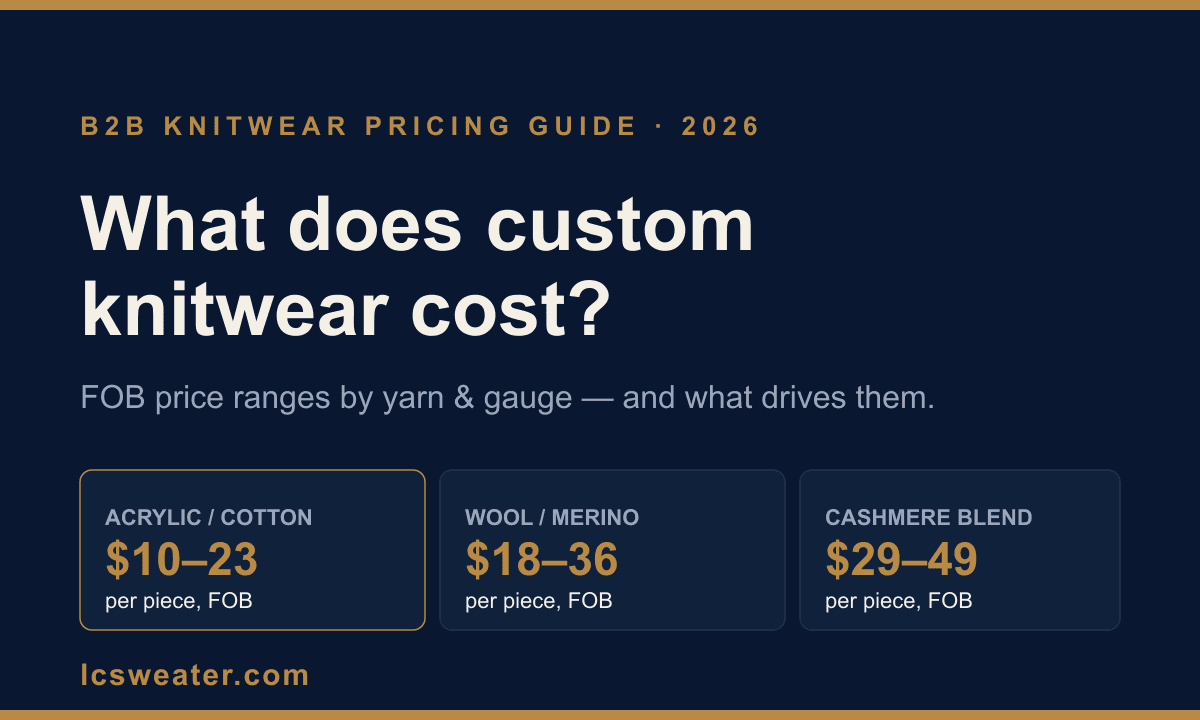
Short answer: For custom OEM/ODM sweaters in 2026, a realistic FOB price is roughly US$10–45 per piece for most knitwear, depending mainly on the yarn and the order quantity. A basic acrylic or cotton-blend sweater can land around $10–18, a wool or merino sweater around $18–36, and a cashmere-blend around $29–49. Pure cashmere, heavy knit jackets and elaborate constructions run higher. These are indicative FOB ranges for typical mid-size orders — your exact price depends on yarn, gauge, complexity, trims and quantity, and is always confirmed by a quote.
This guide breaks down what actually sits inside that price, gives indicative ranges by yarn type, and shows how to bring the cost down without losing quality.
FOB (Free On Board) is the per-piece price to make the garment and deliver it to the export port. It includes yarn, knitting, linking, finishing, standard trims, QC and basic packing. It does not include freight, insurance, import duty or inland delivery — those are added to reach your landed cost.
For a standard men's or women's sweater at a typical mid-size order quantity. Ranges widen for very small or very large runs.
|
| Acrylic / acrylic blend | $10–18 | Most economical; good for value lines |
| Cotton / cotton blend | $13–23 | Breathable SS knits |
| Wool / lambswool blend | $18–31 | Classic warmth, mid positioning |
| Merino wool | $21–36 | Soft, premium, year-round |
| Cashmere blend | $29–49 | Accessible luxury |
| Pure cashmere | $52–90+ | Premium; higher yarn minimums |
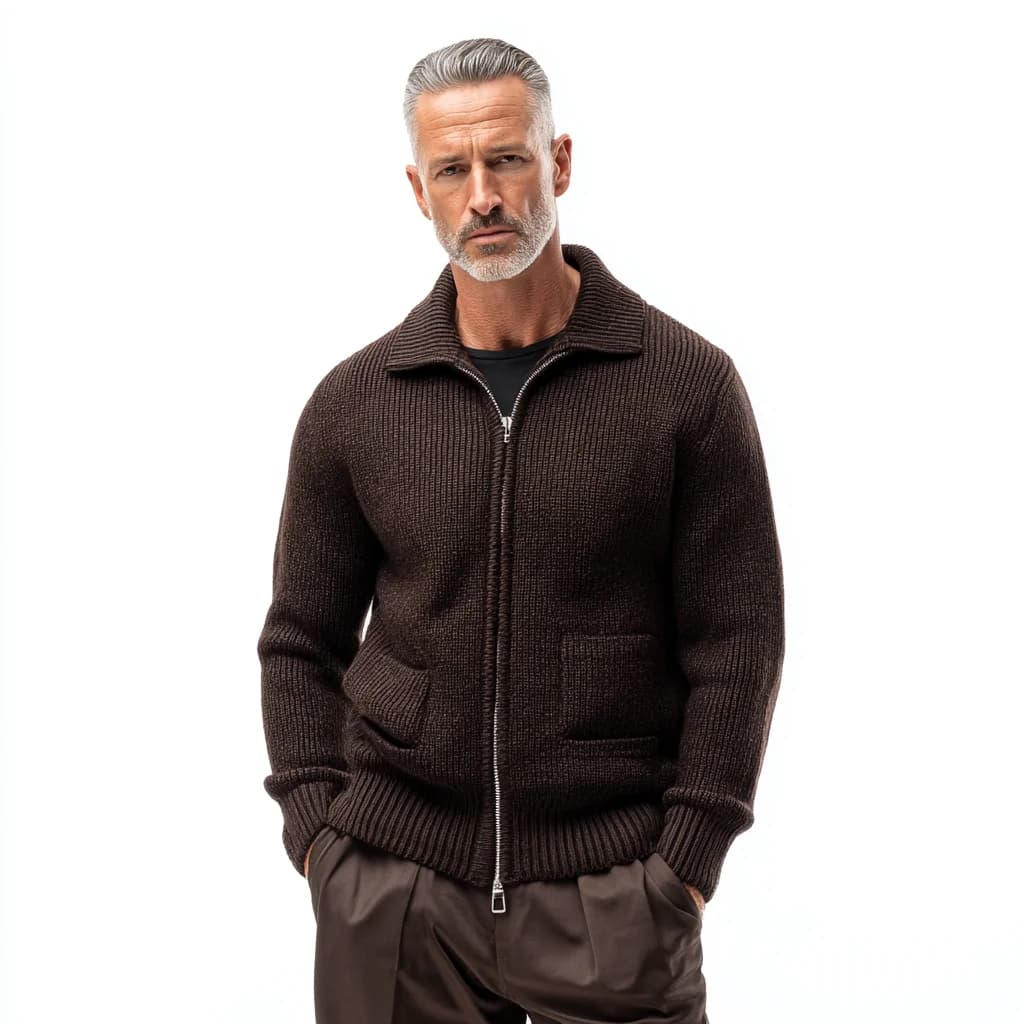
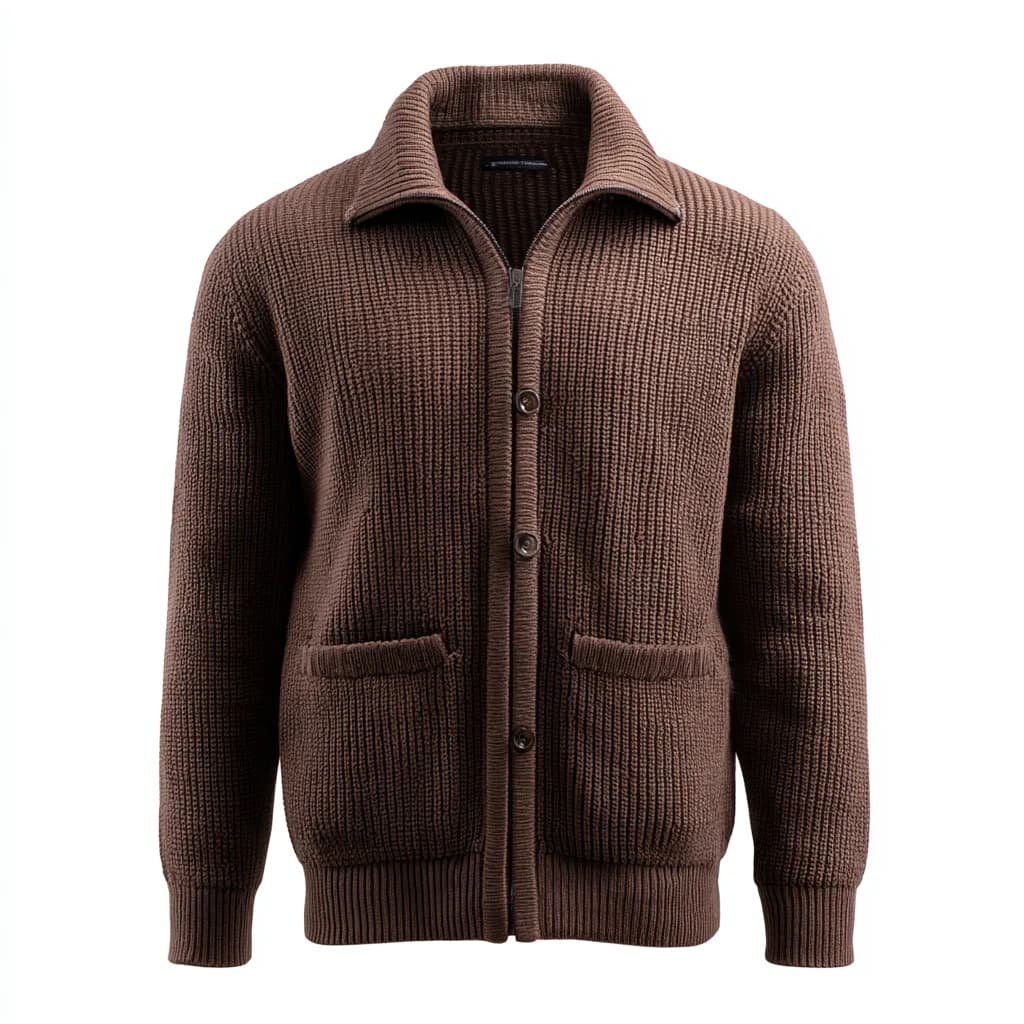
| Heavy knit jacket / outerwear | $33–75 | Zippers, panels, faux-fur, lining |
Treat these as starting points, not quotes. Within each band, gauge, weight, pattern complexity and trims move the price up or down.
1. Yarn type and weight. Yarn is the single biggest cost driver — bought by weight, with premium fibres (merino, cashmere, alpaca) costing far more than acrylic. A heavier, chunky knit also uses more yarn than a fine-gauge one.
2. Gauge and construction. Fine gauges and full-fashioned shaping take more machine time; hand-linking adds skilled labour versus machine linking.
3. Pattern complexity. Plain knits are cheapest; cable, jacquard and intarsia add time and yarn handling. Intarsia logos are typically the most labour-intensive.
4. Trims, hardware and branding. Corozo or metal buttons, YKK zippers, woven labels, embroidery and special packaging each add cost — modest individually, meaningful combined.
5. Order quantity. Fixed costs (yarn dye-lot minimums, machine setup, line changeovers) are spread over the run. A 30-piece order carries a higher per-unit cost than a 1,000-piece order of the same style.
Two factories — or two styles in the same factory — can quote very differently because of:
- Stock vs custom-dyed colour. A custom Pantone colour forces a full dye lot and a yarn minimum; an in-stock colour avoids that and lowers cost.
- Yarn grade within a fibre. "Cashmere blend" can mean 5% or 30% cashmere — a big price difference.
- Construction quality. Fully-fashioned, hand-linked premium knitwear costs more than cut-and-sew jersey.
- Hidden line items. Lab dip fees, sample fees, nominated-hardware minimums and special finishing should appear as separate lines — ask for them.
- Start from stock yarns and colours to avoid dye-lot minimums.
- Share one yarn across several styles so the dye-lot cost is spread.
- Simplify the construction where the design allows (fewer colours in a jacquard, machine linking on value lines).
- Scale quantity on proven styles to spread fixed costs — but validate with a small first run.
- Keep trims standard on entry products; reserve custom hardware for hero pieces.
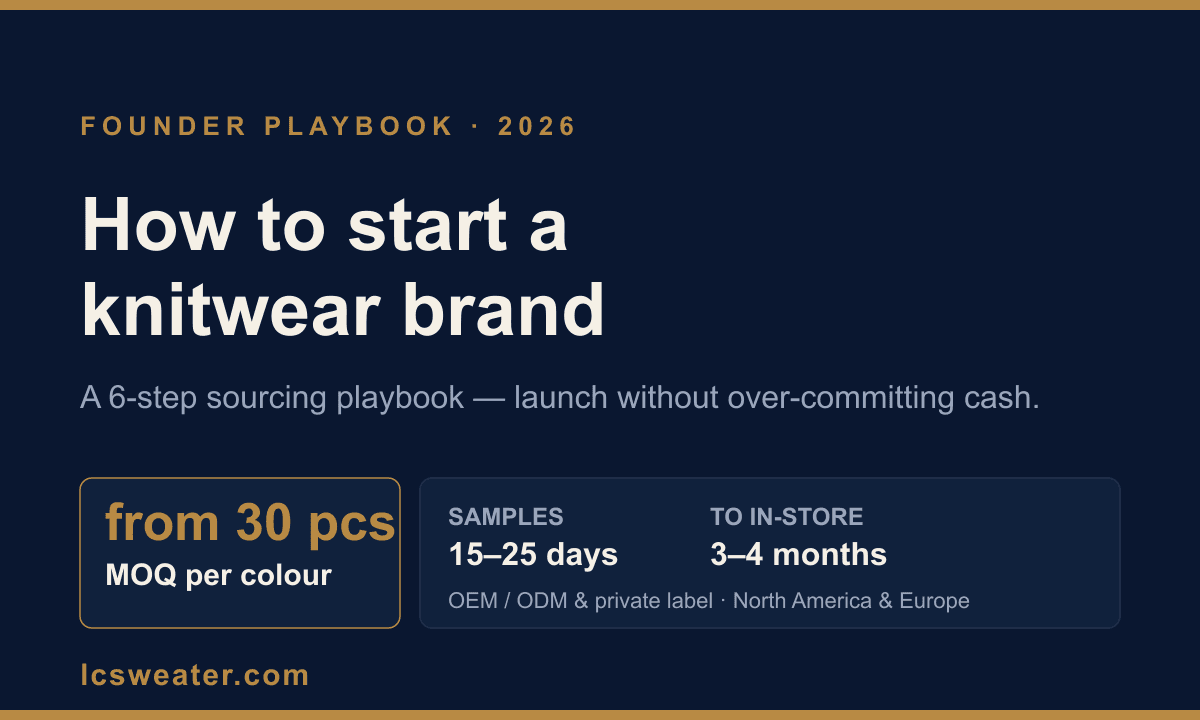
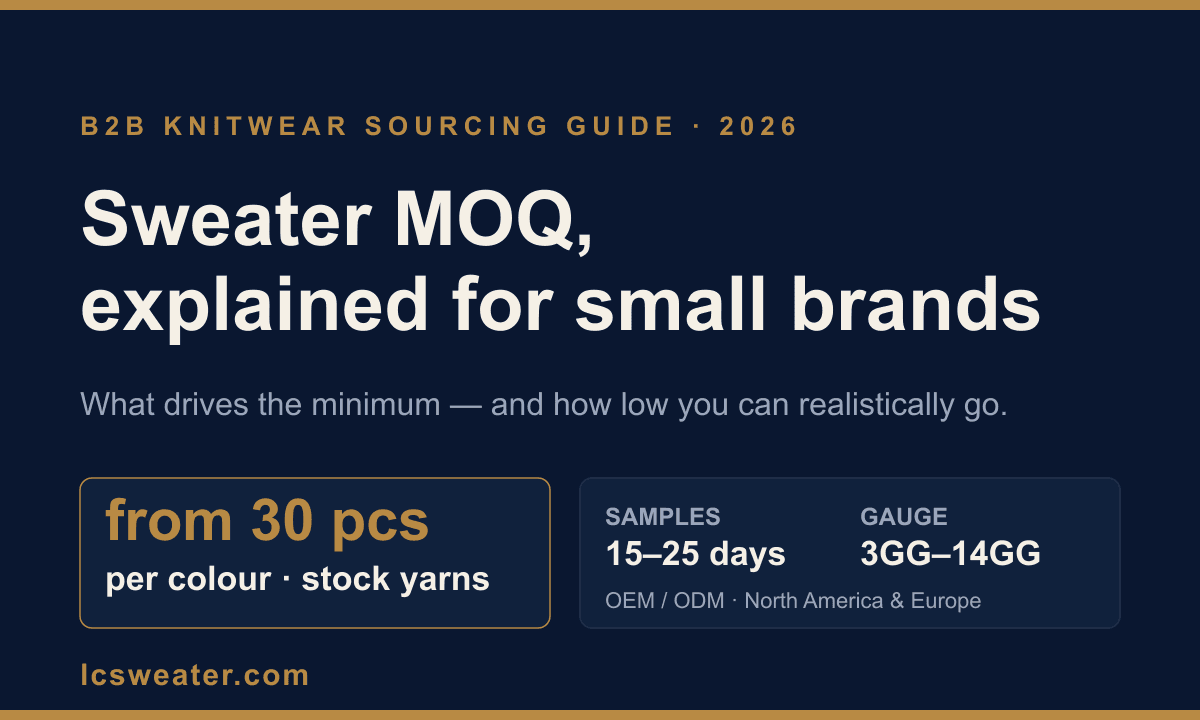
For custom OEM/ODM knitwear you can typically start from 30 pieces per colour using in-stock yarns. Plan 15–25 days for samples and 30–45 days for bulk, plus 25–35 days sea freight to North America or Europe. A low-MOQ first order carries a modest per-unit premium — treat it as the cost of validating the market.
The fastest way to a real number is to send your spec: yarn or reference, colours, target quantity, gauge, trims and any branding. We come back with an itemised quote — yarn, knitting, linking, finishing, trims and packing — so you can see exactly where the cost sits. Request a quote with your style direction and we'll price it properly.
How much does it cost to manufacture a custom sweater?
Indicatively US$10–45 FOB per piece for most knitwear in 2026 — around $10–18 for acrylic/cotton blends, $18–36 for wool/merino, and $29–49 for cashmere blends. Pure cashmere and heavy knit jackets cost more. Yarn and order quantity are the biggest drivers; your exact price is confirmed by a quote.
Why is yarn the biggest cost in a sweater?
Yarn is bought by weight in dye-lot minimums, and premium fibres (merino, cashmere, alpaca) cost far more than acrylic. A heavier, chunky knit also uses more yarn than a fine-gauge piece.
Does a smaller order cost more per piece?
Yes. Fixed costs — yarn dye-lot minimums, machine setup and line changeovers — are spread over fewer pieces, so the per-unit cost is higher at low volumes. The trade-off is far lower upfront inventory risk.
What's not included in the FOB price?
Freight, insurance, import duty, customs/broker fees and inland delivery. Add these to the FOB price to estimate your landed cost.
How can I get a cheaper quote without losing quality?
Use in-stock yarns and colours, share yarn across styles, simplify the pattern where possible, and keep trims standard on entry products — then scale proven styles to spread fixed costs.